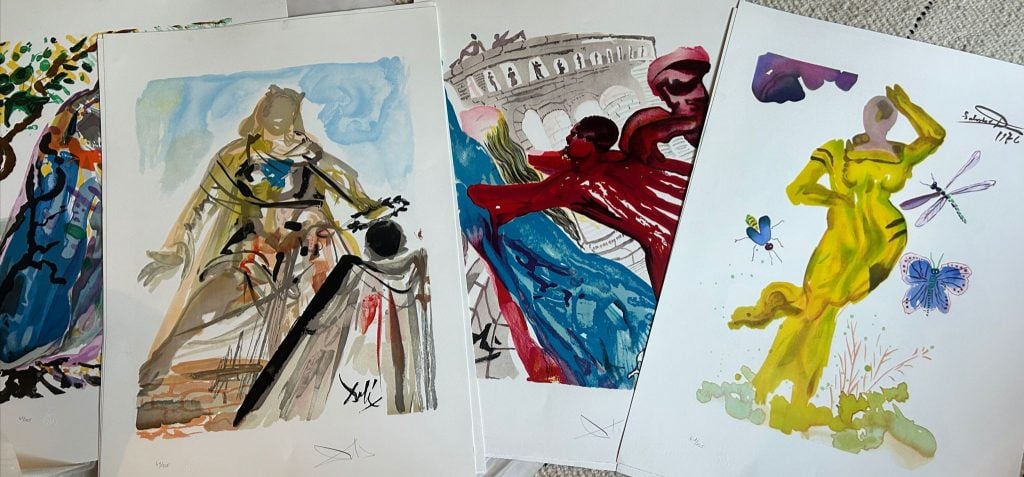
The remarkable discovery of a hitherto lost collection of lithographs by Salvador Dalí and Theo Tobiasse, stuffed in a LIBRARY-IN-LONDON of GARAGE, is a reminiscent plot of a saga long gone by—a gripping tale of how art stands against the erosions caused by time. Two great 20th-century artists whose personal lives were so troubled yet inspired gave a shot of new life to dormant interest in the works of these little-known artists. Scheduled for auction on September 30 at Hansons Auctioneers in Richmond, these lithographs are not only an investment opportunity for collectors but provide an interesting perspective of other aspects of the art industry.
The narrative opens in quiet, leafy Berkeley Square in Mayfair, whose streets are laced with history in either the architecture or the paving stones. This is where Chris Kirkham, an associate director at Hansons, came to what he thought was just another routine valuation trip. The house, being located in one of the most desirable areas of London, must have contained a lot of valuables, but nothing could prepare him for what was hidden behind the inconspicuous door of the garage.
As he was ushered through the splendor of the main house and directed towards a room that was more of an extension of long-gone days, Kirkham’s optimism was less than arousing. The garage, which had its works on the floor, took up all the overflowing, such a person’s lifetime, and unnecessary things every day—even the essential tools. But to the consignor—at that moment perhaps slightly nostalgic or even quite nervous—a box contained dazzling lithographs decorated on each side that brought sorrowful issues to light, which once again, only in this case, bore the signatures of Dalí and Tobiasse.

“There were not many emotional events in their professional lives, and it turned out to be one of those amazing discoveries,” Kirkham puts it with some hesitation. “The dealer led me out to his garage, and I swear it was literally a case of: behold this large amount of surrealist lithographs that came out. They had been all but forgotten for a period of roughly 50 years. Of course, it was rather strange.”
These lithographs in question, outdatedly bought from a London gallery-cum-store rationed out in the late 1970s, cost the consigner £500—an amount that is approximately £2000, and I can say a very punitive-look £3100 today. At that point, the acquirer of the investment is likely to have thought about it as a barking dog and a wise business decision. But life, as it does everything else, got in the way. These lithographs, even with their ties and basement dust, were never framed or shown; they were simply put in a box and became part of the garage clutter. Only now, as the consignor was preparing for retirement and relocating continents, did these stunning pieces of art come into view again.
The upcoming auction has created some hype, particularly for the artists. Salvador Dalí, the outrageous and mysterious surrealist, is still one of the most known faces in the history of art. Dalí’s work was prolific, and he was as famous for his bizarre melting clocks and landscapes as he was for his strange nature. He made many attempts at different art forms, but printmaking earned him a lot; most of the generation eyebrows.
The Dalí lithographs in the garage belong to the 1978 collection ‘L’Art d’Aimer d’Ovide’ (Ovid’s Art of Loving), which is a very diverse series based on Ovid’s characters. Like most of Dali’s works, this series also possesses bright colors, surreal pictures, and intricate themes from classical art, rendered through the perceptions of a very talented but rather strange artist. For example, “Phoebus, this God Crowned with Laurels,” depicts the Greek god of music, poetry, and the god of the sun, Apollon, as a being collected in stunning glimmering light with his features appearing from the storm clouds. In “Divine Erato,” the muse of lyric poetry appears in a bright yellow gown, surrounded by dragonflies and butterflies, while “The Daughter of Minos” depicts the doomed love of Phaedra and Theseus inside an expensive palace.
These prints are not just for embellishment purposes only; they contain all the intricate imagery and symbols associated with Dalí’s later works. But Daí fell more out of the norm in terms of how he treated printmaking in addition to who he was as a person. In order to increase his income, he often allowed an excessive number of impressions of his works, even to endorse blank pages so that the process could be hastened. It is unfortunately common to find both genuine and counterfeit works, and this is the reason why the artwork of Dalí is a problematic market for prints. Like most collectors, they would cherish these lithographs because of the scarcity and condition of these pieces—nearly five decades without exposure to light.
Theo Tobiasse is using similar lithographs, which are going to be sold, but presents a different yet equally compelling tale. Theo Tobiasse was born in 1927 in Jaffa to a family of Russian Jewish immigrants, and his early life was one of instability and exile. Like many of his works, he noticed that these experiences greatly shaped his artistic sensibility. Illustrations on his works show a compelling story and express contemporary societal issues revolving around loss and identity as well as survival with memory and narration incorporated within symbolist artistic context.
However, one should not consider the Tobiasse lithographs based on their valuation, the said range being £100 to £300 ($132 to $396). For he was a painter, an engraver, and an illustrator and imbued with melancholy poetry in the traditions of the Mediterranean and the life of a migrant. The images are filled with the passion of childhood and the melancholy of nostalgia; for those who feel the weight of history and memory, it is familiarity rather than strangeness.
Of Kirkham and the professionals who work with Hansons Auctioneers, this auction is not just a business affair but a way to restore to the public these objects that seem to be hidden. “Dali and Tobiasse are both famous, and everything associated with them is quite popular,” said Kirkham. “These lithos enable the average person to afford a signed reproduction print.”
With time, the auction claims the excitement from all parties involved. The quest transcends that of acquiring a slice of art history; the quest is more about the story of the quest itself—the quest to discover the lithographs that sets them into a world that has forgotten their existence for several decades. In an industry that is ever so captivated and consumed in the creation of the latest and most modern approaches, this auction is a realization that perhaps the best audience forms have already been created and lie within, only subject to reclamation.




Leave a Reply