Last updated on September 9th, 2024 at 05:06 pm
Maurits Cornelis Escher, widely recognized as M.C. Escher, stands as an enigmatic figure in the intersection of art and mathematics. Born on June 17, 1898, in Leeuwarden, Netherlands, Escher’s path to becoming a renowned graphic artist was marked by an unconventional journey. Initially enrolled in the Haarlem School of Architecture and Decorative Arts to study architecture, Escher soon found his true calling in the graphic arts, guided by the influential teacher Samuel Jessurun de Mesquita. This decision was pivotal, setting the stage for Escher’s lifelong exploration of visual paradoxes and mathematical concepts through art.
Escher’s work philosophy was rooted in a profound curiosity about the nature of reality and the ways in which it could be represented. He once remarked,
“I am always wandering around in enigmas. There are young people who are more or less touched by this, and that gives me satisfaction.” This statement encapsulates his lifelong fascination with puzzles, paradoxes, and the limits of human perception. His art is less about providing answers and more about posing questions, encouraging viewers to engage actively with his creations.
One of the core elements of Escher’s philosophy was his belief in the interconnectedness of art and mathematics. He saw mathematics not merely as a tool for creating art but as a fundamental component of the artistic process. Escher was particularly intrigued by the mathematical concepts of infinity, tessellation, and symmetry, which he explored extensively in his work. His approach was methodical and systematic, often involving careful planning and precise execution to achieve the desired visual effects.
Escher’s fascination with infinity is evident in many of his works, where he employs techniques such as recursive patterns and self-referential forms to create a sense of the infinite. For example, in “Drawing Hands,” the hands drawing each other create a loop that challenges the viewer’s understanding of creation and existence. Similarly, his works involving tessellation—such as “Metamorphosis II”—demonstrate his interest in how simple shapes can be transformed and repeated to cover a plane without gaps or overlaps, reflecting his deep engagement with the mathematical properties of shapes and space.

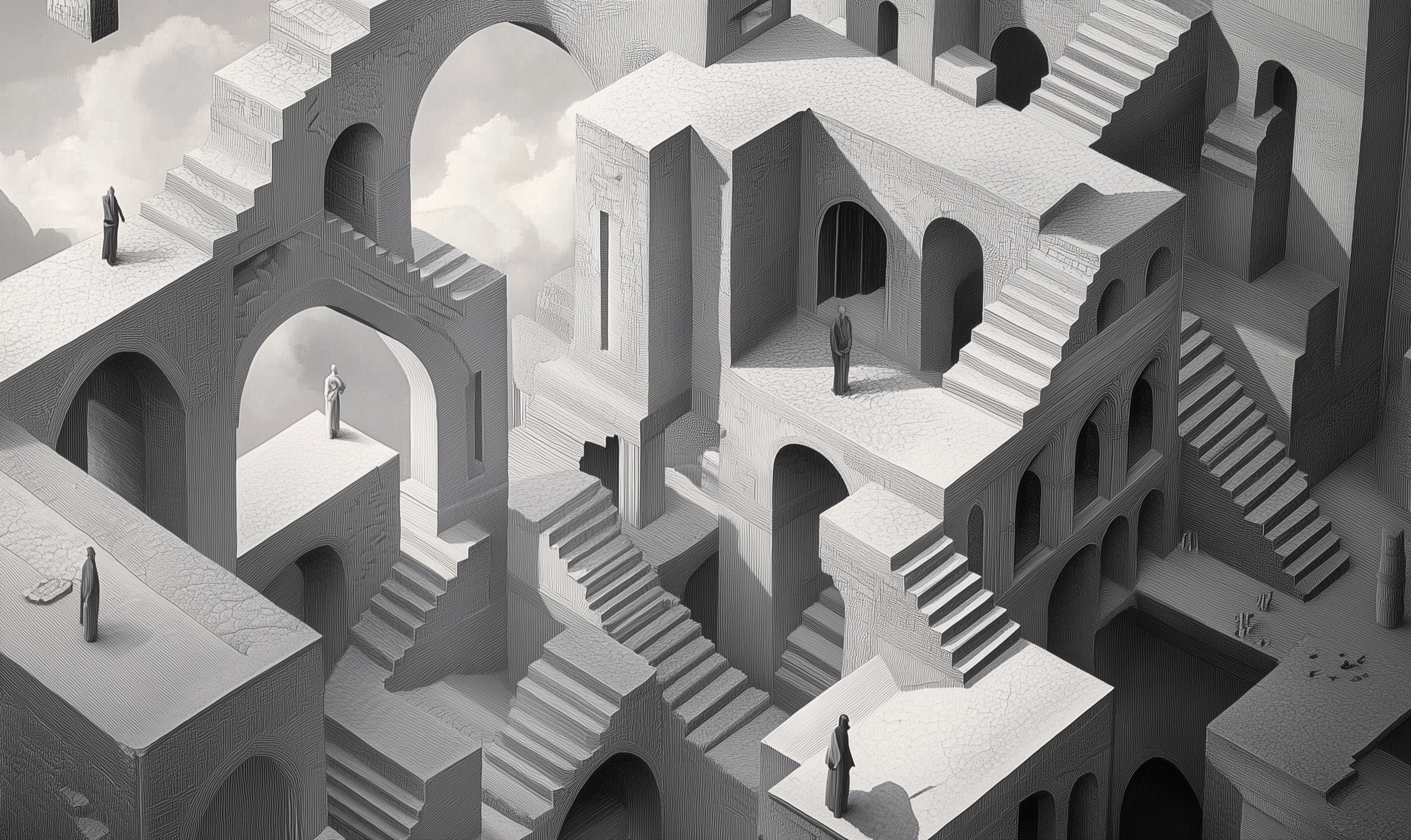
Escher’s art aesthetics are characterized by a meticulous attention to detail and a penchant for visual paradoxes. His compositions are often complex and multifaceted, requiring viewers to spend time unraveling the visual puzzles he presents. Escher’s use of perspective is particularly notable, as he frequently manipulates traditional vanishing points and horizon lines to create impossible constructions that defy conventional spatial logic.

One of the hallmarks of Escher’s aesthetics is his use of tessellation, the process of creating a plane using repeated geometric shapes without gaps or overlaps. This technique is prominently featured in works like “Metamorphosis II,” where Escher transforms simple shapes into complex patterns that evolve seamlessly across the composition. His ability to transition from one form to another within a single piece demonstrates his mastery of visual rhythm and transformation, challenging viewers to see connections between seemingly disparate elements.
Escher’s exploration of symmetry and asymmetry also plays a crucial role in his aesthetics. He often employed reflective symmetry, rotational symmetry, and glide reflection to create intricate patterns that draw the viewer’s eye across the composition. These techniques not only add a sense of harmony and balance to his work but also serve to highlight the underlying mathematical structures that inform his art.
The play of light and shadow in Escher’s work further enhances the sense of depth and realism, even in his most fantastical compositions. His use of chiaroscuro—contrast between light and dark—helps to define forms and create a three-dimensional effect on a two-dimensional plane. This technique is particularly effective in works like “Relativity,” where the interplay of light and shadow adds to the complexity of the multiple gravitational planes.
Escher’s ability to render complex, impossible scenes with precise detail and clarity is a testament to his technical skill and artistic vision. His use of lithography, woodcut, and mezzotint allowed him to achieve a high level of detail and contrast, enhancing the visual impact of his work. Each medium presented unique challenges and opportunities, which Escher embraced to push the boundaries of his artistic expression.
“Relativity” (1953) is a seminal work that exemplifies Escher’s unique approach. This lithograph presents a world governed by multiple gravitational forces, resulting in a composition where figures navigate a structure from different orientations simultaneously. The brilliance of “Relativity” lies in its ability to maintain a coherent visual narrative despite its impossible construction. Escher uses the medium of lithography to challenge conventional notions of space and perspective, inviting the viewer to question the very nature of reality.
Another iconic piece, “Drawing Hands” (1948), delves into the recursive and self-referential themes that pervade much of Escher’s work. The lithograph depicts two hands drawing each other into existence, a visual paradox that plays with the idea of creation and artistic agency. The hands, rendered with lifelike detail, create a sense of both autonomy and interdependence, encapsulating Escher’s fascination with the infinite loop and the boundaries of artistic creation.
In “Waterfall” (1961), Escher takes the concept of the impossible object to new heights. The lithograph depicts a perpetual motion machine where water appears to defy gravity, flowing uphill in a continuous loop. This work exemplifies Escher’s ability to blend rigorous mathematical principles with imaginative visual storytelling. The precise rendering of the architectural elements and the path of the water creates a scene that, while fantastical, is presented with a deceptive clarity that compels the viewer to suspend disbelief.
“Ascending and Descending” (1960) continues Escher’s exploration of infinite loops and impossible structures. Inspired by the Penrose stairs, the lithograph features figures endlessly climbing and descending a staircase that forms a closed loop. The work is a testament to Escher’s mastery of perspective and his ability to translate complex mathematical ideas into compelling visual forms. The endless procession of figures serves as a visual metaphor for the futility and absurdity inherent in certain aspects of human existence.
“Metamorphosis II” (1939-1940) is a remarkable woodcut print that illustrates Escher’s fascination with transformation and continuity. Spanning several meters, the print depicts a continuous evolution of shapes and patterns, seamlessly transitioning from one form to another. This work highlights Escher’s skill in using gradual transformation to explore themes of change and continuity, challenging the viewer to reconsider the fluid boundaries between different states of being.
Maurits Cornelis Escher’s influence extends far beyond traditional art, deeply impacting modern design and architecture. Contemporary designers and architects frequently draw inspiration from Escher’s work, especially his exploration of impossible constructions and tessellations.
Architecture: One prominent example is the Vancouver House in Canada, designed by the architectural firm Bjarke Ingels Group (BIG). The building features an unconventional form that appears to defy gravity, much like Escher’s impossible structures. The building’s unique shape, which twists and expands as it rises, evokes the mind-bending perspectives found in Escher’s lithographs such as “Relativity” and “Ascending and Descending.”
Interior Design: Escher’s tessellation patterns are also widely utilized in interior design, particularly in flooring and tiling. The Escher Hotel in Leeuwarden, Netherlands, embraces this influence wholeheartedly, incorporating Escher’s tessellation designs into its floors, walls, and décor. The use of these patterns creates an engaging and visually stimulating environment, echoing Escher’s fascination with repeating geometric shapes and transformation.
Graphic Design: In the realm of graphic design, Escher’s influence is evident in the works of designers who create optical illusions and impossible objects. The logo for the 2012 Olympic Games in London designed by Wolff Olins, features dynamic, fragmented shapes that reflect Escher’s exploration of form and structure. This approach to design, which challenges traditional perceptions and encourages viewers to see things from new perspectives, is a direct nod to Escher’s artistic legacy.
Escher’s work has also had a significant impact on video game design, particularly in games that explore complex spatial puzzles and impossible geometries.
Monument Valley: One of the most prominent examples is “Monument Valley,” a puzzle game developed by ustwo. The game features surreal landscapes and architectural structures directly inspired by Escher’s lithographs. Players navigate a world of impossible geometry, manipulating the environment to create pathways that defy conventional logic, much like the recursive loops and paradoxical constructions seen in Escher’s work.
Echochrome: Another notable example is “Echochrome,” developed by Japan Studio for the PlayStation platforms. This game is heavily influenced by Escher’s exploration of perspective and optical illusions. Players guide a mannequin through a series of levels where altering the camera angle changes the structure of the environment, revealing new paths and solutions that were previously hidden. This gameplay mechanic mirrors Escher’s manipulation of perspective to create impossible objects.
Manifold Garden: Developed by William Chyr Studio, “Manifold Garden” is a first-person puzzle game that challenges players to explore an expansive world with recursive architectural designs. The game’s environment, characterized by endless staircases and repeating structures, evokes the infinite loops and spatial paradoxes found in Escher’s artwork. Players must think non-linearly to navigate the game’s challenges, reflecting Escher’s influence on the game’s aesthetic and design philosophy.
Antichamber: This game, developed by Alexander Bruce, offers a psychological exploration game experience that incorporates Escher-like visual paradoxes and spatial puzzles. The environment in “Antichamber” continuously shifts and reconfigures, requiring players to adopt unconventional thinking and perspective manipulation to progress. The game’s focus on non-Euclidean geometry and mind-bending puzzles directly pays homage to Escher’s legacy.
The legacy of M.C. Escher is reflected in numerous exhibitions worldwide, which continue to celebrate his innovative approach to art. Major exhibitions, such as “Escher in The Palace” in The Hague and “M.C. Escher: Other Worlds” in Marseille, have provided comprehensive retrospectives of his work, highlighting his enduring impact on both art and science.
Escher’s death in 1972 marked the end of a career that, while not fully appreciated during his lifetime, has since gained significant recognition. His work continues to captivate audiences, challenging them to rethink their perceptions of reality and the possible. Escher’s legacy is a testament to the power of art to transcend conventional boundaries and inspire new ways of seeing and thinking. His work remains a vital source of inspiration, reminding us of the endless possibilities that lie at the intersection of art and mathematics.


Leave a Reply