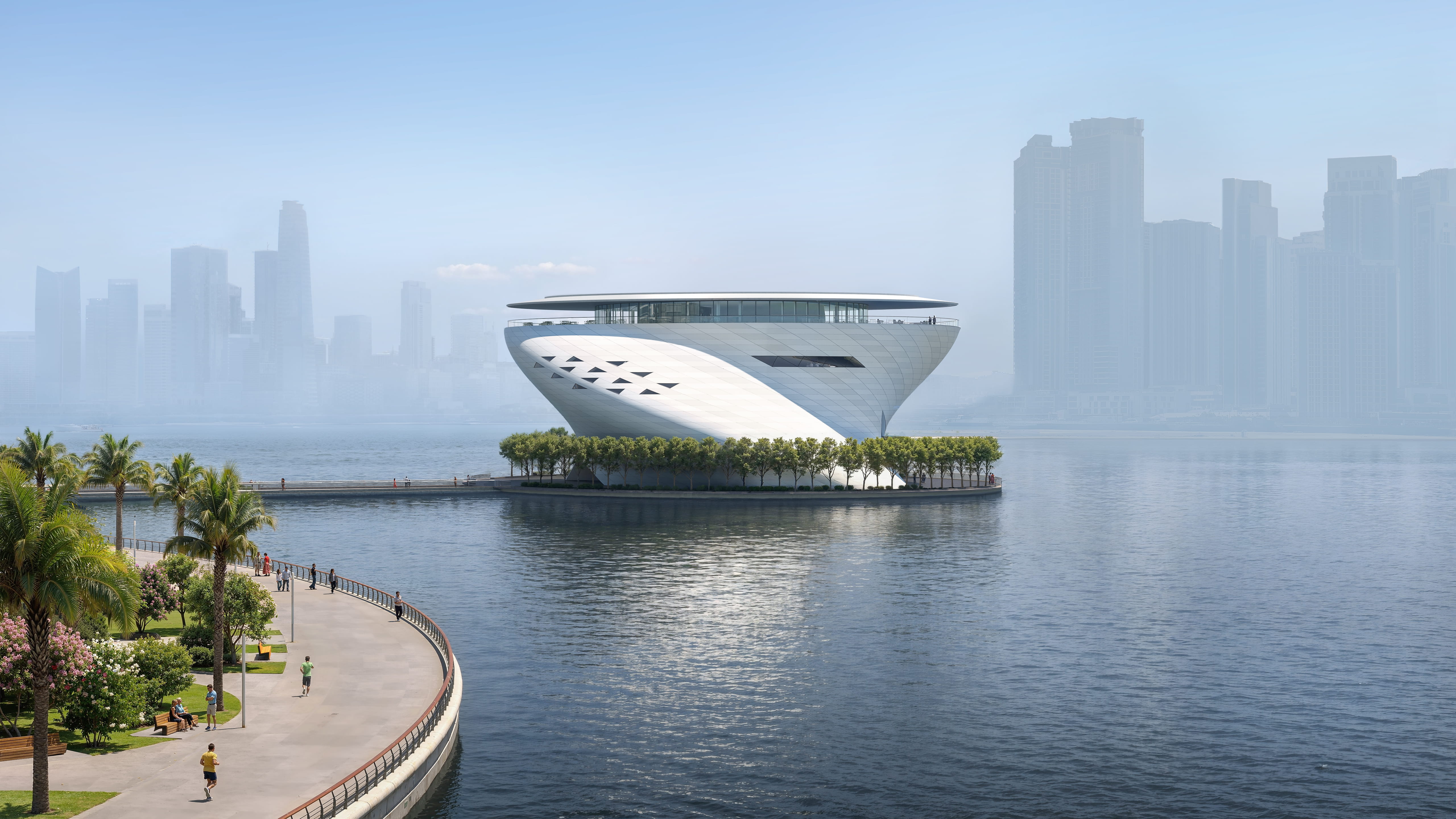
A new vision has emerged in a city known for its bold architectural statements, like the world’s tallest tower and an island shaped like a palm tree. This one is probably the most poetic yet. His Highness Sheikh Mohammed bin Rashid Al Maktoum, the Vice President and Prime Minister of the UAE and the Ruler of Dubai, opened the Dubai Museum of Art (DUMA), a cultural institution that was designed to float on the historic waters of Dubai Creek. This isn’t just another building on an already outstanding skyline; it’s a strong statement about a new chapter in the emirate’s history.
Tadao Ando, a minimalist architect who won the Pritzker Prize, came up with the idea for DUMA. It was built through a groundbreaking public-private partnership with the Al-Futtaim Group. DUMA is a major change in Dubai’s global identity. It is a tool for cultural diplomacy, a way to diversify the economy, and a physical representation of the city’s spirit. The goal of the project is to change how people around the world think about Dubai, moving away from the story of commerce and luxury to one of lasting cultural depth and artistic innovation. As we look more closely at DUMA’s many parts, it becomes clear that this floating wonder is meant to do more than just hold art. It is meant to capture the spirit of a city that has always dared to build its future in ways that seem impossible.
A Royal Vision: The Dubai Museum of Art as a Reflection of Civilization

The announcement of the Dubai Museum of Art was a great example of how to brand a modern country. H.H. Sheikh Mohammed discussed the project on the social media site X, saying that it had deep civilizational meaning. He said that DUMA is “a museum that floats above the waters of Dubai Creek to make it look better and to show off Dubai’s culture and arts.” The words you choose are crucial. A “mirror” doesn’t just hold; it also reflects, validates, and projects an identity onto the world stage.
During the official unveiling, Sheikh Mohammed said, “Culture and art are the soul of a city and a lens through which its progress is seen.” This made the story even more captivating. This statement elevates the museum beyond its role as a mere public service, transforming it into the essence of the city. Dubai’s leaders are strategically writing a new global story by using words like “civilizational spirit,” “humanitarian mission,” and “brilliance” in their speeches. There is a conscious effort to change the city’s brand from a place where people come and go for business to a place with lasting cultural significance. The goal is clear: to make Dubai “the capital of modern art and a global destination for creativity,” a key hub in the art world that encourages conversation, understanding, and social change.
Tadao Ando’s Masterpiece: The Architecture of Water and Light
Dubai hired Tadao Ando, an architect whose work is known for its quiet power and spiritual depth, to help them achieve such a high goal. The self-taught Japanese master won the Pritzker Prize in 1995. He is known for his peaceful buildings that mix light, water, and concrete. His choice shows that Dubai is intentionally changing its style from “bigger is better” to a new language of subtlety, permanence, and high culture. Ando’s buildings aren’t about show; they’re about how they feel. He uses natural light as a real building material to bring minimalist shapes to life and make people think.
The Dubai Museum of Art’s conceptual design is a moving tribute to the city’s history. Inspired by the “sea and the pearl,” it pays tribute to the pearl diving industry that used to be the region’s main source of income. This metaphor is turned into a beautiful, shell-like outside that surrounds a round exhibition hall in the middle, which is the “precious pearl.” A big cylindrical hole in the middle of the building lets sunlight flow through the inside, making patterns that Ando’s team says remind them of “the gentle shimmer of a pearl.” Ando’s philosophy is all about how light and shadow interact on smooth, exposed concrete surfaces. This creates a space that feels both grand and very personal. The building itself becomes a work of art, a peaceful conversation between nature, water, and the human spirit.
Building an ambitious dream on Dubai Creek

It is a huge engineering challenge to make this five-story building look like it is floating on the historic Dubai Creek. It is also a powerful symbol of a city that has seemingly willed itself into existence from the desert and the sea. The project requires overcoming significant challenges that are unique to marine architecture, even though the specific technical plans are still secret.
The primary problem is making sure that everything stays completely stable on a moving waterway. The structure needs to be able to withstand the forces of currents, tides, and wind. This will probably require a huge submerged pontoon foundation for buoyancy, which will be securely anchored to the creek bed by an advanced mooring system. The salty, corrosive environment requires materials that are forceful. Ando’s signature concrete will need to be a special mix that includes additives that stop corrosion, and all of the metalwork that is exposed will need to be made of marine-grade alloys to stop it from breaking down. Additionally, to connect important utilities like power, water, data, and waste, you need flexible, armored underwater conduits that can handle the structure’s small movements. If this “floating” landmark is built successfully, it will show how good Dubai’s engineers are and how good the city is at making big dreams come true.
The Stewards of a Landmark: A Model of Public-Private Partnership
The development model is at the heart of the DUMA story. The Al-Futtaim Group, one of the UAE’s biggest and most diverse business groups, works on the project as a public-private partnership (PPP). H.H. Sheikh Mohammed praised businessman Abdullah Al Futtaim and his son, Omar Al Futtaim, for their work on the project, calling it “a model for the private sector’s responsibility towards its community and the city that nurtures it.”
This partnership is more than just working together; it’s a statement of policy. Dubai’s leaders are setting an example for future national development by framing the Al-Futtaim Group’s role as a civic duty. It means that the country’s biggest businesses are expected to be important partners in reaching civic and cultural goals, which means that their success will also help the country. This is a very important act of legacy building for the Al-Futtaim Group. Omar Al Futtaim called DUMA “a cultural statement that shows Dubai’s openness to creativity” and a sign of the group’s “long-term commitment to sustainability and the important role the cultural sector plays in making progress that includes everyone.” The project gives the group a permanent connection to a national treasure and an architectural masterpiece, giving it a level of prestige that goes beyond business success and secures its place in the history of the country.
The Dubai Museum of Art is more than just a museum; it’s a cultural ecosystem
The Dubai Museum of Art is meant to be a cultural destination that is alive and breathing, not just a place to store artifacts. The five floors are meant to give visitors a complete and immersive experience that keeps them coming back for more. The first and second floors will have large, flexible galleries for modern and contemporary art. These galleries will show a carefully chosen collection that reflects Dubai’s lively spirit, as well as works by well-known and up-and-coming international artists.
DUMA’s mission goes beyond the galleries; it is very community-oriented and educational. There will be many artist talks, panel discussions, and international art fairs at the museum. Dedicated spaces, like a full library and study rooms, will help with research and scholarship. World-class training programs will “nurture future generations of creative leaders.” There is also high-end hospitality, like a formal restaurant and a private VIP lounge on the third floor with views of the Creek. This model combines art, education, and hospitality to make a cultural center that can support itself, is always busy, is good for business, and is at the center of the city’s social and intellectual life.
The Engine of a Creative Economy
TThe Dubai Museum of Art is not merely a cultural project; it plays a crucial role in the Dubai Creative Economy Strategy. This ambitious government plan aims to make “Dubai the “global capital of the creative economy by 2026” by doubling the creative industries’ share of the emirate’s GDP to 5% and the number of creators and creative businesses.
DUMA is a major investment that will help this economic change happen. It draws in and keeps the best artists, curators, designers, and innovators from around the world, which is what you need to reach these ambitious goals. The museum is expected to help creative fields like design, media, technology, and architecture grow by providing a world-class platform for the arts. It is a planned investment in the infrastructure of creativity that will bring in real money and help Dubai stay a part of the global knowledge-based economy.
DUMA will join the Burj Khalifa, the Museum of the Future, and the Mohammed bin Rashid Library as one of Dubai’s most famous buildings that shape the city’s image around the world. The location of the museum holds significant importance. The museum is located on Dubai Creek, which was the city’s historic center and original trade route. It connects Dubai’s past as a trading and pearling port with its future as a global cultural center.
The museum’s opening, right after the technology-focused Museum of the Future, shows that Dubai has a smart two-pronged plan for defining its identity in the 21st century. The Museum of the Future is based on science and new technologies, while the Dubai Museum of Art is based on culture, beauty, and humanistic conversation. The Museum of the Future and the Dubai Museum of Art form a balanced portfolio of nation-branding, with one focusing on the future of our lives, while the other explores the timeless question of why we live. This shows that you have a mature uThis understanding emphasizes that a truly great global city must excel in both technology and culture. Problems and the Way Forward
Since DUMA was revealed, there has been a critical information gap, even though the vision for it is strong and well-thought-out. A thorough look at official channels and public announcements shows that there haven’t been any project updates, construction timelines, or milestones since October 2025. This silence makes people wonder about the project’s current status and is the biggest threat to its progress.
The project also has risks that come with doing it. Building a five-story floating museum is very complicated from an engineering point of view, which could cause delays and cost overruns. It’s a big job to build a world-class art collection from scratch, and keeping the museum running and making money will always be a challenge. Also, building on Dubai Creek, which is near the protected Ras Al Khor Wildlife Sanctuary and is sensitive to the environment, will need to follow strict environmental rules and go through a full Environmental Impact Assessment (EIA) to protect the marine ecosystem.
In conclusion, the Dubai Museum of Art is an example of how to make cultural spaces in the 21st century. It is a brilliant and complex project that combines national branding, economic strategy, architectural genius, and private capital into one famous vision. The goal of the project is to change Dubai’s global identity in a big way. The vision is strong and easy to understand. The world is now watching and waiting for the next part of the story, which is the journey from a stunning rendering to a living, breathing institution floating on Dubai Creek.

Leave a Reply