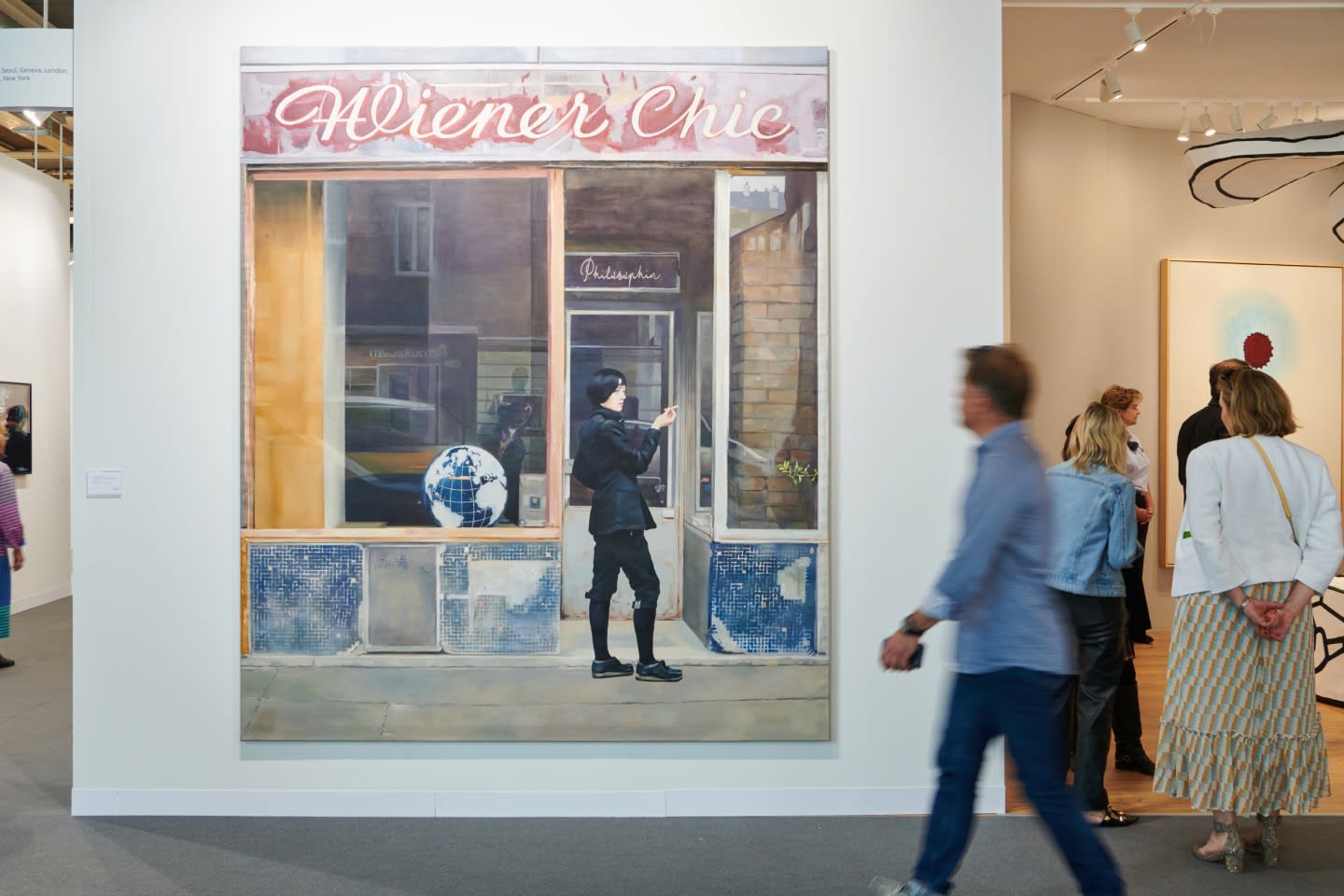
The atmosphere was charged with anticipation on the opening day of the VIP previews at Art Basel 2024 in Switzerland. Dealers and collectors entered the fair with a mix of trepidation and hope, cognizant of the ongoing market slowdown often referred to as a “correction.” This year’s event was poised to test the art market’s resilience amid economic uncertainty.
Pace Gallery’s president, Samanthe Rubell, encapsulated the prevailing sentiment as dealers closely monitored auction outcomes, unsure how the day would unfold. Art Basel CEO Noah Horowitz described the current period as a “recalibration” for the art market. Yet, as the day progressed, it became evident that the market was not only holding steady but thriving.
By the end of Tuesday, sales were brisk, with many transactions occurring in person rather than through presale PDFs, indicating a renewed desire among collectors to experience artworks firsthand. A standout moment was the sale of Joan Mitchell’s diptych, “Sunflowers” (1990–91), by David Zwirner gallery for an impressive $20 million, though some sources indicated the price was closer to $18 million. Zwirner also sold Gerhard Richter’s “Abstraktes Bild” (2016) for $6 million and Yayoi Kusama’s “Aspiring to Pumpkin’s Love, the Love in My Heart” (2023) for $5 million.
Hauser & Wirth placed its most expensive work brought to the fair, Arshile Gorky’s rare 1946–47 large work on paper, “Untitled (Gray Drawing (Pastoral)),” for $16 million. The gallery also sold Jenny Holzer’s red granite benches to an Asian museum for an undisclosed sum, Blinky Palermo’s “Ohne Titel (Untitled)” (1975) for $4 million, and Louise Bourgeois’s “Woman with Packages” (1987–93) marble sculpture for $3.5 million. Coinciding with their museum-caliber Vilhelm Hammershøi show in their new gallery space in Basel, a 1906 painting by the Danish painter, depicting a woman pinning up her loose hair, was sold for an undisclosed amount.
On Wednesday, Hauser & Wirth reported selling the large Philip Guston painting “Orders” for $10 million, and Georgia O’Keeffe‘s serene white moonscape “Sky with Moon” for $13.5 million. (The price for the O’Keeffe is notable, considering that it sold for $3.5 million at Christie’s in 2018.)
“Almost everything was sold in-person today,” said Pace’s Rubell, calling the gallery’s first day at Basel “fantastic.”
She continued, “In years prior, there has been a good amount of pre-sales from previews, but this time we’re really trying to capture new interest, and this moment of suddenly engaging, and having that feedback and response—it’s really worked. The energy is very good.”
A sprawling Jean Dubuffet bench sculpture titled “Banc-Salon,” overhung with suspended kites, was a welcoming attraction for visitors who stopped at Pace’s booth. By early afternoon, the gallery had sold three editions of a total of six, priced at €800,000 ($860,000) each, in collaboration with Galerie Lelong & Co.
Pace also sold its star Agnes Martin painting, “Untitled #20” (1974), which last sold at auction in 2012 for $2.43 million. Though Pace would not share the price, a source told ARTnews that it was $14 million. In 2021, a similar work sold for $17 million at auction. Pieces by First Nation artist Emily Kam Kngwarray, whom the gallery recently took on, also sold: one for $250,000 and the other for $220,000. Kngwarray had a retrospective at Australia’s National Gallery, and next summer will be featured at Tate Modern in London.
Thaddaeus Ropac, which historically does not presell its offers, was humming early in the fair, with fast-paced sales from the get-go. “Like the old days,” one spokesperson told ARTnews. The gallery sold a major Robert Rauschenberg work from 1985 for $3.85 million, several editions of a Georg Baselitz bronze sculpture for €2 million each, along with other works by the artist, priced between €1.2 million and €1.8 million.
At White Cube, a Julie Mehretu painting from 1999 went for $6.75 million; it was last seen at auction six years ago, when it sold for $2.5 million. A “monumental” Mark Bradford, titled “Clowns Travel Through Wires” (2013), also sold for $4.5 million. Jeff Wall’s “The Storyteller” (1986) sold for $2.85 million, along with works by David Hammons, Tracey Emin, Gabriel Orozco, Antony Gormley, Howardena Pindell, and others. At the time of writing, the $1.75 million Richard Hunt sculpture and the $1.35 million Frank Bowling were not listed as sold.
Alex Forbes from Artsy provided a broader perspective, noting that despite year-to-year fluctuations, the long-term trend for the art market remains positive. The European Central Bank’s recent interest rate cut contributed to a sense of stability, bolstering confidence among collectors and dealers.
While the top-line successes were evident, some dealers acknowledged a slower pace of sales, requiring more effort to close deals. This “slower” market allowed for deeper relationship-building with clients, which many saw as a silver lining.
The fair’s programming also highlighted the evolving dynamics of the art world. Panels and talks addressed themes such as sustainability in art, the impact of digital transformation on traditional art forms, and the rising influence of artists from emerging markets. Collectors were particularly interested in artworks that engaged with contemporary issues, including climate change and social justice.
Technology continued to make inroads at the fair. Augmented reality (AR) and virtual reality (VR) experiences allowed visitors to engage with art in innovative ways, expanding the possibilities for both viewing and purchasing. Several galleries reported that these tech-driven interactions helped to bridge the gap between physical and digital art markets, attracting younger, tech-savvy collectors.
The presence of a diverse array of global galleries underscored Art Basel’s role as a premier platform for international art exchange. Galleries from Asia, Latin America, and Africa reported strong interest and sales, highlighting the increasingly global nature of the art market. This diversity was reflected not only in the range of artworks but also in the collector base, which included high-profile buyers from across the world.
Overall, the first day of Art Basel 2024 demonstrated a resilient market with robust sales and high spirits. The fair’s ability to attract global collectors and facilitate significant transactions underscored its continued importance in the art world. As the week progresses, the art community will closely watch how these dynamics evolve, hopeful for continued success and engagement.
Image Courtesy of Art Basel


Leave a Reply