In the rarefied air of the world’s best auction houses, there are nights that are just okay, and then there are nights that feel like a tectonic shift, when the way things are supposed to be changes forever in front of a captivated audience. One such night was the Sotheby’s Modern & Contemporary South Asian Art auction in New York in March 2025. The sharp, rhythmic volley of bids, the tense silence, and the final, gavel-banging totals did more than just sell paintings; they marked the start of a new era. The sale brought in a record-breaking $16.8 million, which was three times the low estimate of $4.9 million. This total was the highest amount ever for a single sale in this category. The outcome was not a market that was slowly going up; it was a market that was going through a major change, a coming-of-age on the world stage.
This important event was the main introduction to the highly anticipated Sotheby’s Indian Art Auction in London on September 30, 2025. The results from New York give us a new way to look at the masterworks that are coming up for auction. They show that collectors are more knowledgeable, confident, and willing to look beyond the established canon to reward artistic genius in all its forms. The 2024–2025 season has seen a total of $67.1 million in sales and an incredible 94% sell-through rate. This is a story of significant changes. It is a story of new titans being crowned, of old ones regaining their power, and of an exciting diversification that is bringing long-forgotten masters into the international spotlight.
The Sotheby’s Indian Art Auction Changes the Masters’ Canon
For many years, the story at the top of the Indian art market was told by the great artists of the Bombay Progressive Artists’ Group (PAG). This group of artists created a new language for modern art in India after it became independent. On the other hand, the March sale in New York marked a significant and exciting expansion of this pantheon. The two most expensive lots, accounting for nearly half of the sale’s total, did not belong to the founders of PAG. Instead, they were done by two unique artists who went their own way.

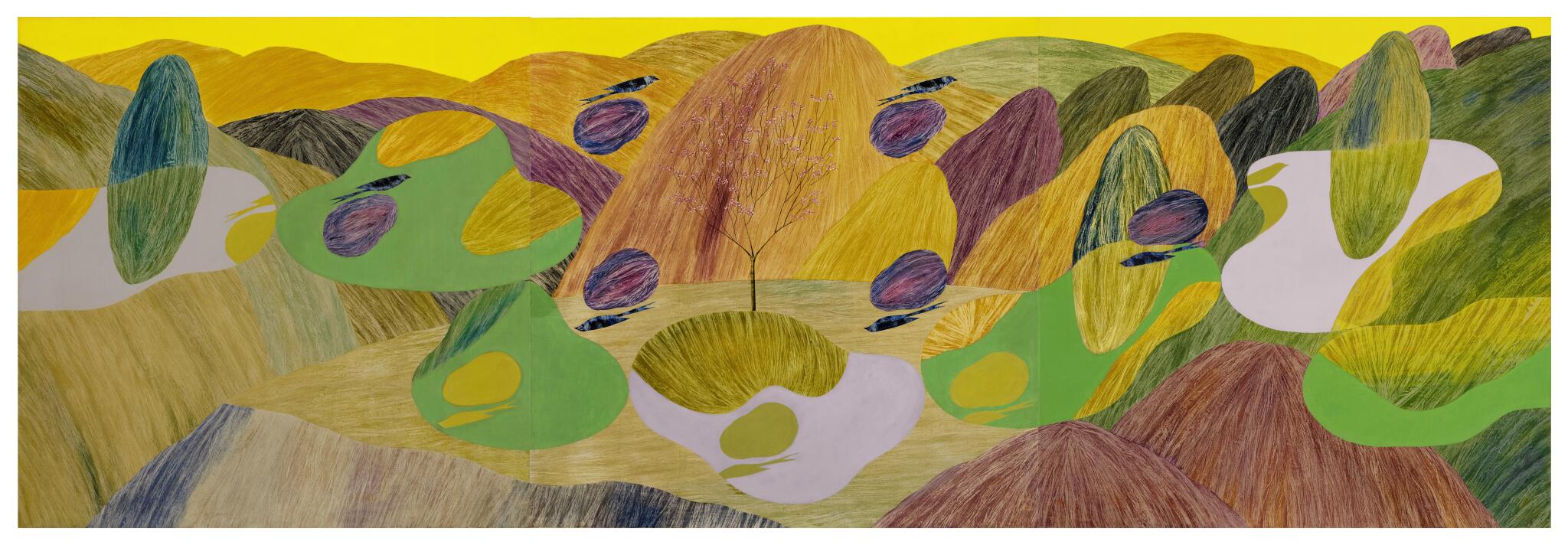
The sale of Jagdish Swaminathan’s huge 1973 triptych, Homage to Solzhenitsyn, was the main event of the night. The piece, a beautiful and basic work from his famous “Bird, Mountain, Tree” series, sparked a fierce bidding war before selling for a wonderful $4.68 million. The outcome was not only a new record for the artist; it was almost five times better than his previous high, which had only been set a few months earlier. Swaminathan, who started the rival Group 1890, was a philosopher-artist who on purpose stayed away from Western styles and instead looked for a visual language based on Indian tribal (Adivasi) art and ancient symbols. His work is a meditation on the basic forces of nature, done in a simple but very modern way that is also ancient. With this sale and another triptych that sold for $4.7 million, Swaminathan has now joined V. S. Gaitonde and Tyeb Mehta in the multi-million-dollar stratosphere. This is a market coronation that recognizes his important role in defining a truly indigenous Indian modernism.
After that, Jehangir Sabavala’s 1963 masterpiece, The Journey of the Magi, put on an equally wonderful show. During a tense ten-minute bidding war between six determined collectors, the painting went for $2.73 million, which was more than its high estimate and set a new world auction record for the artist. Sabavala learned from Cubism while studying in London and Paris, but he made it his style. His paintings aren’t broken-up dissections of form; they’re calm, clear reconstructions of light and landscape that give off a sense of peace that is almost spiritual. The high level of bidding for this piece shows what art lovers have known for a long time: Sabavala is a top-notch artist whose market, which has been steadily rising for decades, has now reached its logical, multi-million-dollar end. This historic event
Swaminathan and Sabavala’s work at Sotheby’s Indian Art Auction is a strong statement. It indicates that the market has grown up and is no longer just interested in the PAG. It is now smart enough to reward a wider range of contributions to art history.
The Lasting Foundation of the Sotheby’s Indian Art Auction
The market may crown new kings, but it hasn’t forgotten about the people who built it. The New York sale was also a strong reminder of the Progressive Artists’ Group’s lasting strength, especially its fiery, iconoclastic co-founder, Francis Newton Souza. Souza was born into a Roman Catholic family in Goa. His work is a raw, brutal mix of religious symbols, raw expressionism, and cubist structure. He was the driving force behind the PAG, and his market remains one of the most stable and heavily traded in the entire category.

The best thing he had for sale was the powerful 1958 canvas Oriental City, which sold for an amazing $1.17 million, more than twice its high estimate. The work is from his important London period, which was in the 1950s and 1960s. During this time, he became famous around the world and made some of his most famous works, like burning crucifixions, aggressive mask-like heads, and densely structured cityscapes. The fierce competition for this piece shows that the market is still convinced that a prime-period Souza is an important part of any serious collection of modern Indian art.
But Souza’s market isn’t just strong at its seven-figure highs. The sale showed a huge amount of demand, and even smaller works sold for much more than their estimates. A 1962 Still Life With Flowers sold for $50,800, which was more than the high estimate of $35,000. A small untitled piece sold for more than five times its low estimate. This multi-tiered appeal is a sign of a mature artist’s market, which means that there are many collectors who are interested in his work and that his value is stable. This long-lasting demand sets the stage for the two main Souza canvases that will anchor the upcoming London sale. These canvases are expected to challenge the boundaries of his market once again.
The Widening Gyre: How New Records Are Making the Market More Active
The fact that so many new auction records were set for a wide range of artists is probably the best sign that the market is doing well. This indicates that there is a wave of critical and commercial reevaluation that is expanding the whole field. The real energy in the market right now comes from finding and promoting masters who aren’t getting enough credit.
Madhvi Parekh’s bright 1975 painting Flower Seller had the most surprising result. The work was expected to sell for a modest $20,000 to $30,000, but it sparked a bidding war that ended with a sale price of an amazing $444,500. This total is more than ten times higher than her last auction record, which puts her in a whole new market level right away. Parekh is a self-taught artist who gets her ideas from the folk traditions and village life of her home state of Gujarat, not from Western modernism. Her style is a joyful, complicated tapestry of memory and myth that reminds me of the Rangoli floor paintings from her childhood. This sudden change in value suggests that collectors are genuinely interested in artists with authentic, culturally rooted styles that aren’t part of the mainstream story.
Ganesh Pyne, a well-known but very private artist from the Bengal School of Art, had a similar but less dramatic breakthrough. His scary tempera from 1970,
The painting, which had no title, sold for $787,400, setting a new world record for an auction. Pyne was a painter of shadows and dreams. His careful, layered tempera technique made an eerie, trapped light that was perfect for his subjects, which were based on Bengali folklore and his own traumatic memories of the 1946 Calcutta riots when he was a child. For a long time, he was known as an “artist’s artist,” but now his commercial market has caught up with his critical reputation. These market-making moments for artists like Parekh and Pyne have a big impact on the value of their whole bodies of work, raising the baseline and encouraging a deeper search for quality across all of Indian modernism.
A Strategic Look at the Sotheby’s Indian Art Auction in London
The building excitement made the Sotheby’s Indian Art Auction in London on September 30 a significant event. The catalog is based on museum-quality works by F.N. Souza and stands out because it has several key pieces with perfect, market-making provenance.
Two huge Souza canvases are the main focus of the sale. Lot 8, the 1950s masterpiece called Emperor, is the most important piece and is worth between £1,000,000 and £1,500,000. This work comes from his most famous time in London and has a wonderful exhibition history. Edwin Mullins published it in his famous 1962 book about the artist. It is a perfect example of his raw, expressive power, and how it does will be a big sign for the top end of the market. Lot 14 adds to it.
A major landscape in Hampstead with houses worth between £800,000 and £1,200,000. Its newness is a big plus, as it’s been over 20 years since it was last auctioned.
The provenance of the London sale is one thing that sets it apart. Several of the works come from collections that are well-known in the field, which guarantees their quality and historical significance. Both Maqbool Fida Husain’s Chittore Fort and Bikash Bhattacharjee’s powerful Two Sisters No. 2 originate from the renowned collection of Chester and Davida Herwitz. People often credit this American couple with “kickstarting the market for South Asian art.” When you buy something from the Herwitz collection, you get a legacy of connoisseurship, which is why people often bid much more than they think they will. In the same way, Kattingeri Krishna Hebbar’s Untitled (Summer) is owned by Mrs. Ute Rettberg of Surya Galerie, the first gallery in Europe to focus on modern Indian art. Such ownership adds a layer of historical significance.
In addition to these highlights, the sale has many other works by modern masters. Shanti La Paix, a peaceful work by Sayed Haider Raza from 2001, is special because it is up for auction for the first time. The artist gave it directly to a private collector. The auction also has a rare, more accessible untitled work by Vasudeo S. Gaitonde, one of India’s most expensive modernists. This painting is a great chance for collectors to get a piece by a true master of the field.
The 2025 auction season has shown that the Indian art market is not only doing well but also changing. The establishment of a new top tier of artists beyond the PAG, the rapid growth of the mid-market, and the constant emphasis on quality and provenance all point to a new stage of growth. The Indian Art Auction at Sotheby’s in London is more than just a sale; it’s the next chapter in this exciting story. It’s a time when new histories will be written and the value of a country’s artistic heritage will be redefined on the world stage.


Leave a Reply