Last updated on September 9th, 2024 at 03:34 pm
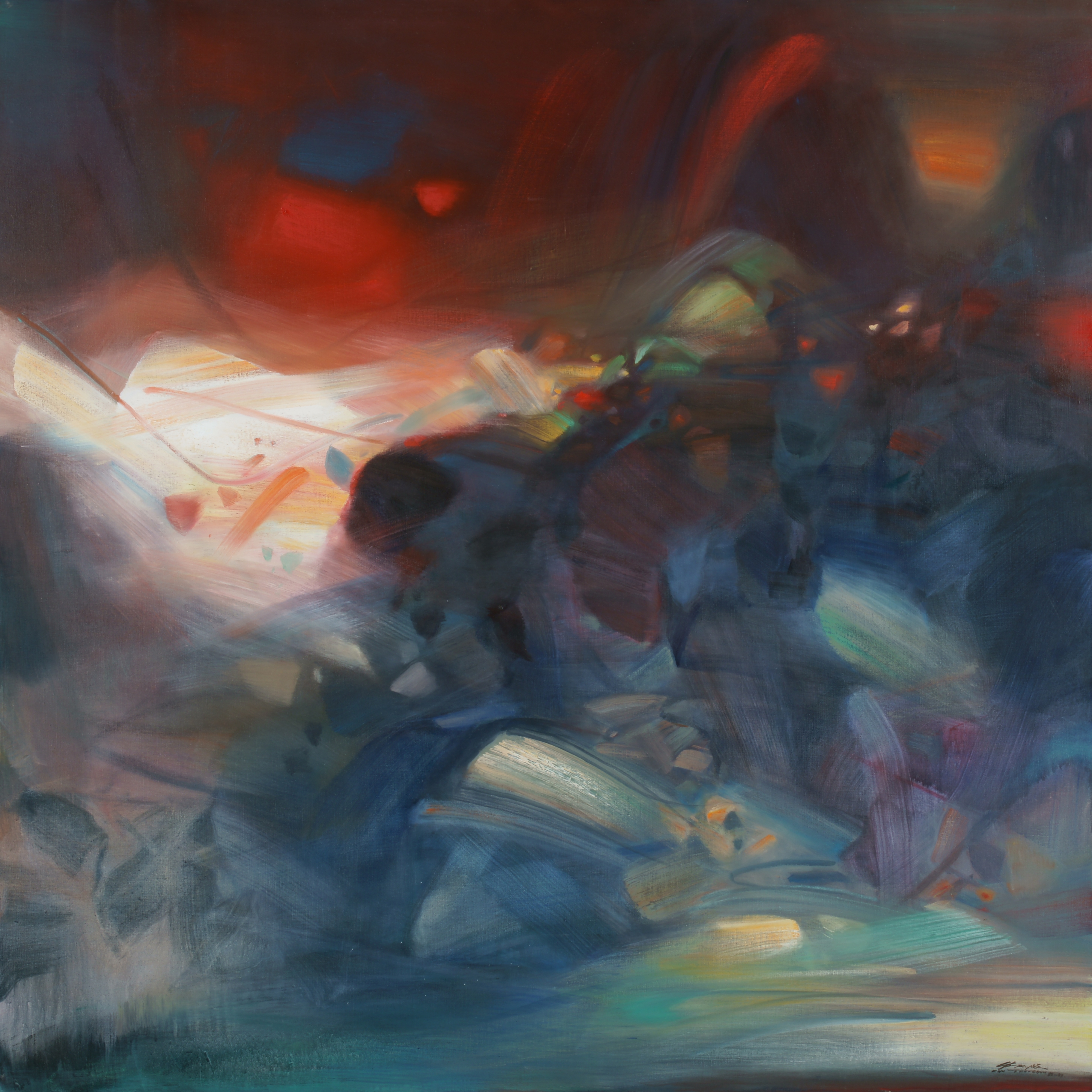
When Chu Teh-Chun embarked on a month-long boat ride to Paris from Taiwan in 1955, little did he know that in about a year, he’d reject figurative painting to start his journey afresh in abstraction. Sailing away from the preceding chaotic life of war and tragedies, he anchored at the peacefulness of his studio in Paris for the remaining lifetime.
Artists with long careers have often experienced creative shifts. Take Francisco José de Goya for example. This late eighteenth century Spanish artist moved from lighthearted and happy to intensely pessimistic in his drawings, frescoes, paintings and etchings. The spark of the ‘creative shift’ in CHU was flared high and bright when he visited Madrid and Toledo to admire paintings of Goya and El Greco and encountered the works of Nicolas de Staël during his retrospective at the Musée d’Art Moderne in Paris.
This spark of abstraction, however, wasn’t newfound. “He was trained at the Hangzhou academy by the best artists of the time, who went themselves to study in France and were keen on reporting the Occidental avant-garde activities. Cézanne was of tremendous importance on Chu’s early works, making him question already the validity of realism in painting—a logic in which Chu excelled. It means that when he came to Paris and encountered the local avant-garde painting trends like Lyrical Abstraction or Informal Art, he was opened and prepared for his shift towards abstraction,” decodes Matthieu Poirier, curator of “Chu Teh-Chun: In Nebula”, a retrospective exhibition to be held at Fondazione Giorgio Cini from April 20 to June 30, 2024, on the occasion of the sixtieth edition of the Venice Biennale of International Art.
“His studious and quiet life in Paris offers a sharp contrast with the torments and the tragedies, i.e. loosing both his parents, but also the entirety of his paintings, drawings and archives during the war with Japan and then with the Cultural Revolution. What looks like a paradox is in fact a reminiscence of the past into the works. Art does reflect life, but here it happens within a temporal distance.”
– Matthieu Poirier
Curated by art historian Matthieu Poirier, in partnership with the Fondazione Giorgio Cini and with the support of the CHU Teh-Chun Foundation, this is the most important exhibition devoted in recent years to this Franco- Chinese painter, a key player in gestural abstraction, whose work forms a link between Hans Hartung, Mark Rothko, and Helen Frankenthaler.
“The ‘In Nebula’ exhibition will offer an exceptional selection of the artist’s works, including large-scale paintings. Nine of the exhibited paintings have never been published or displayed, with hardly any shown in the last 10 years, and 15 not exhibited for over 20 years. This exhibition will also feature a large snow-scene painting, emblematic of the artist’s work. For this exhibition, we have been fortunate to receive support from European collectors and the loan of an important painting from the Museum of Modern Art in Paris. The envisioned scenography for this unique space will provide exceptional presentation of the artworks, complementing the curator’s narrative.”
– Anne-Valérie SCEAU

Memory of the Memoir
In Poirier’s words, Chu was “a very discreet character, entirely dedicated to his studio practice, Chu kept himself voluntarily from the art crowds and from any promotional strategy. This lack of communication let critics and museums think of him as a late boomer of post-war abstraction, which he was not. He was just writing a new chapter, very personal and obsessive, of this aesthetic logic that appeared in the 1910s. His institutional and public success, in the late 1980s, almost came despite of him, I’d say. Today, there are plenty of artists whose work are based on immaterial processes, mental mapping or AI generated notions that echoes Chu’s singular aesthetic.”
Perceptions often change with situations and circumstances. While a discreet character is often perceived differently by the professional world and the industry, it leaves a distinctive mark on a child who witnesses his father at home. Yvon CHU, son of CHU Teh-Chun and Vice President of the Foundation, fondly recalls, “The memories I have of my father are varied. They have evolved since we started working on the foundation’s archives. The photo archives bring out moments spent together as a family. But the most striking memories are without photos, what comes to mind are the moments when I was 10 years old, doing my homework in the atelier, where my father used to paint. I would hear the brushes sliding on the canvas, the smell of oil paint filling the house, and when he prepared the canvases, the glue to fill the holes in the canvas would perfume the apartment. Over time, I realize he spent a lot of time in his atelier, the slow process requires tenacity and hard work. These values are part of the legacy he will leave to future generations.”
Diving deep into memories cherished, Yvon adds, “We travelled together as a family every summer. The light and warmth of summer, the colors of sunsets are landscapes associated with family moments that later served him in his studio. These moments are memories that take on particular significance now that we are working on the foundation’s archives. We realize that the work of observation accompanied him at every moment of his life. He was, in his own way, an aesthete of beauty, because for him, beauty was a creative engine.”
Saving Chu Teh-Chun
Fondation CHU Teh-Chun, founded by the CHU family in Geneva in 2017, have meticulously preserved the Franco-Chinese painter’s journey and is dedicated to the collection, conservation, interpretation, archiving and exhibition of CHU’s art. “The foundation aims to perpetuate the memory of the artist and keep his work alive. Currently comprised of eight individuals, each highly invested in their respective tasks, the foundation adopts a rigorous and demanding approach, with Yvon and me as guarantors. It focuses on collecting and cataloging archives, an essential aspect of its work that has led to a better understanding of the Chu’s work. To continue keeping his work alive, it is crucial to document it and attract the interest of art historians and new generations, adapting to their modes of communication. However, nothing replaces the direct interaction of the public with the artworks, hence the ongoing importance of museum exhibitions,” Anne-Valérie SCEAU, Director of the Foundation elaborated.
The past decade, starting from the 2000s, represents to me the culmination of his work. I am particularly moved by the paintings inspired by moments spent with family, notably in Saint-Jean-de-Luz in 2008, where the paintings are bright and joyful. The viewer can feel a mastery of technique through the colors, transparency, and composition. There is a freedom in the brushstroke that is found both in the oil paintings on canvas and in the ink works on paper. The oil paintings are essential to understanding his oeuvre. They combine the Western technique of oil painting with the traditional approach of Chinese painting.
-Yvon CHU
In 1954, prior to his departure for Paris, Chu held his inaugural solo exhibition in Taiwan. He was able to pay for his journey to France with the proceeds from this exhibition, which featured all his figurative oil paintings. Life divided and compartmented in eras always pose a difficulty in the act of tracking and preservation.
“Chu Teh-Chun’s artistic journey before his arrival in France is poorly documented, primarily due to the destruction or loss of the majority of his works created in China. Only a few rare pieces accompanied him during his travels. During his years in Taiwan, he completed several commissions and held an exhibition that allowed him to gather the funds needed to move to France.
However, during this time, he was a figurative painter, whereas the work for which he is now recognized is the abstract art he began creating from 1956 when he settled in Paris. From this abstract period, his work immediately found great success with the French and European public, thanks to various organized exhibitions.
So, his historical audience is primarily in Europe, with many collectors having lived with his works for decades. It wasn’t until the late 90s that the painter had the opportunity to exhibit repeatedly in China, and Asian collectors began showing interest in his work. The Fondation’s documentation and expertise work provide a clearer understanding of the artist’s work distribution, with requests coming from all continents and a presence in significant museum and private collections,” elaborates SCEAU.


In Nebula, An Important Landmark
The exhibition ‘In Nebula’ is a worthy milestone in this initiative of preservation. The exhibition, which includes remarkable loans, including one from the Musée d’Art Moderne de Paris, features over fifty emblematic paintings, the most of which were created after 1955, when Chu permanently settled in Paris.
“It all really started with a conversation with Yvon and Anne-Valérie, the representative of the artist’s foundation, when I shared, as an abstract art scholar, the reasons of my interest toward the work, that many aesthetic aspects of Chu’s work remained to be explored, that one historiographical gap needed to be filled. I had the same feeling with the painter Hans Hartung a few years prior. It led me, very naturally, to write a new book (that will be published by Gallimard, Paris, April 2024) and to propose this exhibition to the Fondazione Cini, within the very international context of this Venice Biennale,” Poirier reminisces.
“Collaborating with curator Matthieu Poirier has been very enlightening. His expanded view of the work allowed us to explore new angles and establish artistic connections with artists or movements with which we were not necessarily familiar, not being art historians ourselves. Chu Teh-Chun’s work has thus gained a new dimension, enhancing our understanding of its depth. It was important for us to allow the curator to present his vision of the artist’s work independently of previously explored perspectives in other exhibitions. Thus, the exhibition conceived by the curator is unique yet resonates with Chu Teh-Chun’s work,” manifests SCEAU.
The exhibit takes visitors on a reverse chronological trip from contemporary giant forms to the earliest small formats, displayed in a panoptic manner on three levels of an extraordinary setting that echoes the unknown expanse of Chu’s pictorial nebulae.
“Chu’s exhibition space at the Fondazione Cini is its historical emptied swimming pool, i.e. a very unconventional space, far from a classic museum. I had to think along with the scenographers, Yvon and Anne-Valerie, about ways to build elements that would echo aspects of the paintings. This might have been the moment that I particularly thought of the wandering of the gaze within the painted chromatic clouds and abstract landscapes. It goes from the mountains-like or even dragons-like irregular dividers walls that we built, to the pathway through the totally open, arena-like space, along three different levels, from ground 0 to minus 2, where the visitor walks on stairs or wooden platforms, to a large number of ideal viewpoints onto the paintings and finally ending in the depths of the pool, where the most ancient works are presented,” Poirier elucidates a vivid visual of the exhibition
In his lifetime of nine and a half decades, Chu created more than 2500 oils on canvas, wash drawings, works on paper and ceramics. This exhibition represents a tip of the iceberg. Apart from the vast array of his work, he leaves a thought for his appreciators that may provide a keyhole to comprehend the ‘in nebulae’ works of the prolific artist- “The artist absorbs what he sees in nature and refines it in his mind, and it is the power of the artist’s imagination, his sensitivity and his inner character that is revealed on the canvas. This is where the concepts of Chinese painting and abstract painting come together very clearly.”


Leave a Reply