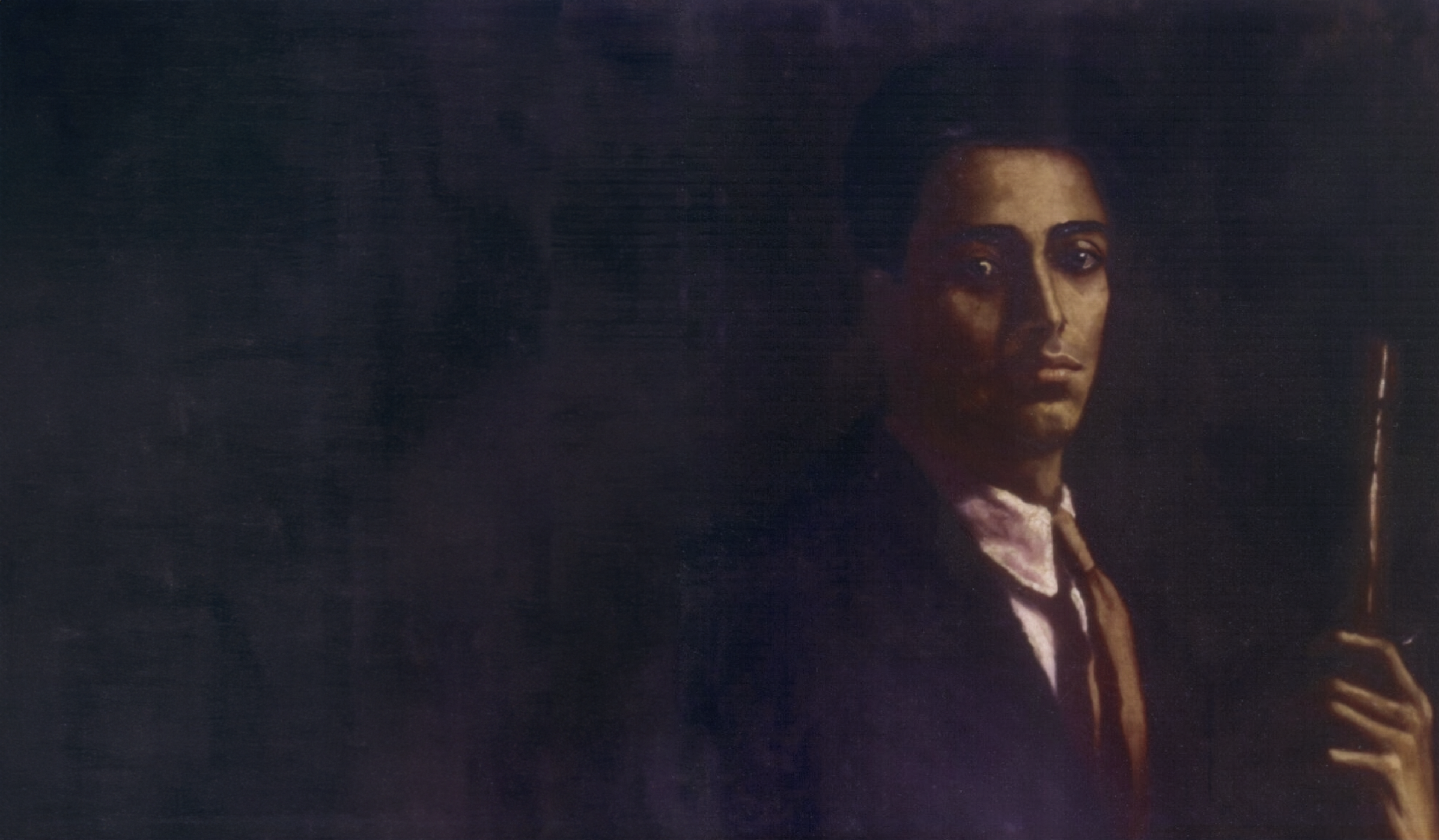
Dr. Homi Jehangir Bhabha may be known as the “father of India’s Nuclear Programme,” but he is also widely recognised as a scientific genius. A closer look at his life indicates that he was also a talented artist with a strong appreciation for many types of art. He spoke eloquently on how the skills were crucial to leading a fulfilling life.
The oil on canvas painting titled “Angels’ Concert….Homage to Mozart” is a beautiful synthesis of two of the artist’s favourite artistic mediums: painting and music. This entrancing artwork depicts a heavenly scenario in which angelic-looking people are shown playing instruments as part of an orchestra. Their slender figures are illuminated in a soft light, giving off an unearthly feel while they perform a musical duet.
The artwork immortalises a fleeting moment of heavenly harmony, depicting a group of angels performing together in a way that appeals to viewers on both the other side of the veil and on Earth. In addition to the title, the artist has placed his initial “H” in the middle of the canvas. The piece can also be seen via the lens of the famed Swiss theologian Karl Barth, who famously said that Mozart was the music that the angels in heaven performed for themselves.
Homi Bhabha began his studies of harmony and counterpoint very immediately after moving to Cambridge in October 1927. He also dabbled in composition, writing essays and even a symphony in the vein of Mozart, and often timed recordings to their accompanying scores. His early interest in Mozart’s music developed into a lifelong passion. Homi Bhabha, who was born on October 30, 1909 in Bombay, had the good fortune to be raised in a family that valued education. His grandfather, an educator by the name of Hormusi Bhabha, amassed a vast library for the family, one that included works of history, literature, and poetry.

His father, Jehangir Hormusji Bhabha, also possessed an extensive collection of illustrated books covering the Renaissance in Italy, as well as the works of other European masters such as the Spanish, Flemish, Dutch, British, and French. During his early years, he was fortunate enough to be tutored by the careful artist Jehangir Lalkaka in the scholarly, classical art form. He became well-known after winning many prizes at the Bombay Art Society’s Annual Exhibitions for young painters. One of his best works is a self-portrait he painted when he was just 17; it’s a sincere attempt to copy Rembrandt’s style.
Similarly, Homi Bhabha’s early exposure to a varied musical environment fostered a deep appreciation for music, leading him to study the symphonies, concertos, and chamber works of Beethoven, Mozart, Bach, Haydn, and Schubert. His taste in music included a wide range of classical pieces by masters such as Chopin, Mendelssohn, Wagner, Dvorak, and Tschaikovsky. Dr Homi Bhabha made significant contributions to the field of art beyond the canvas. Initiating the TIFR collection in the early 1950s, he oversaw its meteoric rise to become the world’s most remarkable assemblage of Indian contemporary art in only ten years.
In AstaGuru’s forthcoming ‘Modern Treasures’ Auction, which will include a compelling tapestry of Modern Indian Art, including an outstanding assortment of rare and exquisite works by prominent Indian modernists, you may bid on this lovely artwork and many more like it.
Artists represented in the carefully curated catalogue include Jamini Roy, M. F. Husain, S. H. Raza, K. H. Ara, F. N. Souza, Sadanand Bakre, Akbar Padamsee, Krishen Khanna, Avinash Chandra, Ram Kumar, K. G. Subramanyan, H. A. Gade, Ganesh Pyne, Jogen Chowdhury, G.R. Santosh, J. On September 1-2, 2023, the auction will take place.


Leave a Reply