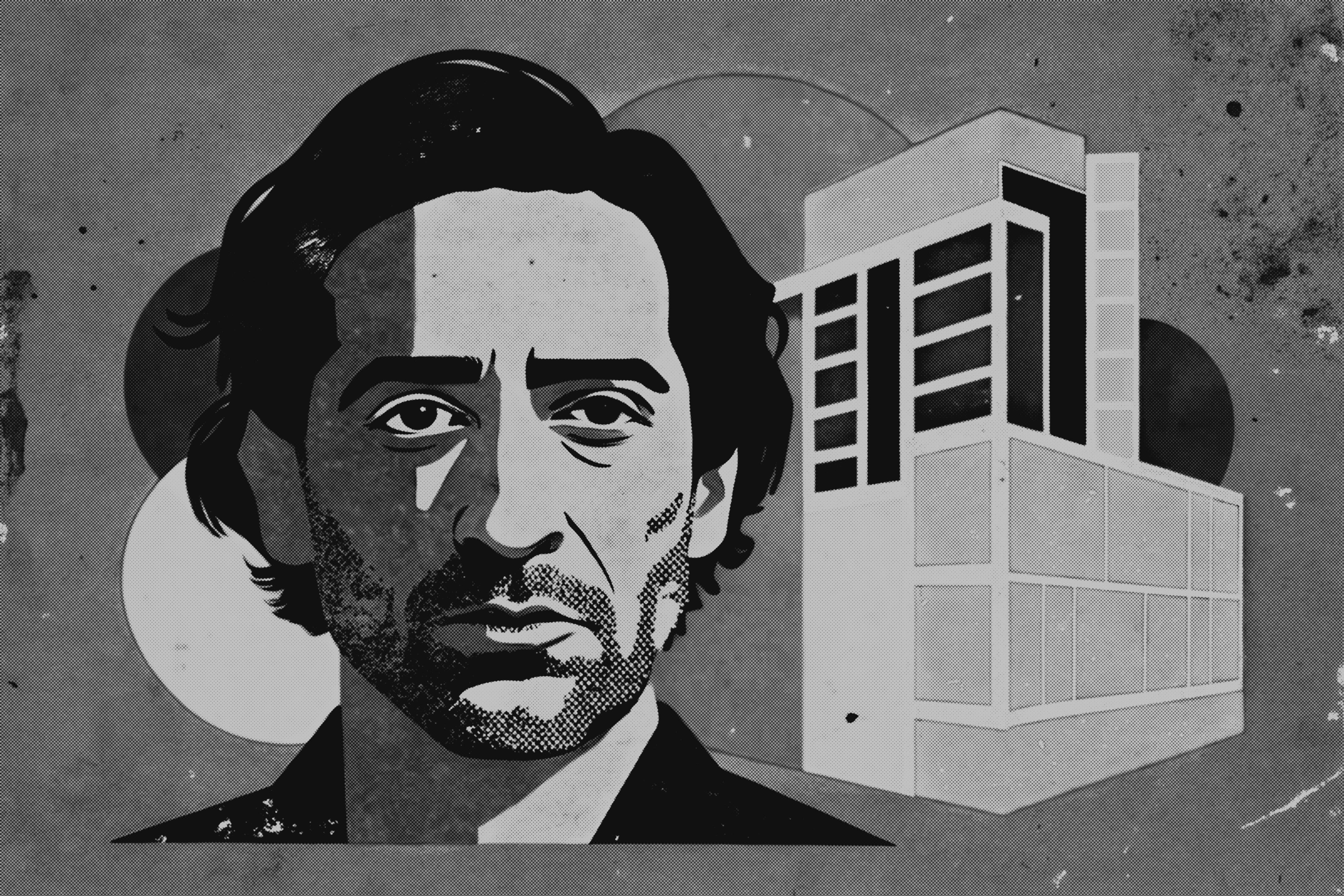
Having a stunning narrative on architecture, The Brutalist (2024) is a brilliant film that challenges the boundaries of traditional storytelling. It traces the life of László Tóth, a Hungarian Jewish Holocaust survivor who worked as a civil engineer in America post-WWII. As a tribute to both his personal struggles and the Brutalist architecture style, the film literally and metaphorically fuses the anger and pain the artist has felt throughout his life. This review explains how ‘The Brutalist’ employs masterfully artistic movements, deep themes, and unconventional camera work to immerse the audience in the film.
First Impression, Themes and Influence Behind The Brutalist: Cinematography.
The opening frames of the film are highly accurate and fulfilling, which is a bold move. The film’s breathtaking (and sometimes horrifying) history is presented through the director’s decision to use 35mm VistaVision. Although the technique may seem like a regular cinematic tool, the use of VistaVision in modern cinema is borderline obsolete. The ruined buildings are brought to life, vividly illustrating the harsh sharpness of cold concrete beauty. VistaVision excels in allowing each shot frame to breathe, creating a sense of smallness within the vast world. It captures colossal buildings with such precision that the audience feels as if they are truly witnessing a piece of art.
Cinematography in The Brutalist is as intentional as the architectural designs integrated within the plot. The scale of László’s projects is captured through wide and steady shots, while the rough textures of the intricate designs are revealed through composed close-up shots. Interiors and exteriors are sculpted using natural light, and how sunlight interacts with materials is showcased. This technique serves as an inspiration to modernist architects such as Marcel Breuer, Louis Kahn, and Paul Rudolph, who are always influential in design. The awe-inspiring blend of light and shadow does more than create stunning visuals; it represents the transition from hopelessness to hope, which is one of the key themes in the film.
The brutalist at its surface is about construction rising from destruction. László Tóth, the main character, attempts to heal from his trauma by envisioning a future where a grand community center serves as a memorial and a beacon of renewal. The film discusses the notion that art and architecture can be therapeutic after a tragedy strikes. Every building and space in “The Brutalist” has a highly detailed design: the structures serve as a testament to resilience, showcasing the grueling reality of a broken life.
One other sensitive issue is the immigrant experience The Brutalist deals with. László’s life, from war-ravaged Europe to America post the World War, is described with a hint of hope, yet with harsh truth. Initial parts depict carefully his struggles—working in low-paying jobs and dealing with culture shock—whereas later portions reveal glimmers of hope and possibility. The man’s relationship with Harrison Lee Van Buren is combined with his wealthy industrialist patron, which also illustrates the cynical side of the American Dream. Van Buren first comes offering support as a sponsor, acknowledging László’s talent, but later, the audience is introduced to the more sinister sides of power and control exploitation. The film forces the viewer to confront the poignant reality that creative intellectual power invariably carries a hidden cost.
 The Brutalist is styled in ways that tell a story and utilizes cinematic references quite impressively. Alfred Hitchcock’s epics come to mind while considering the film’s wide, panoramic shots due to the classic feel they capture, and at the same time, moments can be appreciated intimately, recalling the works of Michelangelo Antonioni when built structures function as an expression of human feelings. A particular scene is quite striking where László is seen walking through a vast construction site, and the camera is unmanned on a dolly capturing both the vastness of space and his self-contemplative look. This process forms a visual narrative of the impact of design and history on an individual.
The Brutalist’s thematic depth is just as profound as its visual beauty. Its narrative centers on the argument that rebuilding, whether physically or psychologically, reconstructs something new and requires skill and extensive inner change. László’s struggle is delicately depicted as a tug of war between the past and the heady future. Every one of his architectural designs becomes part of his self-image: every line and material selection is an act of reinvention. With the pacing meticulously slow, it allows viewers to experience a world where every tiny element meticulously matters, like the texture of unfinished concrete to the changes of lighting throughout the day.
Additionally, the influences of different forms of art enhance the narrative of the film, The Brutalist. It clearly stems from the principles of the Brutalist style of architecture, which is a fusion of a lack of decoration with raw expression and functionalism. This style of architecture was developed after World War II as a means to assist in the rebuilding and spirit of renewal. The Brutalist makes use of this approach by depicting architecture as an actual and subjective form of having to rebuild. The visual language of modernity, which focuses more on aesthetics, is present in the film, which relays the minimalist features of mid-century design and the constructivist vision that celebrates form, utility, and social development. The film is a clear depiction of modernism.
The fusion of contemporary storylines with history is one of the stunning aspects of the film. Today’s audiences can relate more to the issues of immigration, identity, and survival, which gives modern appeal to the use of VistaVision. Every frame of The Brutalist is set to construct a sense of longing for hand craftsmanship while critically being aware of the current state. The process not only transforms the visual representation of the film but also encourages the audience to challenge the perception of art and architecture in modern society.
Furthermore, The Brutalist has a particular sound to it that makes it appealing. The mixing of the score with other sounds creates a beautiful combination with the visuals. While visually stark, industrial drones and minimal ambient sounds reinforce the barren concrete soundscapes, depicting the struggle between order and chaos. In the more subtle sections, the sound design adopts a more personal tone as it reflects the inner turmoil of László, the reality of losing his loved ones, and the burden of his dreams and aspirations. This attention to detail in the relationship between sound and imagery enhances the emotional impact of the film and encourages the audience to respond to the multilayered story by using different senses to understand the various elements of it.
The editing style of The Brutalist also contributes to the themes presented within the film. The film utilizes long takes and mid-cuts, imitating the structural designs of a Brutalist building, in contrast to modern cinema’s focus on a fast pace. This format approach gives time for the audience to reflect on the moment, which is often not found in modern films. The inner meditative pace allows for every detail of the film to be put together to form the greater narrative of reconstruction and hope.

The Brutalist combines character change with the film’s architectural features. László Tóth is not only an architect; he represents the spirit of a fighter, a man full of strength, and one relentlessly chasing the truth of his creation. The best and worst times of his life come when he tries to tackle his life’s obstacles and the external friction of his past. His character growth is seen alongside his architectural undertakings. At the beginning of the film, he is shown carefully drawing plans and building small structures that portray his guarded optimism. In the latter part of the story, his designs become more and more sophisticated as he undergoes the metamorphosis from a broken man to an exceptional builder. The film’s scale and personal development relationship is striking—the greater the devastation, the greater the need for a human to transform and have a goal.
Brutalism does not only focus on architecture; it reflects on the essence of art and creativity. The methodical activity of building a gradually more complex structure is presented as an expression of one’s being. When László undertakes a project, it becomes an opportunity to remember, hope, and dream, which transforms the process of creation into healing. The film posits that outstanding art is achieved by confronting skills and one’s inner turmoil at the same time. The Brutalist flips the mainstream view on artistic genius, claiming that real creativity is the product of hardship.
Alongside its strong storyline and stunning visuals, The Brutalist stands out as a remarkable piece of technical filmmaking. This approach interweaves Telluride’s Bold Ideas with the craftsmanship aspect of the film and its completion. The use of traditional film stock in the digital era is a statement by itself, capturing the beauty of handcrafted work. That analog effect gives the film a sense of touch that is difficult to reproduce with digital techniques. The film’s grain, the imperfections within the frame, and the gradation in colors create an organic, timeless essence. Just like with powerful buildings, one can expect the film to be designed and constructed with the same care and attention to detail. The use of these techniques not only improves the enjoyment of watching the film but also strengthens the notion of the never-changing nature of legacy and permanence.
The Brutalist has a well-planned narrative structure, and it is divided into sections like chapters of a book. It has an episodic form, which makes it easier for the audience to untangle the plot and characters’ depth at each step. Each section builds upon the other, and parts complement one another, which lets the audience enjoy the entire experience as a whole. Walking through a museum with many rooms allows a viewer to reflect on the experience in the same way the film approaches this concept. The pace is slow, which makes every single moment engaging, and the connection between form and function is complex. The approach is quite the opposite of many films today, which are edited constantly on the go. It brings into comparison how art as well as the creation of it needs thought and intention, not simply an end goal of a finished film.

Moreover, The Brutalist deals with the social and political issues that are far away from art and architecture. The film analyzes the study of immigrant life, their struggles with assimilation, and power relations in a society and approaches these subjects with care and subtlety. To illustrate, Harrison Lee Van Buren stands in stark contrast to the American Dream. He is a philanthropist who serves as a patron, yet his assistance is often accompanied by conditions, a characteristic of patronage in both art and commerce. This phenomenon deepens the social criticism in the film, making the audience analyze what the price of achieving success in a capitalist state is, where it is possible that low intentions would pollute noble ones.
In the end, The Brutalist remains a striking articulation of the intersection between art and architecture. It dares its audience to look deeper than mere concrete and steel, challenging them to uncover the human narratives shrouded within every building. The film is a tribute to tenacity: it’s ennobling the spirit of creativity that can be smashed but never utterly defeated. It tells us how every significant piece of art is erected on the ground of battle, and like architecture, real art is a sanctum and visage of humanity’s spirit.
To summarize, The Brutalist (2024) is thematically profound as much as it is spectacularly executed cinematically. Its imaginative approach to cinematography, as well as its use of traditional filming and narration, is unprecedented in modern filmmaking and provides an all-around experience, unlike any other mainstream movie. By addressing the issue of architectural design and the unyielding search for the genuine essence of creativity, the film examines art as a reflection and remedy for human suffering.
Viewers must add The Brutalist to their list if they want a film that exercises the mind as much as it captivates through imagery. This film engages its audience by taking them on a journey where they uncover the stories within beams, columns and the spaces that enchant them with its depth and sophistication. Through its intertwining history, design, and personal conflict, The Brutalist evokes an imperative question—what do we actually choose to build in a world constantly unraveling and deteriorating? And for what sacrifice?
With its unwavering focus on human strength, The Brutalist is a landmark film that offers a new perspective on contemporary cinema and architecture and, in turn, will continue to invoke debate and appreciation for many years to come. Its multitude of views and super-inclusive approach establish the fact that art offers people life-changing experiences.


Leave a Reply