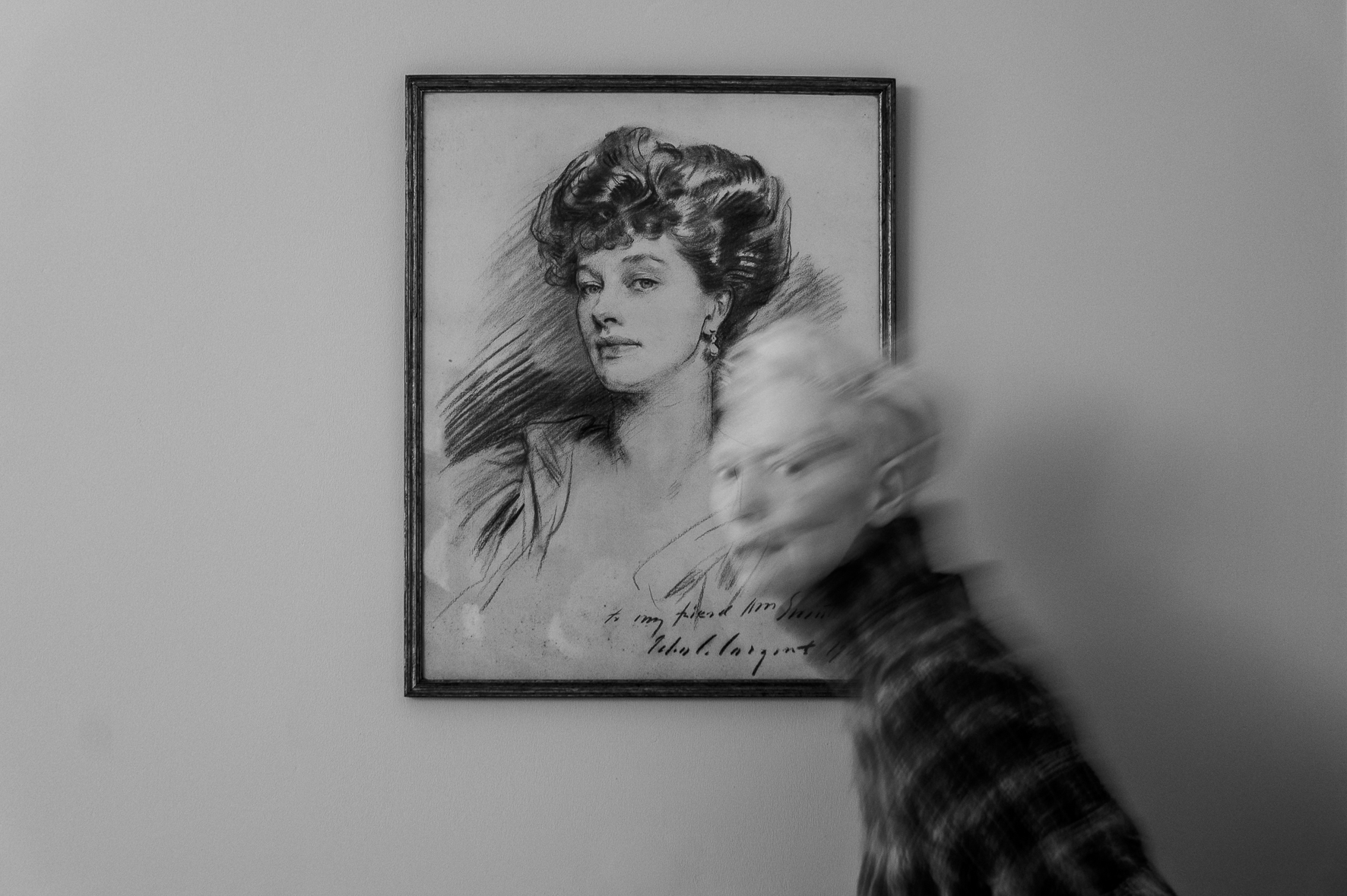
As blurred as the lines distinguishing moving pictures from visual art are nowadays, the exhibition at the EYE Filmmuseum in Amsterdam stands out as an icon of a multidisciplinary investigation. Tilda Swinton, who has relationships in the graphic arts and cinema, is a driving force behind this superb exhibition. Her work is both stunningly aesthetic and richly philosophical. Rather wildly, and rather nicely, Swinton’s recent exhibition—reported on by The Hollywood Reporter—comprised a mosaic of images, installations, and prose that serves as a commentary on perception, identity, and the nature of polygons, which culminated in deep thoughts on meditative perception as a whole.
An actress, a cultural figure, and now a curator of cutting-edge expressions of visual arts, Tilda Swinton exercised her abilities to elicit a heightened level of engagement that demands the audience to confront the perplexing duality of the viewer and what they are viewing. The exhibition itself is inextricably linked to Pedro Almodóvar and is a sensory feast of voices, styles and times. It is a polyphony of art and cinema— the self and the mysterious other straddling the border of what is real and fantasy.
Tilda Swinton: An Iconoclast’s Journey into the Intersection of Art and Cinema

The very beginning of this exhibition brings to mind a meticulously choreographed balance. Tilda Swinton’s biography is a captivating narrative. A visual story told through cinema because she has been a performer, a remarkable myriad of characters in show business. I believe she embodies herself in a mythology-mnemosyne-lyrical rendezvous, a daydream spiral reflective unto itself. She manifests herself alongside her unfiltered odyssey.
An anathema narrative. An expressionistic style, with striking periods of order, is evident in her latest appearance at the EYE Filmmuseum. She has made a dedicated effort to document an encompassing emotional voyage both within and beyond the orbit of film. The installations resonate with an unmistakable sense of rigidity. There is a strong desire to free oneself from the constraints of temporality. Every object and subsequently every image in each temporal interval achieves an unattainable space laden with ambiguity where rationality cannot prevail devoid of active mental participation.
The exhibition’s title, which references both the institution housing the exhibit and the metaphorical “eye” as a site of perception and revelation, captures the key point of focus of Swinton’s curatorial imagination. It is in this space that the viewer is forced to reassess the process of looking— going beyond a mere visual reception to thinking as an active, dialectic process. Tilda Swinton, in her lifelong ability to merge art with life, propels us to navigate the ways of seeing and to rethink an image as a representation of witnessing and vice versa.
The exhibition is more than an episode of aesthetic experiments; it breathes as a discourse between two different and, at the same time, interconnected worlds. Pedro Almodóvar’s influence is apparent in the way Swinton’s installations draw from the director’s irrepressible use of bold colors, counter-narratives, and cross-cultural identity politics. She transforms the museum space into a type of cinematic setting where the moving images dissolve into the still ones and vice versa in a meditative supreme experience.
The focus of the exhibition revolves around the dual role of Tilda Swinton, an actor, muse, and intellectual provocateur who embodies both the subject and the object of inquiry. Her image, both literally and metaphorically, is distributed throughout the installations in a way that implies self-fragmentation. This style is indicative of her other works, where the self is not fixed but is constantly shaped by currents of external narratives and internal thoughts and reflections. In this case, the work aims to challenge the audience to adopt a perception of identity as an entity that is flexible and metamorphosized in the act of perception.
Tilda Swinton: A Beacon of Avant-Garde Aesthetics in the Contemporary Art Sphere

The exhibition’s conceptual foundations are as diverse as they are deep. A primary focus is putting forth a questioning examination of the intersecting boundary between visual art and cinematic art and narrative, debatably one of the most important concerns for avant-garde art practitioners. One can view Tilda Swinton’s curatorial endeavor in light of her continued fascination with this connection, relying on her wealth of cinematic experience to bring life to an installation that is equally intellectually stimulating and sensorially rich.
The investigation of “otherness” in cinema and visual art marked one of the most intriguing features of the exhibition. How images shape reality and how reality affects images is one of the most prominent questions brought to life by Swinton’s oeuvre, paying homage to the notions of postmodernism and deconstruction. The exhibition encourages interactivity by controlling light, shadow, and scale, allowing viewers to engage in the dance between presence and absence.
Here, the impact of Pedro Almodóvar is not incidental. Rather, it is integral to the overarching narrative of the exhibition. The work of the Spanish filmmaker, who specializes in stories that explore the realms of transgression, desire, and identity, Almodóvar’s films are a rich conceptual ground for Swinton’s artistic pursuits. The exchange is woven together with a delicacy that is simultaneously understated and striking: Almodóvar’s films do make use of bold, at times extravagant, emotively heightened rendering of the visual world, and Swinton’s works make use of stark contemplation of the image as an object. Together, they create a wonderfully rich experience that invites the viewer to navigate the permeable boundaries that separate dreaming and recollection— the fleeting and the timeless.
The exhibition reflects culture and the changing modes of artistic creation in the 21st century, aside from its aesthetic aspects. Tilda Swinton’s work is fueled by a profound suspicion toward the commodification of art, which appears to be pervasive in the fashionable period of digitally reproduced images and their widespread circulation. She is a cultural alchemist who turns the ordinary into the extraordinary by forcing the viewer to question what they see. Her installations, which often combine the ephemeral with the perpetual, provoke fresh contemplation on the interactions people have with art, including how it is created, “consumed,” and internalized on different levels.
Consequently, EYE Filmmuseum’s exhibition illustrates Swinton’s unwavering dedication to complex intellectual thought and aesthetic experimentation. Every single installation perfectly showcases the precise attention to detail that Swinton exhibits in the rest of her work, which is a blend of academic study and an almost overly visceral engagement with materiality. This is how Tilda Swinton’s curatorial project goes beyond the constraints of an exhibition and creates a context where art, film, and philosophy are no longer blurred but rather dismantled as separate pieces.
Conceptually, her work captures what is arguably a postmodern phenomenon within a modern paradox deeply attuned to its inner violence. The exhibition is full of reservations, so it can never be absolute due to many variables like time and perception. This very ambiguity is what makes the exhibition evergreen, as it captures the essence of contemporary life. The title figure stands as the embodiment of those endless contradictions, remaining unconditionally experimental even when deeply contemplative.
An eclectic assortment of visual motifs that question the essence of representation add depth to the curatorial narrative. The exhibition dismantles traditional methods of visual interaction through the use of mirrors, fragmented images, and multi-layered installations. The audience is guided through a maze-like environment where every reflection and shadow holds multiple interpretations. Within this meticulously constructed setting, Tilda Swinton’s figure appears as a beacon—her radiant form forever transformed amidst fresh meanings with every viewing, revealing her image as a palimpsest.
These themes of metamorphosis and transformation also heighten the dialectical interplay of the exhibition. Swinton’s installations suggest the fluidity of one’s identity and that the self cannot be a fixed entity. The repetitive imagery of the eye—a sign associated with perception, insight, and the act of seeing—is transformed and reimagined as the art’s strength. This not only acknowledges the iconographic batons of cinema and painting but also forges new avenues of artistic capture within an ever-more globalized context.
Furthermore, the exhibition works on many chronologies at once. There is a delicate conflict between the age-old cinematic art form’s historical burden and the collage impulse of contemporary art. Tilda Swinton’s curatorial intervention, therefore, has a sense of double temporality: it is both a retrospective engagement with the storied past of visual representation and a speculative foray into the future of aesthetic experience. In this case, the dialogue reinforces the tension between memory and recontextualized contemporary reality.
The exhibit’s appeal to the intellect is accompanied by an equally striking appeal to the senses. Striking and sumptuous images bombarded the visitor—a modern-day duality of life’s yin and yang—this visual chiaroscuro is still within the boundaries of modern performance art. Tilda Swinton’s curatorial brilliance is most evident in this interplay: her installations, which are not image-centered, instead prompt the viewer to contemplate the complex network of production, circulation, and consumption that surrounds those images. The exhibit thus takes on the character of a hyper-cinematic meta-commentary focused as much on the ethics of representation as on the beauty on which those abstractions are based.
In modern art critique, the exhibition has received acclaim as a bold and intellectually challenging statement. Critics say the work goes beyond display and provokes discussion about the future of art. The incorporation of more cinematic influences, especially from the works of Pedro Almodóvar, accentuates the relevance of the exhibition and situates it at the intersection of film theory, visual art, and cultural studies. From this perspective, Tilda Swinton’s curation is not only an artistic project but rather an investigation into the essence of contemporary artistry.
The intertextual exchanges that stir the exhibition are a microcosm of the contemporary art world, one in which genre boundaries become increasingly blurry and where looking at something is as much of a cognitive activity as it is a physical one. Because of her long-celebrated career in cinema, Tilda Swinton’s contribution to this discourse is all the more remarkable. She has been cherished for years for her ability to portray the unspeakable. Now, through this exhibition, she extends that ability to the domain of visual art, which seeks to reflect on the ability of images to conjure, challenge, and ultimately change perception.
The ramifications of Swinton’s creations are boundless. This exhibition counteracts the idea of temporariness and superficiality in an era defined by overwhelming visual input and the grip of screen culture. Rather, it proclaims, albeit quietly and without compromise, that true art is an act of defiance — a testament to the aesthetic experience. Tilda Swinton’s installations, within their methodical setting and symbolical depth, articulate the strong burden of responsibility to the viewers, asking them to retrieve meaning instead of simply looking through the cacophony of images.
In addition, the exhibition propels us to rethink the “spectacle” of contemporary culture. Considering images are manufactured and passed around at an alarming rate, looking itself has transformed into a radical act. Tilda Swinton’s work is a gentle yet deep indictment of modern media consumption’s superficial nature. Her work serves to wake us up in intellectual rigor mortis; a reminder that the highest form of art is a command to reflect and an indulgence to witness.
Also, the curatorial narrative is enriched through the weaving of contemporaneous and historical references, which helps position the exhibition in the scope of endless artistic exploration. Tilda Swinton pulls from a diverse array of sources, such as the cloistered hermetic symbolism of Renaissance painting and the jarring modernist cinema, creating work that is simultaneously timely and timeless. This diversity of influences embodies her artistic philosophy, which is rooted in the ever-changing nature of art, one that defies the traditional frameworks of hierarchy and civilization.
Arguably, the exhibition has generated a great deal of interest among art historians, critics, and cultural theorists. Scholars have praised its scope, observing that Tilda Swinton’s work echoes the intellectual currents of the last few decades—a period that has witnessed a surge of interest in the interrogation of identity and the construction of culture. This exhibition goes beyond showing works of art; it is, in fact, an exhibition of ideas. It captures a spirit of questioning that is both perennial and painfully current in a world where art, film, and theory are continually redefining their boundaries.
In addition, the arrangement of the installation’s parts and its particular regard to the layout of the museum has been noted widely. The interplay between the exhibits and the characteristic outline of the EYE Filmmuseum has a synergistic effect that augments the impact of the exhibition as a whole. Tilda Swinton’s placement of the individual components within the space motivates a deep, almost tactile engagement with the work. The spectator is no longer a mere spectator but a participant in a dynamic, visually unfolding story—one that is intimately personal and yet profoundly collective.
A further aspect of this exhibition’s intricacy is the engagement with the idea of metamorphosis as both a physical reality and as an emblem of the fluidity of artistic identity. The body of work by Tilda Swinton has been defined for a long time by the capacity to change— to reinvent oneself, in a manner so singular that there is no discernible way to put it in a box. This impulse to change is clearly discernible throughout the exhibition in a range of installations that seem to defy the idea of change and the certainty of permanence. The images are changing, but their careful arrangement evokes stillness. This duality is aesthetically pleasing, intellectually stimulating, and engaging all at once.
This is perhaps the very contradiction of Tilda Swinton’s artistry—an oscillation between something fixed and fleeting, clear and uncertain. In her latest exhibition, she steps into the border regions of sight and depiction with a confidence that is at once refreshing and breathtaking. The work honors cinema’s deep roots and redefines the complex relationships of the gaze, recollection, and storytelling. In this manner, Tilda Swinton reestablishes herself as a cultural trendsetter, an icon of the avant-garde in the ever-growing sea of uniformity dominating contemporary visuals.
In summary, the exhibition at Amsterdam’s EYE Filmmuseum presents a nuanced exploration of the interplay between art, cinema, and identity. It serves as a reflection of our temporal existence and simultaneously prompts a reconsideration of the future of creative possibilities. With her thought-provoking installations and complex visual stories, Tilda Swinton has constructed an experience that defies perception and calls for an encounter with art that is deeply cerebral. The conversation she has with towering figures like Pedro Almodóvar speaks to the capacity of art to transcend and deepen perception of, a shared humanity.
The exhibition represents an example of a larger cultural change: a shift from the mindless consumption of images toward engaging with the visual world in a deeper, more thoughtful manner. Tilda Swinton’s work serves as a reminder of the possible changes art can make in the world, prompting us to transform not just our perceptions but also how images influence our understanding of reality. In a time of rapid technological advancement and a bombardment of digital images, the exhibition provides a much-needed moment of stillness in which the viewer can indulge in the timeless quest for meaning and beauty.
In the ever-changing world of art, Tilda Swinton’s dual career in cinema and visual art highlights how powerful her impact is. Her unapologetic deep-diving into the themes of selfhood, representational politics, and narrative multiplicity resonates beyond the walls of a museum and into a deeply interconnected and multicultural world. The exhibition powerfully affirms the ability of art to confront and challenge us, while simultaneously transforming our shared visual culture.
Upon contemplating the sculptures’ numerous layers of meaning, the adage “art is not what you see, but rather what you must reimagine” resonates. Tilda Swinton, with her unusual combination of bold visual taste and deep intellect, has not only assembled an exhibition of exquisite beauty and complexity but has also sparked a deeper conversation regarding the evolution of artistry. She, and we could say ‘her’ as in Tilda’ with regard to screen and museum, demonstrates beyond the shadow of a doubt how art can perpetually motivate, provoke, and above all reveal to us the many facets of our collective reality.
As I have stated previously, the current exhibition at EYE Film Museum goes beyond showcasing pieces of art; it serves as an exploration regarding the relationships of interdependence between the two worlds of cinema and art, a dialectic that transcends time and is contemporary at the same time. Thanks to the daring curatorship of Tilda Swinton, we can all step into a world where the familiar transforms into something alien—an ever-so- strange place where merely looking becomes a true mental and emotional investment. In this wonderfully odd world of creative inquiry, Tilda Swinton not only reinvents the definitions of her artistic self but also prepares us for an era where art transforms into something more, a new form of expression and identity that transcends boundaries, a form that expresses and redefines art as we know it.
Tilda Swinton has gone beyond traditional approaches, which enables her to form an exhibition that captures both the eyes and the mind. This claim serves as the grandest example of protecting the perception that art is a force able to challenge the norm, articulate deeply rooted sentiments, and rediscover for us the enigmas behind our sense of sight. All intellectuals who walk this exhibition’s course are guaranteed, as a reward, not just the journey through the mind of a creative marvel, but an artful proposition to reconsider the understanding of art and its existence within our lives and society.
In the end, all claims pertaining to the exhibition, Tilda Swinton’s legacy, will rest on a fresh philosophical claim that will mark her art with its comments gushing with praise or with reasoned critique as she is lacking the ability to dissect the nature of art, film, and the soul. This serves as a centerpiece to every thinking human, an artist, a scientist, a viewer, compelling them to broaden their limitations, wonder, and comprehend that all the limitations that exist in creative work and perception are redefined time and again.
As Tilda Swinton’s contribution resonates across EYE Filmmuseum and the cultural landscape, the lasting impact of this exhibition illustrates a fundamental truth that she has always championed: art is, at it’s most transformative, an act of perpetual reinvention; forever illuminating the way out of our own eyes, dreams, and everything in between.


Leave a Reply