Last updated on September 9th, 2024 at 03:38 pm
When one tries to make sense of the vivid hues in Iraqi artist Vian Sora’s paintings, the word “chaordic” comes to mind. Inspired by historical, environmental and psychological landscapes, Sora’s works reflect order in a chaotic yet opulent world.
Born in Baghdad during the late seventies, Sora endured the terror of living in a war zone after the US invasion of her country in 2003. She lived the first thirty years of her life under dictatorship and sporadic warfare. After finally leaving Iraq in 2006, she travelled through Turkey, the UAE, and other countries for three years before eventually immigrating to the US. “My work is an act of resistance,” said Sora in a conversation with Guardian during an exhibition marking the 20th anniversary of the invasion of Iraq.
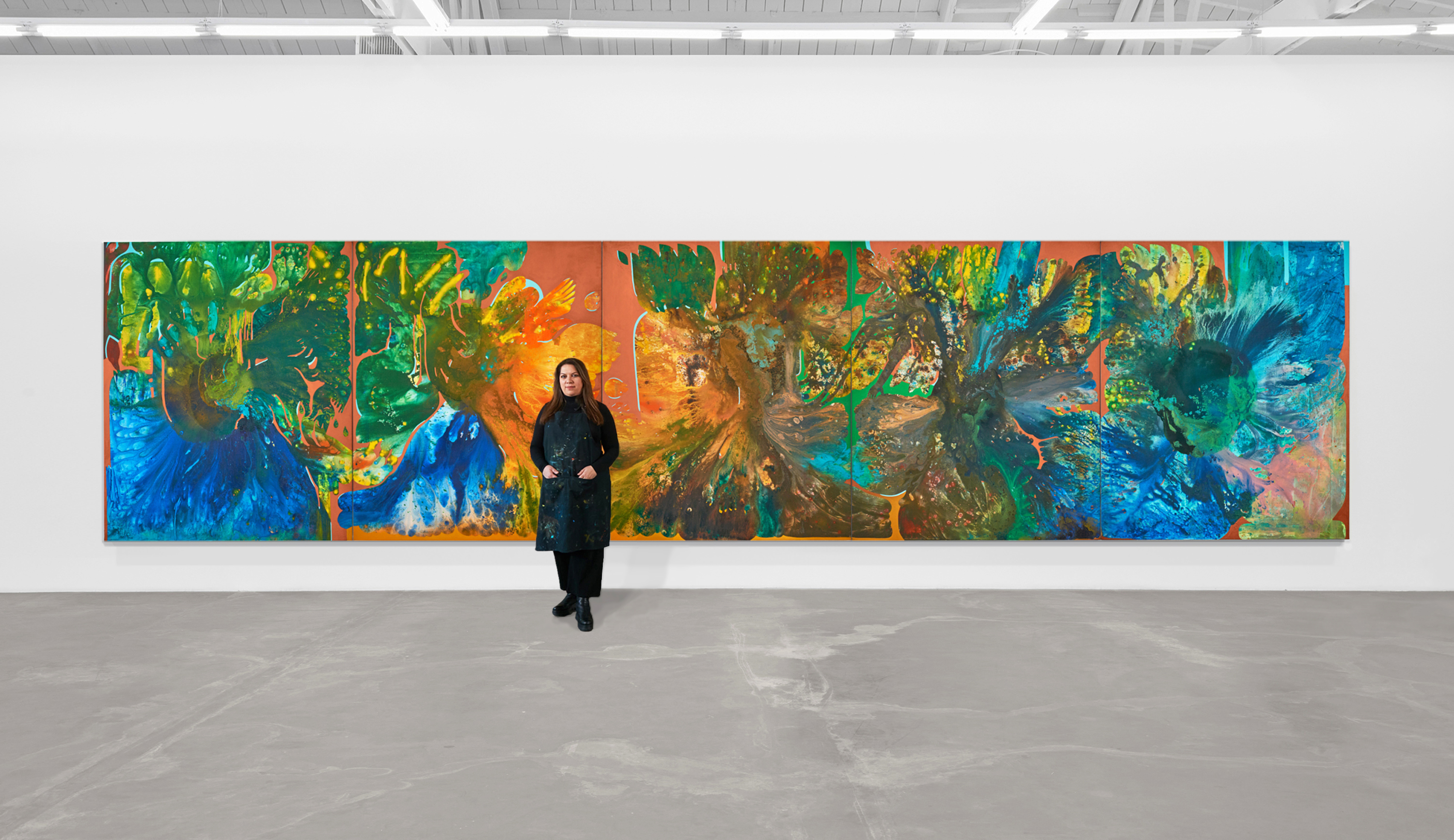
‘Abzu’- Sora’s monumental painting exhibited by the Los Angeles gallery, Luis De Jesus, at this Art Basel Miami Beach show, is yet another statement of resistance. Informed by her personal experience and global perspective of life in the Middle East and abroad, Sora uses water to symbolise flux, resilience, and rebirth amongst shifting attributes—exposing human necessity and vulnerability.

‘Abzu’ refers to the primaeval subterranean sea, a middle realm inhabited by deities that source fresh water. In Sumerian and Akkadian mythologies, the mystical underground aquifers were believed to provide water to lakes, rivers, and wells, springing forth regenerative powers. The painting addresses the lost fertility below the alluvial fields that were once able to sustain Iraq.

In this conversation with TNA, Sora talks about her childhood in Baghdad, her early inspiration, and ‘Abzu’.
You were forced to move due to the unrest in Iraq in 2006 and are now settled in the USA. When you look back at your work, what do you think has been inspiring you, and what do you wish?
Painting is my instinct, and thus, I find inspiration in the act itself. Art is a universal language, our global dialogue, that does not need a dragoman at the Tower of Babel, mistranslating between disparate languages. And maybe that is what I wish for- commonality, understanding and for us to recognise that we are symbiotic.
Tell us about your childhood and what inspired you to become an artist. Do you remember the first artwork that you were in love with?
I was surrounded in my childhood by artistic minds in Baghdad and my grandmother’s garden, with its alluring flowers, pomegranates and possibilities, which then translated from my brush to canvas when I was a child. My respite during the many wars in Iraq has been the studio, a place of safety and creative release. The first artwork, though there are many, would be an early untitled painting by Jawad Saleem that my mind’s eye recalls.

How was ‘Abzu’ inspired and conceived?
Abzu is the freshwater underground aquifers, particularly significant in Sumerian and Akkadian mythologies, representing fertility and life, the regenerative powers of spring. The painting is a rumination upon the man-made and other forces that are impacting the once Fertile Crescent, and particularly in my homeland of Iraq. The painting depicts clashing scenes of water, particularly with fire, which are references to the dried up, once alluvial plains, and the arid marshes and rivers in Iraq, the results of wars and abusive water restrictions between national man-imposed boundaries. Such temporal boundaries are thus stretched and questioned in this painting as the threats of decreasing supplies of freshwater and global warming are permanent to our existence, impacting each, forcing additional mass displacement of humans.
How has your audience resonated with your work? Do you remember any comment in particular?
When I hear the words, “thank you”, or “you made me remember”, and other seemingly simple but pure expressions from connectivity are the most endearing comments. I have learned from surviving wars in Iraq that life is delicate, uncertain, and chaotic, and we are in an existential state of longing to be together, stable and not divided.
Visit Art Basel Miami Beach between December 8-10, 2023 to see Vian Sora’s ‘Abzu’.
Image Courtesy: Luis De Jesus


Leave a Reply