
Last updated on September 9th, 2024 at 05:08 pm
When the Modern Art Museum (MAM) Shanghai opened its doors to “David Hockney: Paper Trails” in June 2024, visitors were drawn into a world where atmosphere and emotion were as palpable as the paper on which Hockney created his masterpieces. This exhibition, co-curated by Shai Baitel, the museum’s Artistic Director, and actor Russell Tovey, showcased 110 works on paper that highlighted Hockney’s extraordinary ability to evoke moods and atmospheres.
David Hockney has been a towering figure in the international art world for more than six decades. He burst onto the scene in the early 1960s as a leading light of the British Pop Art movement. Known for his relentless innovation, Hockney has always celebrated the world around him with a distinct blend of curiosity and joy. His work spans various mediums, from his iconic swimming pool series that captured the allure of 1960s Hollywood to his groundbreaking iPad paintings during the Covid lockdown, each piece reflecting his deep fascination with perspective and representation.

Curating Through Atmospheres
The thematic organization of “Paper Trails” was a labor of love for Baitel and Tovey. They eschewed a chronological approach, opting instead to delve into the emotional resonance of Hockney’s works. Reflecting on the process, Baitel shared, “After surveying the works we could assemble for ‘Paper Trails,’ I consulted with co-curator Russell Tovey and my team on how to approach curation and the visitor journey. We chose to explore Hockney’s work through the lens of atmosphere, identifying six moods and pairing them to show how similar images can evoke different feelings.” The chosen pairs—Playful – Somber, Intimacy – Distance, and Fragmented – Peaceful—offered a nuanced and rich view of Hockney’s artistry.
Emotional Depth on Paper
Hockney’s works on paper are uniquely powerful in conveying emotional depth. Baitel explains, “David Hockney is said to have expressed that he believes works on paper are equal to those created in other mediums. I’m with him on that: The art presented in ‘Paper Trails’ are strong in their emotive power and are likely to leave a strong impression on the viewer. Not more than say painting but certainly not less either.”
A Personal Favorite
Choosing a single standout piece from the exhibition was no easy task for Baitel. However, he singled out “Matelot Kevin Druez 2 (2009)” as particularly compelling. “It’s a prime example of how David Hockney captures the sitter, the mood, immediacy, and the atmosphere of the moment. The observer feels Kevin looking directly at them, making eye contact. At the same time, we almost smell the cigarette smoke wafting through the room. It is a work that very much speaks to me,” he said.


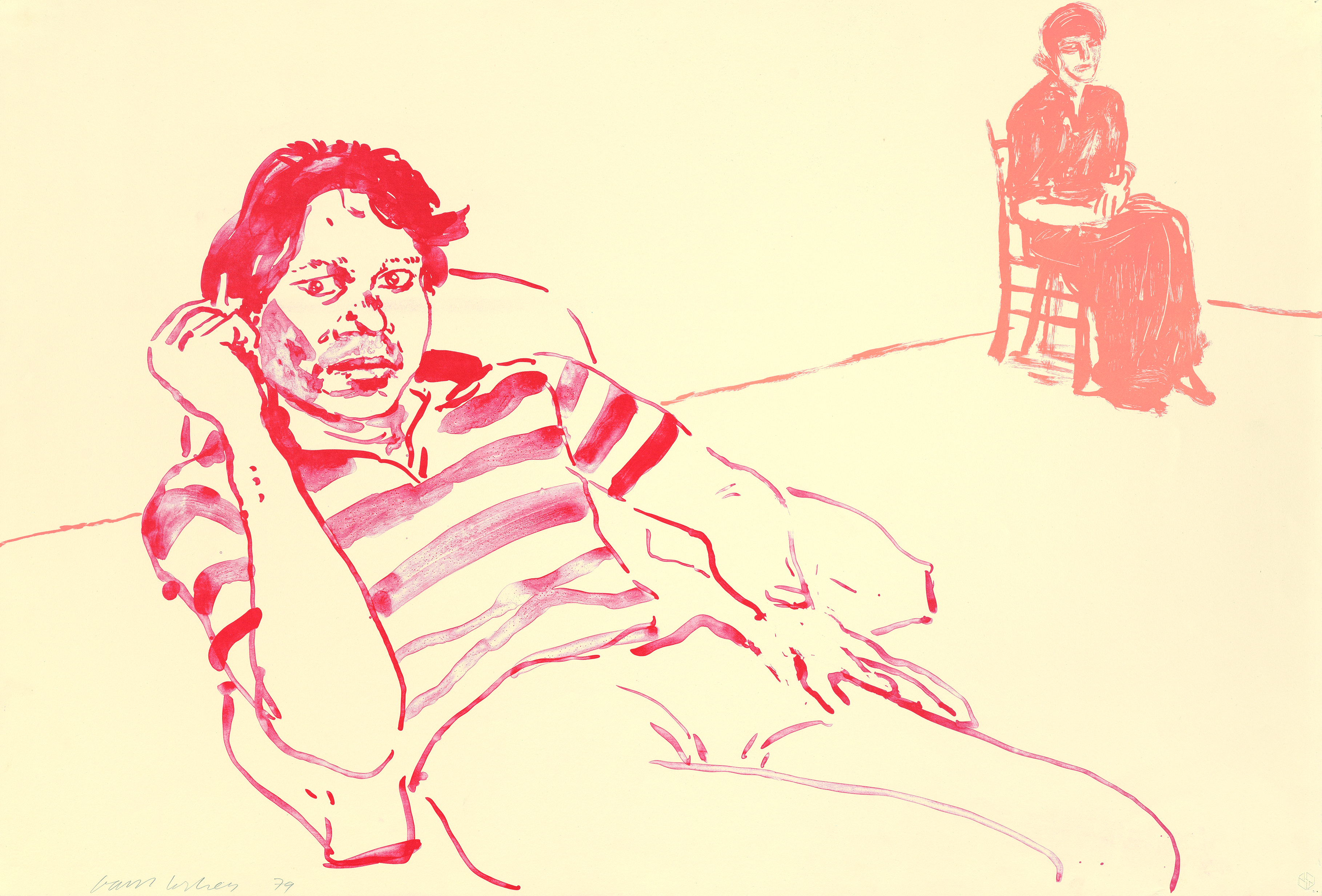


Hockney’s Multidimensional Art
Baitel hoped visitors would leave the exhibition with a deeper appreciation for Hockney’s art. “The gift of David Hockney and his art is that it is multidimensional: It is at the same time very personal and universal in themes and visual language,” he noted. The exhibition aimed to highlight Hockney’s mastery of shape, color, and perspective, allowing visitors to experience the emotional depth and contextual richness of his works.
A Personal Milestone
Curating this exhibition was a significant milestone for Baitel. “It is an honor to curate this exhibition together with Russell Tovey. A privilege and a challenge because of the importance of the work and the responsibility to get it right—to do justice to David Hockney, to the art, and to the audience,” he reflected.

Russell Tovey’s Connection
For Russell Tovey, a lifelong fan of David Hockney, curating the exhibition was a dream come true. He recalled his early encounters with Hockney’s work at the Tate Britain, saying, “I have been a lifelong fan of David Hockney, first seeing his works at a young age at the Tate Britain. Then discovering who the artist was behind some of the most iconic imagery of the 20th century, he has been an incredibly important constant in my development as both an art enthusiast and as a forty-something metropolitan man.”
Exploring Intimacy and Distance
The exhibition’s thematic pairing of Intimacy and Distance was particularly significant. Tovey explained, “The ‘Intimacy’ works capture personal moments and close relationships often in domestic scenes, reflecting affective closeness. The ‘Distance’ works here broaden the perspective in an exploration of space and environment, conveying a sense of observation and contemplation. What’s significant here for us and the audience is to witness how David Hockney balances personal connection with a broader artistic exploration—a duality of the personal versus the universal. We get to take a glimpse into his ever-evolving artistic journey and worldview.”
Hockney’s Ever-Evolving Techniques
Tovey also highlighted Hockney’s continuous experimentation with different mediums, including iPad art. “David Hockney has always embraced new forms of art-making and was one of the earliest adopters of the iPad for making art. I bet that he has already looked at artificial intelligence and how he might use it to make art. For ‘Paper Trails,’ we were lucky to have an assembly of stellar works on paper, an art form that is equal to any other. I hope our audience agrees with Hockney who is said to have expressed this very opinion.”
Inspiring the Next Generation
Tovey hoped the exhibition would inspire younger visitors, much like his early experiences with Hockney’s work inspired him. “To be invited to curate an exhibition on a real hero of mine and titan of the art world is a true ‘pinch me’ moment and brings a feeling of intense pride. To now bring these works into an exhibition for an audience in Shanghai feels like a historical and incredibly important moment, and I’m hoping that there will be some younger people, just like I was, who will now find the genius of David Hockney for the first time all for themselves,” he shared.
“David Hockney: Paper Trails” was more than just an exhibition—it was a transformative experience, offering a deep dive into the emotional and atmospheric mastery of one of the most important contemporary British artists. In addition to showcasing Hockney’s unmatched talent, the exhibition honored the significant influence of his work on a personal and a global scale. As Baitel aptly summarized, “This artist changed the art world and is one of the last giants of the Pop Art movement among us. I’m grateful for this challenge and I look forward to the feedback from the visitors of ‘Paper Trails.’”


Leave a Reply