Last updated on August 30th, 2024 at 01:22 pm
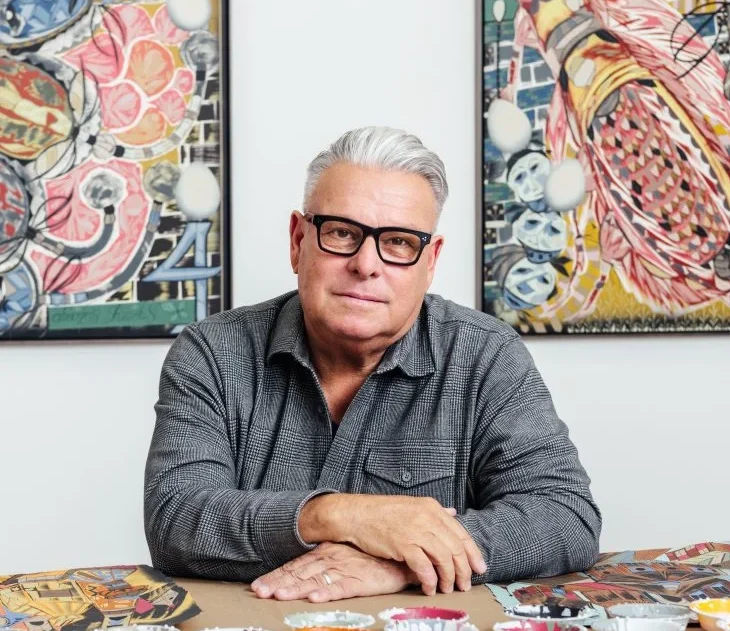
Lari Pittman is a celebrated American contemporary artist, renowned for his vibrant, intricate paintings that explore themes of identity, form, and social organization. Born in Los Angeles in 1952, Pittman’s unique style is deeply influenced by his bi-cultural upbringing, blending his Colombian and American heritage. His work, known for its complex layering of ethnicity, gender, and political history, challenges traditional artistic boundaries and invites discussions on social equity and the human experience.
Over the years, Pittman has gained significant recognition, with exhibitions in prestigious institutions like the Museum of Contemporary Art in Los Angeles, the Whitney Museum of American Art in New York, and the Hammer Museum. He has been honored with awards such as a Guggenheim Fellowship and grants from the National Endowment for the Arts.
Beyond his success as a painter, Pittman is also a respected educator, having taught at UCLA for over 30 years, influencing generations of artists. Today, he continues to push the boundaries of contemporary art, using his work to engage with important social, political, and cultural issues.
In this interview, conducted by Sreerupa Sil for The Neo Art Magazine, Pittman reflects on his journey as an artist, his deep connection with nature, and the influences that have shaped his unique perspective.
Interview:
Sreerupa Sil: You know, Lari, as I was preparing for this conversation, I found myself fascinated by your garden of cactus that I saw in some of your YouTube videos. What is it about cactus that draws you to them so deeply?
Lari Pittman: Well, I don’t have that garden anymore because I sold the house—it was just outside of Los Angeles. As I got older, I decided to move back into the city center. But when I had that cactus garden, it was more than just a collection of plants for me. There’s a long history of artists having gardens, and for me, the garden was deeply philosophical. It was about life and death, over and over again, a cycle that reflects the human experience. The cactus, in particular, is like a metaphor for both vulnerability and armor, a duality that resonates with me on a very emotional level.
Sreerupa Sil: That’s such an insightful perspective. When I think of a cactus, it also speaks to me of resilience—its ability to withstand harsh climates, much like your art that thrives despite various challenges.
Lari Pittman: Exactly. Even though I live in the city center now, I still start my day with a ritual of checking on my small garden. It’s something that grounds me, much like my morning routine in the studio. I’m very much a creature of habit and a morning person, which has always influenced the way I approach my art.
Sreerupa Sil: It’s interesting how your morning routines and the Californian light you grew up with have shaped your artistic ethos. Could you elaborate on how growing up in Southern California influenced your journey as an artist?
Lari Pittman: Growing up in Southern California was unlike any other place in the United States. The ethos here is progressive, socially liberal, and inventive. It’s a casual, laid-back culture that’s also the least Eurocentric part of America. This lack of European influence meant I wasn’t weighed down by the traditional art history that East Coast artists often grapple with. Instead, I was educated by feminist and revisionist historians who encouraged us to look beyond the official timeline of modern and contemporary art to include women, people of color, and the LGBTQ community. This inclusive view has deeply informed my work, especially in how I see my place within the art world.
Sreerupa Sil: That feminist influence is quite evident in your work, particularly with the recurring symbolism of eggs. Could you talk about the significance of this symbol in your art, especially in pieces like The Sparkling Cities?
Lari Pittman: For me, the egg is a metaphor for potential. It’s not just about life, rebirth, or purity; it’s about the immense possibilities that lie within. In The Sparkling Cities, the oversized eggs represent this potential on a monumental scale. Instead of traditional monuments to war or power, these cities celebrate potential—the potentiality of a culture. It’s a vision of what could be, rather than what has been, and I find that incredibly powerful.
Sreerupa Sil: That’s a fascinating approach. Speaking of potential and possibilities, how has your experience as a bicultural individual—being both American and Latino—influenced your artistic narrative?
Lari Pittman: Being bicultural has given me a unique vantage point. Growing up, I spoke Spanish with my mother and English with my father, which has profoundly shaped my cultural identity. Spanish, as a language, allows for more leaps of logic, hyperbole, and theater, which are all elements that influence the imagery in my work. This duality is something I cherish because it allows me to analyze and critique both sides of my heritage.
Sreerupa Sil: Your reflections on language are incredibly insightful. Now, during the pandemic, your work seemed to take on a more introspective tone, with a heightened focus on details like insects and other small creatures. How did the pandemic influence your artistic direction?
Lari Pittman: The pandemic was a strange time for everyone. As a traditional studio artist, I was fortunate to have my studio as a refuge. The series I worked on during the lockdowns, like the Iris Shots, was deeply influenced by the confinement we all experienced. The world became smaller, and we became hyper-aware of details—like insects—that we might have overlooked before. This heightened awareness of our surroundings made its way into my art, making it more introspective and contemplative.
Sreerupa Sil: It’s clear that the pandemic has left a lasting impact on all of us. In this four-decade-long career, have you faced any unexpected challenges that stand out?
Lari Pittman: One of the more challenging aspects of my career was dealing with the critical resistance to the decorative elements in my work. There was a time when the American art world, particularly the academic circles, viewed decoration with suspicion. It wasn’t considered serious enough, especially for male artists. But I’ve always believed in the power of beauty and decoration in art, even when it wasn’t widely accepted.
Sreerupa Sil: It’s wonderful to see how you’ve stayed true to your vision despite these challenges. As we wrap up, could you share what you’re currently working on and your thoughts on the rise of AI in the art world?
Lari Pittman: Right now, I’m finishing a series called The Remedy of Analog Space and Time, which features air balloons floating in a turbulent night sky. These paintings are about stillness and silence, a reflection of the analog time we were all forced to confront during the pandemic. As for AI, it’s unstoppable, and I see it as a tool with incredible potential. However, I also notice a resurgence of interest among young artists in creating with their hands—there’s something irreplaceable about that tactile connection to art.
Sreerupa Sil: Lari, thank you so much for this thoughtful and enriching conversation. It’s been a pleasure to explore the depths of your artistic journey, and I look forward to seeing how your work continues to evolve.
Lari Pittman: Thank you, Sreerupa. It’s been a pleasure speaking with you. I hope we get to meet in person someday.


Leave a Reply