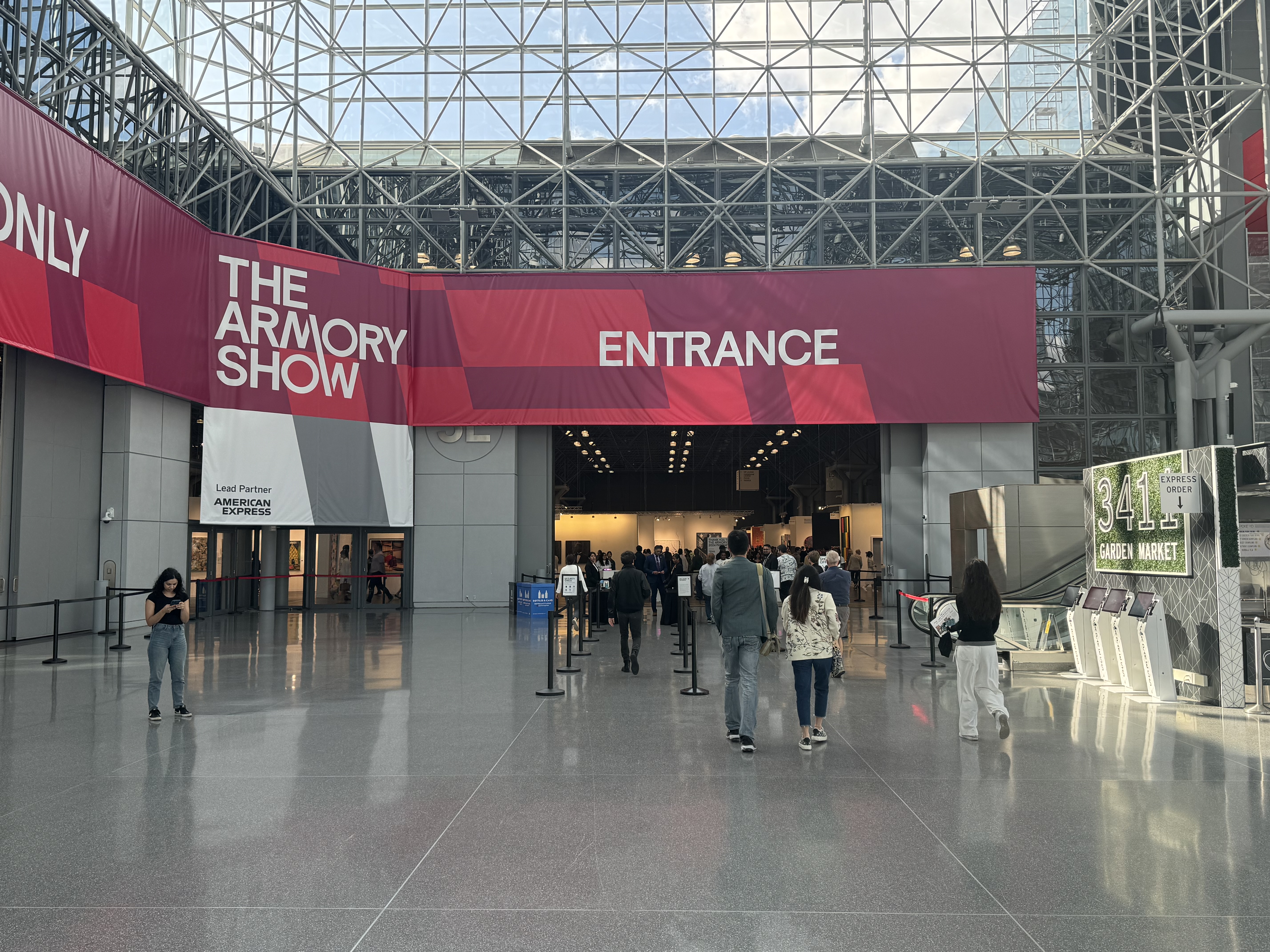
As the Re-evolutionary of Deconstruction exhibition drew to a close and the silence gave way to last-minute installations, crowds of shoppers, dealers, collectors, and advisors flocked to the Javits Center for the VIP opening of The Armory Show. Known as the “first day of school” for U.S. art during the harvest season, this event typically sets the tone for the season, but this year’s experience was markedly different. However, the excitement that comes with the process of rediscovery was sequentially produced by the forces of the world—inflation, instability, and war. Scene: An alarmed senior dealer, Hollis Taggart, spoke up, revealing that, contrary to her expectations, her clients had shown signs of fear. In numerous instances, The Armory Show served as a predictor of these developments, acting as a guide for the market to maintain its composure.
Despite the unpredictability of the weather, the first day saw robust sales. Morning sales left a range of prices, from emerging artist works to blue-chip ones with six figures. Despite external worries permeating every interaction, there appeared to be a continued appetite for purchasing in the art market. If such arbiters could be described during this period of partial prosperity, it’s none other than an attitude shift in expectations.
The Yield Woes
As one goes through the sales figures of this season, one thing that comes out is the notion of resilience—albeit a very pronounced one. Taggart’s gallery managed to offload a few other choice pieces, such as a Teruko Yokoi oil painting at $65,000, while Dana James and Hayoon Jay Lee managed to place their clients. However, these transactional activities also shed light on certain characteristics of the numerous collectors. Although the armory’s preview was somewhat reminiscent of the “good old days” in the sense that bidders rushed with their paddles up, this one was different. It was about skillfully grappling with the tricky economic situation.
One of the most famous sales during the preview was the purchase of Lynne Drexler’s Autumn Twilight (1977) for $450,000 by Berry Campbell Gallery. drecxler The market is currently in demand for Lynne, a midcentury painter whose rediscovery has gradually expanded in recent years. She is an underappreciated artist with immense historical value. As Christine A. Berry says, Yes, the market may be dull; however, this very dullness is bringing about a different kind of strategy—that of focusing on building up a portfolio of solid works worthy of museum collections that are not flashy or attention-seeking but are stable in value.” Prior to that, Berry advises some of her clients who are increasing their prices, saying, “If you are raising your prices and they don’t seem reasonable, then I don’t think people will buy any visions.”
This kind of conservatism speaks volumes about the current psychology of the art world. Kier, Ian. Although the auctions held in May left a certain degree of uncertainty, with experts mentioning disappointing totals and consignments quieter than most, there is still a predominant view that the market for works of art will not simply dry out. Still, this elasticity has its own boundaries. In the case of Megan Fox Kelly, the auction advisor, the general tendency to drop the total amount of art auctioned out, such as basing the possible figures on the past sales amount minus 10 to 20 percent, has become a “doom cycle” that creates unnecessary worries for all concerned. The point is not that the market is dead; rather, it is going through a phase of reconfiguration.
The shift in emphasis on physical works of art
Over the last few years, there has been a noticeable change from looking at art purely as a speculation to a more down-to-earth approach to art collection. This realism was evident during The Armory Show, where galleries and collectors favored quality over eye-catching circuitry. Robert Dimin, an art dealer, is quite pleased with the persuasive and optimistic aura or spirit of the brokers and sellers. With only a few bourgeons, one does not have such an unfructifying hope, because even though the art world is jittery, there is enough and more of the puzzle to put together for those for whom it is worth investing.
The turn towards realism, though, should not entail a pulling back from the high stakes inherent in contemporary art. Kasmin Gallery, for example, sold Robert Motherwell’s Apse (1980–84) for $825,000 during a preview showing of an art fair, proving that blue-chip artists, who have a powerful market history, still attract the market. In the same vein, Tang Contemporary Art sold an Ai Weiwei bronze figure for $450,000, confirming that even such works associated with political, economic, or ideological causes are still valuable. However, such sales clash with the quieter, more stable sales of emerging and mid-career artists. It’s not the wild whipsawing speculation of years gone by, but every one of these collectors is still buying, and clearly, the buying is happening with a lot more reasoned attention.
There is global uncertainty.
There may have been clear strength in the New York art market during September; however, the relative concept of stability that hangs over other global markets is not dismissable. As Sean Kelly made clear, the forthcoming presidential elections in the United States are very much on the minds of the buyers, creating a nervous environment. “The election is hanging over us all,” Kelly said. And although the fair itself appeared relatively peaceful politically, the works, such as Qualeasha Wood’s This is America, Season 248, Episode 45, have been exhibiting the cracks caused by sociopolitical issues in the art world.
The American market, which has been one of the world’s most resilient segments for several years, is now facing a new threat. Major players in the art world rallied behind Vice President Kamala Harris during the recent Democratic National Convention, providing a sense of stability. However, some collectors have expressed concern about her foreign policy stance, particularly in relation to the Gaza conflict. The question still stands: Will political and economic conditions cause the art market to experience further turmoil in the coming months?
What Happens After: The Frieze Effect
The 2024 edition of The Armory Show was also remarkable as it was the first year of the fair under Frieze ownership, one of the game-changing players in the art sector. There were apprehensions that, under the British management, the fair might lose its predominantly New York character, but there are indications this has not happened. Dealers voiced minor complaints about the logistical details of the event, prompting a reorganization of the setup to create and increase space for showcasing large-scale works in the room. Despite these minor complaints, there was a general sense of patriotism in anticipating a fair that would more closely align with Frieze’s ownership.
Nonetheless, as with the market itself, no one can tell how this new ownership will impact The Armory Show’s place in the U.S. art eco-system. Will the fair still be the “barometer” of the season once again, or will it already be just another piece of a rough game of fairs? At this time, the market appears to be trying to take a rest in order to wait for the next sequence of sales as well as political actions.
Conclusion: Cautious optimism
The Armory Show’s preview showed us an art market at the ‘brink’ of transformation. While the universe is still abundant with that kind of easy money, the overheated gun-slinging style that dominated the years prior to the pandemic is slowly transitioning to a more level-headed norm. Instead of emphasizing theatrics and dramatics, the focus is now on quality. As the drama in the aforementioned art world braces for its impending storms, it appears that its greatest weapon at this moment may not be pure unqualified will, but rather the prudent and slow building up of changing will.
It’s always difficult to predict the future, but the art world has experienced similar events in the past and more recently, so it’s likely that they will occur again.



Leave a Reply