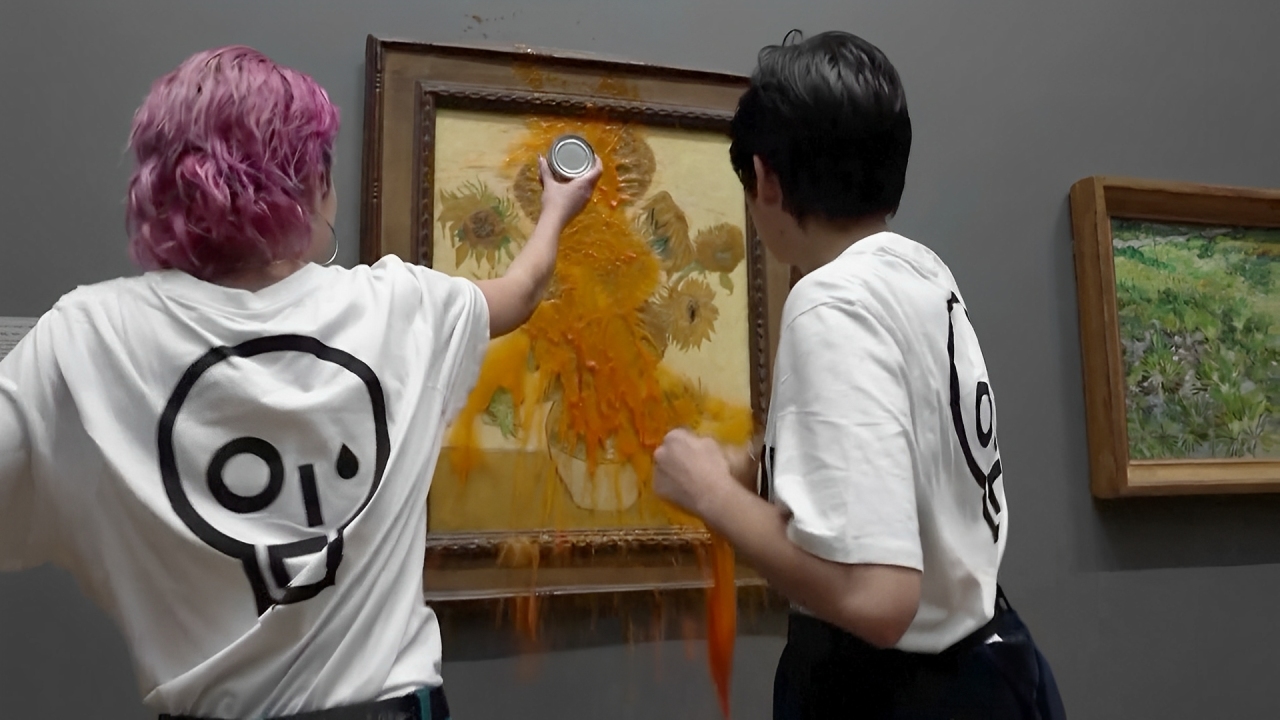
If we condense the year 2024 with its necessary elements, it would include drama, social activism, and art. As the New Year approached, not many could’ve fathomed that one moment set in a London art gallery would spark a major debate across the world. But that is exactly what unfolded when climate activists decided to soup attack Van Gogh, which in turn steered debates about cultural protection, climate urgency, and protest violence into the mainstream.
This story retells the narrative of 2024 events in respect to how one particular incident ignited a global discourse on the climate crisis and preservation of the global heritage of art. In a nutshell, we examine the online storm, institutional hurdles, and personal narratives all linked to this moment.
A Profoundly Unanticipated Start for 2024: Sweeping Together Art and Activism: The Events of One Fateful Day
It was mid of October and the year was 2024. The place was the National Gallery in London; tourists, and art lovers were roaming around aimlessly oblivious to the action that was set to happen. Two people clad in hoodies began walking towards one of the most recognized paintings, Sunflowers, created by Van Gogh. Out of nowhere, they appeared with two soup cans in their hands and started striking at the glasses protecting the painting.

Bystanders were amazed as the incident occurred, and phones managed to capture the whole event. Security guards came in large numbers to escort people out of the gallery while videos of the soup incident targeting Van Gogh went viral. It was only a matter of a few hours that this action became a trend across the globe with the help of specific hashtags related to the year 2024. Later, the activists declared that they were part of “Save Our World in 2024” and claimed that radical measures were required to ensure concrete action on climate issues.
The Wave of Social Media of the Year 2024
It took only a few hours into lunchtime for Twitter, Instagram and TikTok to go into a frenzy. The soup incident, Van Gogh and 2024 became widely discussed topics on multiple platforms. Questions began to arise whether 2024 should be protested against in a more extreme manner to avoid political apathy or whether it was right to do any of those for the sake of art.
It didn’t take long for comedy and sarcasm to follow. Users on TikTok chose to reenact the incident with a unique perspective and criticize other accounts that expressed their views on the boundaries of protest. News channels began to gather experts from different domains, such as art historians, environmentalists and ethicists, to hear what they believe in. Questions like, Could you ever justify an act of threatening artwork even if the intention behind it is for the sake of the planet and the future? were common. Everything, and I mean everything about 2024, had just begun.
Looking back at 2024’s overlying inquiry, Is Art More Important Than Life?
To put everything into perspective, one concern became a defining facet of 2024, and that is the question, “Which is more important—art or life?”. This is a question that was raised in response to the shouts and protests of guards taking protesters away, and it has evoked profound reactions on social media, with many users, journalists, and politicians taking sides or searching for some common ground in regards to it.
Climate activists worried about the collateral damage cultural objects might face due to the fight against climate change, while Normand 2024 claimed that all unrestrained ideologies needed to be suppressed in the year, especially with all the cut-down emissions deadlines that were set for that very year, as there were other dire alternatives that needed to be considered. Philosophers, on the other hand, disagreed and informed both sides of the rationality. However, during this time there was also one remaining question on everyone’s mind: “How do we tackle prioritization in such circumstances where one is constantly facing deletion?”.
In 2024, cultural institutions will face a paradigm shift.
Before 2024, idle, toned, feminized museums decorated with a rich history and embedding those centers would often regard themselves as separate from the social spectrum and as a zone dedicated to the tranquilization of thoughts. But as the environmental activist Splash Campaign for Climate Justice initiative creamed a can of soup on Van Gogh’s portrait, it turned out that even the reserved domains of art museums might be the next frontier of radical environmental action. The directors and the curators were suddenly being grilled for the reasons behind these drastic measures, as the fossil fuel-funded exhibition at the Smith exhibitions was the new sass.
What’s Next for 2024?
Security Reinforcements: Bagging checks and better training of employees have been proposed as a means to deter copycat acts of violence.
Sustainability Pledges: Numerous institutions implemented environmentally friendly objectives such as using less plastic, installing better lighting, and creating exhibitions that focused on climate-related topics.
Ethical Funding: Museum curators eliminated funding from potential donors whose history portrayed institutions in a negative public image, such as an active supporter of polluters.
Such actions were indicative of a growing sense of urgency because for the museums all over the world, this was the year that was not just another year; 2024 was the year of deeper response to global issues.
2024’s Global Reaction: From Applause to Outrage
People’s reactions from various parts of the world were distinctly different from one region to another. To regions that expected environmental protests and environmental protection, throwing soup at Van Gogh was just the latest act in a whole series of ‘I can’t believe this’ stories. Younger activists took to social media, claiming it helped create the needed outrage to push the issue of climate change. The reaction of older activists, conservators of works of art, and some politicians was that such a stunt was culturally incorrect and politically irresponsible.
Even politicians were divided. Some believed vandalism should be punished more severely now after seeing what happened in 2024. Others, who were more inclined in a green direction, claimed this was a good shock, an outcry that was needed. In the midst of the turmoil was the growing expectation surrounding international meetings scheduled in 2024 to deliver urgently needed and effective plans to minimize climate change.
Art as a Response: What Happened in 2024’s Museum Response
In the museum worldview, there was a heated debate about if 2024 was to be the year vending shops witnessed a bigger number of riots. Emails that were leaked unearthed concerns by curators about the staff, as front-liners had to deal with the conflicts of protecting irreplaceable artifacts alongside being considerate of the critical voices from the environment.
The soup attack was pivotal as it triggered quite an increase in the number of visitors. institutions were compelled to embrace some bitter conversations on the climate crisis and later opened some exhibitions and panels whose focal point was culture and sustainability. Towards the end of 2024, there was a bit more research and implementation into some of the more radical approaches as a pedagogical tool in the hope of diverting the attention from chaos into something constructive.
Reflections on 2024: Was the leaky soup aimed at Van Gogh a worldwide sensation?
Among the key talks of 2024, what took center stage was whether the soup aimed at Van Gogh had made the climate change movement more aggressive or only left people irritated for a short amount of time. There was a rise in donations directed towards environmental movements, along with many politicians increasing the number of climate commitments. But do critics, those in opposition, maintain that there has been no real change in government policies any time soon, and the food fight tactics have been a distraction from the real long-term goals?
Some Solid Results by September 2024
1. Activism: Polling indicated that there was an increase of focus on the climate, and the amount of people that cared about the climate increased greatly as well.
2. Policy Changes: Planes sorts put forth goals that sought to lower emissions systems and more investment into eco-friendly ideas.
3. Normalization of Debate: In the year 2024, topics that were previously considered as “extreme,” such as abolishing fossil-fuel subsidies, became a part of normal conversations.
Even then, political will and the consolidation of influence largely determine such alterations. The soup incident might be a one-off event, but it is likely to be an inflection point. However, resolving such issues permanently will necessitate broader participation.
Tales of People: 2024
There are personal stories that shadow 2024 that are equally important, if not more so. There was an Australian family who went to one of the Australian museums and were affected on one of the days, and one of the teenagers went on to become a member of a youth climate change group. There existed ordinary people and not just around-the-world climate change activists who were getting arrested with fake climate change protests. They themselves were embroiled in legal disputations as well and did not shy from saying that 2024 was a year for turning scripts on violence onto the people. One of the security guards who became popular on the internet with a video detailed how unsurely handling the abashing of people for dressing up in security guards with Mickey Mouse heads to attend a protest for a cause they believed in while filming the whole event was why he was being subjected to the abuse.
These narratives give a face to the news, providing evidence that soup that was thrown on the painting of Van Gogh in the year 2024 was lifelike and not just embedded on Facebook or on news platforms or news articles.
Looking Ahead: Post 2024
As 2024 came to a close, larger questions were still left unanswered. Could it be that museums acted now as political centers? Did it mean that a more normalization of attacks on paintings could be anticipated as well? Or could the new focus on climate actually lead to lasting change?
Most scholars opined that the upcoming years will reveal whether American exceptionalism for 2024 can be reflected in climate change laws across political divides and in the broader restructuring of societies. As a minimum, the soup attack on Van Gogh showed us that art and activism can combine in very disturbing ways, sending waves out of a gallery, unlike a soup.
The Story That Will Be Told of 2024
The attempt at throwing soup at Van Gogh is going to the one of the incident that defined the year 2024- a story that married love for culture to an impending disaster of environmental concern. It compelled millions, and I include: In the year of 2024, can both our cultural artifacts and the weak earth that nourishes us be saved? Or was it too far-fetched?
Come the end of year 2024, the year’s consensus was established; the notion of life vs. art as two choices was an illusion; life and art both deserve to be preserved. The activists’ tactics may be condemned, but the impact they achieved was hard to ignore—calls for action sparked conversations in museums, drafts in legislative rooms, and around family dinner tables. From here on out, the year of 2024 becomes an example of how constructive a single brave deed can make the world in understanding and adjustment of priorities where creativity, heritage and a sustainable environment are given equal importance.


Leave a Reply