
As all members of the art world come together for Paris Photo 2024, one name comes to be more familiar in the digital arena: Gretchen Andrew. Incorporating art techniques alongside the use of artificial intelligence and digital activism, Andrew’s art pieces have been known to raise many eyebrows; this is because they go against the basic principles of what is regarded as art today concerning identity, beauty, and power in the context of the globalized electronic world.
The Life Cycle of Gretchen Andrew’s Journey: The Sequence of Events
Being born in 1988 in Los Angeles makes Gretchen Andrew a perfect representation of the term’ ‘technology meets rtistry.’ While working as an apprentice for revered artists, Andrew has diverse life goals, as her professional career started off at Intuit as a software engineer and later at Google as a People Technology Manager. The tech giant careers allowed her to grow as an artist; she was always interested in the amalgamation of arts with technology and how perception could be altered through that.
She pursued further art careers and relocated to the UK following her encounter with Billy Childish. AI as a concept was in its infancy, so she used her understanding of oil painting techniques to create pieces that went against the norm.
Andrew’s transition from the tech industry to art does not only add a layer to her work but also makes her stand out. Instead of abandoning manual octets, as plenty of her compatriots, Andrew adopts a techno-centric approach in order to dominate the ones she used to labor inside.
Facetune portraits: making the lovely faces more beautiful
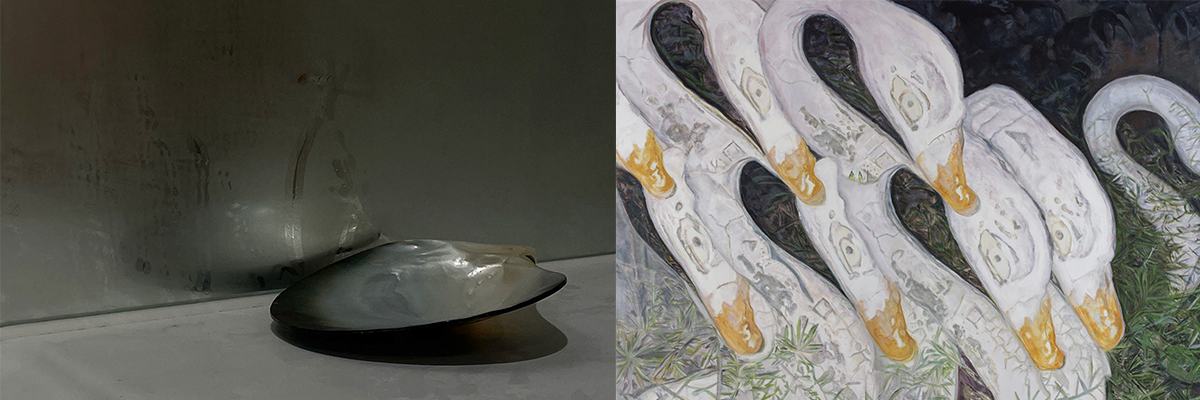
At Paris Photo 2024, Andrew presents her new series of working facitune portraits, which targets the negative transformations caused by the application of artificially engineered beauty models. Together with loincloths, Andrew uses programmed machinery and oils to reconstruct the remote aesthetic principles forecasted by the gadgets, therefore demonstrating how the industry creates and enforces the culture of sameness.

The Facetune Portraits series is a direct response to the disturbances caused by beauty-augmented models such as the Facetune app. Andrew’s paintings combine scars, stains, and algorithmic omissions, depicting the literal war between the true Lauren and the computer-generated Lauren.
“Facetune Portraits challenge viewers to consider what we lose when we conform to algorithmic definitions of beauty,” Andrew explains. “It’s not just aesthetics that are focused on, but an individual’s personality and uniqueness that are at risk of extinction due to the digital era.”
Paris Photo 2024: Stage of New Technologies
Paris Photo, which is the largest international exhibition focused on photography, has been the crossroads of ideas. Here, I would like to remark that the trends towards the marginalization of technology in art have applied to this year’s event as well, since the sector was included in understanding the digital arts. The works of Gretchen Andrew in this regard surely stimulate how the audience thinks and what questions contemporary art poses for them regarding AI and algorithms’ role in shaping the creative economy.

The presenter’s review of Andrew’s work at Paris Photo 2024 marks yet another important stage of her career development. Her work is not just about showcasing her technical and aesthetic skills; rather, it also allows her to spearhead the current debates on what the future of the arts will be, courtesy of the technological advancements.
Andrew’s work has been hailed by critics as a fine balance between artistic intellect and emotional depth. Comments made about her Facetune portraits range from ‘beautiful and haunting’ to being tossed into a boxing ring-style depiction of the tensions between the real and the virtual on a cosmopolitan scale.
Gretchen Andrew, The Search Engine Artist
Andrew has been known in the art space when she did Search Engine Art, where she had her artwork ranked in the top Google results for the Turner Prize and Whitney Biennial sites. This was extreme behavior, but it drew attention to the role technology plays in narrative making and broke the boundaries of gatekeeping in the art industry.

Her practice became an embodiment of being a rebel who never shies away from attacking the establishment. Andrew has had the privilege of showcasing at some of the most prestigious venues across the globe, including the Victoria and Albert Museum, the Monterey Museum of Art, and the Annka Kultys Gallery in London.
Solo exhibitions like her Growth Hacking in Dubai and Trust Boundary in Austria look more curious about the reason for CI and manipulation in the digital world and what the future holds for it. These exhibitions, alongside her participation in group shows such as “Female Pioneers of Digital Art” in Berlin and “The Lure of the Image” in Switzerland, have paved her way to becoming a notable artist in the Ivy League of the advocates of digital art.
An Original Thinker on the Usage of Art and Technology
Gretchen Andrew’s artistic contributions are not limited to her visual work as an art and technology discourse advocate; she has written for The Art Newspaper and A British Computer Society Journal, writing about issues from the ethics of AI to the use of digital technologies in new forms of creation.
She works actively in the areas of business and universities as a presenter and researcher. She has given talks at Cambridge, the University of Chicago, and at the Ars Electronica Festival in Austria. She has found greater audiences in both the art and the tech industries because of her ability to explain complicated concepts in layman’s terms.
The significance of the concept of Internet imperialism
Andrew describes her practice as being anchored on the art of “Internet Imperialism.” Andrew explains that by the use of digital means, she confronts the existing power relations underwriting the art world. She has produced works that subvert these systems and, at the same time, use these systems in the work through search algorithms and social media.
Her Turner Prize project “NOT NOT THE TURNER PRIZE” demonstrates Andrew’s artificial submission strategies. By nudging the online discourse around her work, Andrew’s project was transformed, gaining notoriety as a Turner Prize candidate, as well as raising probative questions of legitimacy, accessibility, and programmatic media.
How is Gretchen Andrew going to perform next?
After completing this complex task at the Paris Photo 2024, she is going to have an innovative list of projects. In 2025, she will also be part of the exhibition at Gray Area in the United States and the Mia Foundation in the city of Dubai, delving further into the concepts of AI, identity, and the digital zeitgeist.
At MatLabs, she perfects her work and also moves it to an outer world, especially in virtual and augmented reality. These ongoing explorations also extend her abiding interest in how emerging technologies can allow creators to go beyond the expected.
Gretchen Andrew’s perspective makes her one of the most captivating personalities of the modern art and technology era, as she works on projects in leading tech and art institutions that integrate both fields.
Why Gretchen Andrew’s Work is Important
Considering the implications of technology on every aspect of human life, the relevance of Gretchen Andrew’s work is remarkable. Her art encourages the audience to reflect on the algorithms and systems that govern them and the world. She attains this by employing analogue practices as well as advanced technology, thereby creating artworks that are visually striking and appealing to one’s senses.
Her attending Paris Photo 2024 reinforces her stature as an artist—not just the one who contemplates the digital age but also voices on it. Faced with the staggering effects of digital technologies and the ubiquitous presence of the virtual, Andrew’s Facetune Portraits challenges us to rethink what it means to be human.
As she continues to expand the definition of art in terms of technology, Gretchen Andrew’s work offers a critique but at the same time an endorsement of the digital age. Paris Photo 2024 is more than simply an exhibit for her; it is an introduction to what the future holds: an integration of art with numerous forms of technology and art tools that foster creativity.
In the case of art lovers but also tech dreamers, Andrew’s work is an inspiration that art, regardless of how the final product looks—even if it is in the most digital form—is still very much a human activity.


Leave a Reply