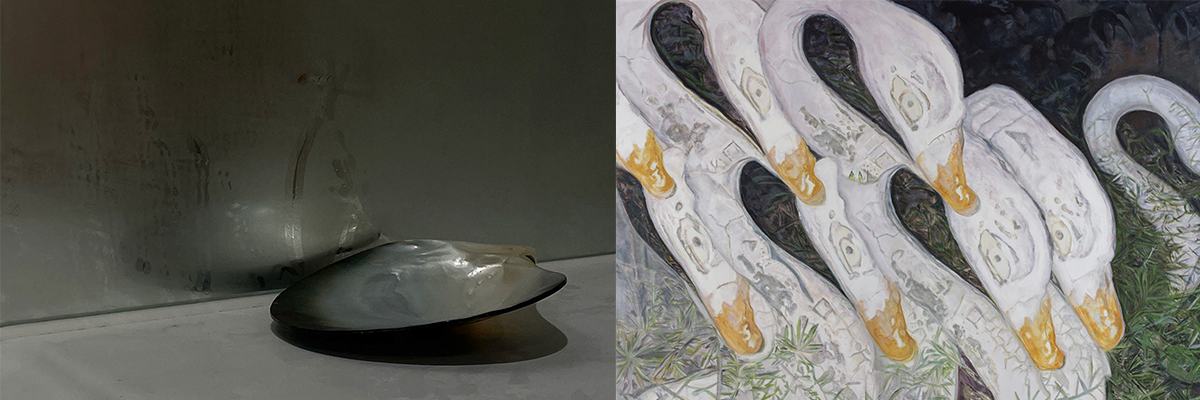
The Body Quotidian exhibition opens at Sharjah Art Foundation on 13 June 2026, bringing together recent works by London-based artist Laila Majid and Dubai-based painter Inaam Zafar in a quietly rigorous meditation on the body as it moves through ordinary life. Curated by Raja’a Khalid, Assistant Curator at Sharjah Art Foundation, the show occupies Gallery 6 at Al Mureijah Square and remains on view through 20 September 2026. It is, at first encounter, a deceptively simple proposition: two practices, one preoccupation. What emerges across the gallery, however, is a sustained inquiry into how light, latex, paint, breath, and steam register the body’s presence—not in heroic poses or sculptural ideals, but in the residue of a morning bath, the slump of a mourner, or the after-image of a hand passing through a curtain. The body, in this telling, is not represented so much as ambiently disclosed.
A Dialogue Between Two Sensibilities
The pairing announced by the Body Quotidian exhibition is not an obvious one, and that is part of its intelligence. Majid, trained at the Slade School of Art and in film aesthetics at Oxford, works in a vocabulary of latex, faux fur, UV printing, and Dibond mirror that pulls visibly from contemporary sculptural and photographic discourse in the United Kingdom. Zafar, a painter whose recent solo exhibitions in Karachi, Lahore, and Dubai have established him as one of the most patient image-makers working out of South Asia today, builds his canvases from layered washes that hover between figure and field. What stitches the two practices together—and what gives the Body Quotidian exhibition its curatorial spine—is a shared refusal to depict the body directly. Neither artist offers a portrait, a nude, or a clearly identifiable figure. Instead, both work in the register of trace, suggestion, and metaphor. The body is something that has just been here, or is about to be here, or is imperceptibly here behind a curtain of paint or a haze of steam.
Laila Majid: Mist, Latex, and the Tactile Image


The first room of the Body Quotidian exhibition introduces visitors to Majid’s particular form of slow revelation. Steam 07 (2026) presents what reads at first as a misted bathroom mirror—a fogged surface in which a fleeting image has been pressed by the warmth of a body just out of frame. The image is in fact a UV print on Dibond mirror, a technical choice that does considerable conceptual work. Because the substrate is reflective, the printed image is never fixed: ambient gallery light, the wall opposite, and the viewer’s own face all become part of what is seen. The work refuses to be photographed cleanly, refuses to settle into a single composition, and instead enrolls each viewer’s body onto its surface. The domestic moment it conjures—that brief vapor on the mirror after a shower—becomes a small allegory for how all images of the body are filtered through whoever happens to be looking.
Across the gallery, Blinds (2026) takes Majid’s interest in soft, semi-translucent skins to an architectural scale. The latex blinds are hung within the space and lit so that they cast a warm, faintly human-toned wash across the floor and walls. The reference to curtains, partitions, and bathroom screens is deliberate; so is the choice of latex, a material that holds an unavoidable bodily association. The effect is less a sculpture to be circled than an environment to be entered, and the result is one of the exhibition’s quieter triumphs: a room that feels, at a level below conscious recognition, as though a body has just left it. Majid is interested, here as elsewhere, in the threshold rather than the object—the moment of having just been seen, the moment of having just been touched.
The Chaser series (2025–ongoing) shifts register entirely. Crafted from faux fur, feathers, and tinsel and explicitly modeled on cat toys, these small sculptures introduce a frankly playful, even camp, vocabulary into the Body Quotidian exhibition. To read them only as decoration would be a mistake. The cat toy is one of the most disarming objects in domestic life: an instrument designed to provoke instinctual pursuit in a creature that cannot articulate desire. By scaling the form to the gallery and rendering it in luxe, theatrical materials, Majid asks viewers to consider how attention, attraction, and play operate in the body before they are named as such. The Chasers are the wittiest works in the show and, arguably, the most pointed. They identify desire as a quotidian condition rather than a heightened state—something we live in, not something that happens to us.
Inaam Zafar: Grief, Decay, and the Image That Will Not Settle


If Majid’s contribution to the Body Quotidian exhibition concerns the body as it inhabits domestic space, Zafar’s paintings press at the body as a perishable thing. Mourners (2026), commissioned by Sharjah Art Foundation specifically for the exhibition, is the anchor of his presentation. The canvas suggests a row of bowed forms, their contours half-resolved between figuration and pure abstraction. One reads them as hooded heads; one reads them as ceremonial vessels; one reads them, eventually, as both at once. The painting refuses to commit, and in that refusal it produces an unusually exact image of collective grief — the way mourners at a funeral begin to blur into a single, slow gesture of bending. Zafar achieves this not through dramatic chiaroscuro or expressionist gesture but through patient tonal work, the kind that asks a viewer to slow down and stay.
Zafar’s other works in the Body Quotidian exhibition extend this practice of strategic ambiguity. Untitled (2024) reads, on first encounter, as the interior of a tent: a soft, fabric-like enclosure rendered in muted tones. Stay with it, and the painting begins to feel less like shelter and more like containment, less like a domestic interior and more like a held breath. Bent Moon (2025) performs a similar slippage in the opposite direction, taking a perfectly ordinary street lamp — the kind that lines a residential block in any city in the world—and pulling it toward the celestial. The lamp becomes a moon; the moon becomes a lamp; neither reading wins, and the painting is better for it.
The most demanding work in Zafar’s contribution is To see and not see (2025). The composition initially registers as two medicine tablets resting on a surface, a still life of pharmaceutical banality. With time — and the exhibition is generous in providing it — a face emerges from the surface, stoic and embedded, as though the painting has been quietly watching the viewer for the duration of the encounter. The title is a precise description of how the work operates. Finally, Automatism of doubts (2026) gathers a circle of outstretched hands into a composition that withholds the bodies they belong to. The hands suggest a meal shared, a vote taken, a séance, or a prayer; the painting names none of these and authorizes all of them, leaving the viewer to assemble the social occasion from the gesture alone.
The Quiet Politics of the Everyday Body
It would be a mistake to read the Body Quotidian exhibition as a purely formal exercise. Both artists are working, in different idioms, against a contemporary visual culture that demands the body be legible, photogenic, and continuously available for capture. Majid’s misted mirror, her latex curtain, her cat-toy sculptures refuse the front-facing camera as a matter of method. Zafar’s mourners, his outstretched hands, his face that emerges only with patience refuse the algorithmic image entirely. Taken together, the works mount a quiet but substantial argument: that the body is most truthfully registered in the moments when it is not performing for visibility—when it is bathing, mourning, reaching for a cup, dimming the lights, waiting for someone to arrive. The exhibition does not announce this thesis from a wall text. It allows it to accumulate at the speed of looking.
There is also a geographic argument folded into the Body Quotidian exhibition that deserves attention. By placing a London-based artist in dialogue with a Lahore-trained painter now working out of Dubai, the show resists the easy oppositions — center and periphery, contemporary and traditional, conceptual and painterly—that too often structure exhibitions of this kind. Both artists work with the body’s residue; both work in a register of restraint; both are exactly contemporary in their concerns. The dialogue between them is genuine rather than staged, and the curatorial choice to let it unfold without footnoting the geographies involved is one of the show’s subtler strengths.
Curatorial Framing and Foundation Context
The Body Quotidian exhibition is curated by Raja’a Khalid, assistant curator at Sharjah Art Foundation, whose framing of the show resists the temptation to oversignify. The wall texts are spare; the works are given room to breathe; the sequence allows Majid’s domestic interiors and Zafar’s bowed figures to call to each other across the gallery without forcing the conversation. Khalid’s curatorial instinct here is closer to that of a translator than an interpreter—a faithfulness to what each work is actually doing rather than a hurry to tell the visitor what to feel.
That curatorial generosity is consistent with the foundation’s broader program. Established in 2009 to extend the work of the Sharjah Biennial, which has been running since 1993, Sharjah Art Foundation has built an international reputation for supporting contemporary artists at the level of production—commissioning new work, hosting residencies, and underwriting research — rather than merely circulating finished objects. The commission of Zafar’s Mourners specifically for the Body Quotidian exhibition is a small but characteristic gesture in that pattern. The Foundation operates under the leadership of Hoor Al Qasimi, who serves as President and Director, and maintains a policy of free admission to all exhibitions, a policy with real consequences for who feels licensed to enter a contemporary art gallery in the Gulf and who does not.
The Artists

Laila Majid. Image courtesy of the artist and Niru Ratnam
Laila Majid graduated from the MA Fine Art program at the Slade School of Art in 2021 and holds an MSt in Film Aesthetics from the University of Oxford, completed in 2022. She is represented by Niru Ratnam in London, where her work has recently been the subject of presentations at Le Wonder in Paris (2026), Tala in Chicago (2025), Niru Ratnam in London (2024), Rose Easton in London (2022), and Fotografiska in New York (2022). In 2021 she was selected for Bloomberg New Contemporaries, with exhibitions at South London Gallery and Firstsite, Colchester. She lives and works in London.

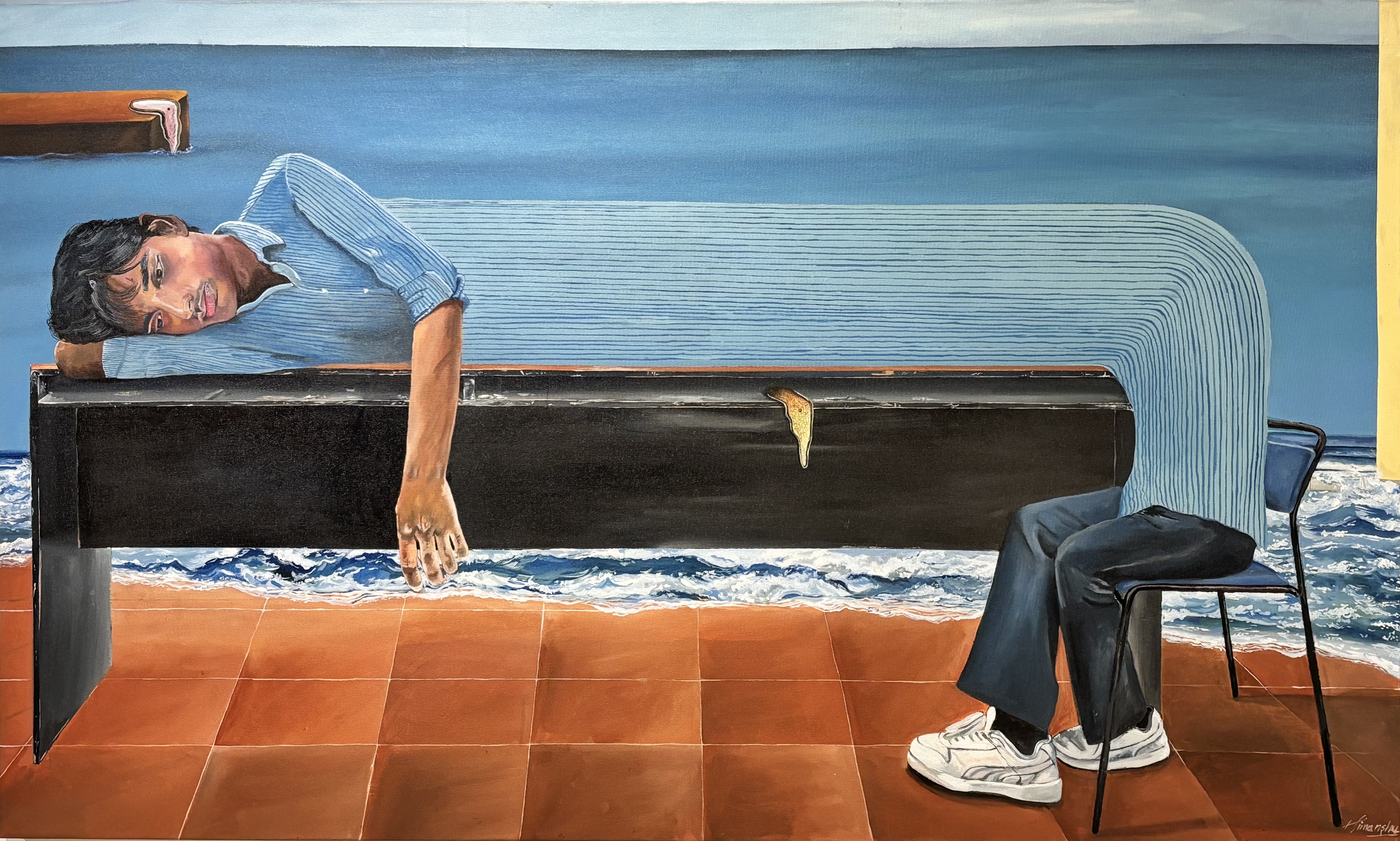
Inaam Zafar is a painter and visual artist whose practice coheres around what might be described as a poetics of time, memory, and material residue. His sustained interest is in how images and elements decay, endure, and reconstitute themselves across personal and collective histories. Recent solo exhibitions include The dust, too, is replete at Grey Noise, Dubai (2024); Without at Sanat Initiative, Karachi (2017); and so long as it’s grey at Rohtas II Gallery, Lahore (2015). He is represented by Grey Noise, Dubai.
Visitor Information
The Body Quotidian exhibition is on view at Gallery 6, Al Mureijah Square, Sharjah, from 13 June to 20 September 2026. Admission is free, and the gallery is open to the public throughout the run of the exhibition. Further information, including programming associated with the show, is available at sharjahart.org. For visitors planning a trip to the Emirate, the exhibition pairs naturally with the Foundation’s wider seasonal program across Al Mureijah Square and the surrounding historic district, which has been progressively repurposed over the past decade and a half as one of the most considered contemporary art neighborhoods in the Gulf.


Leave a Reply