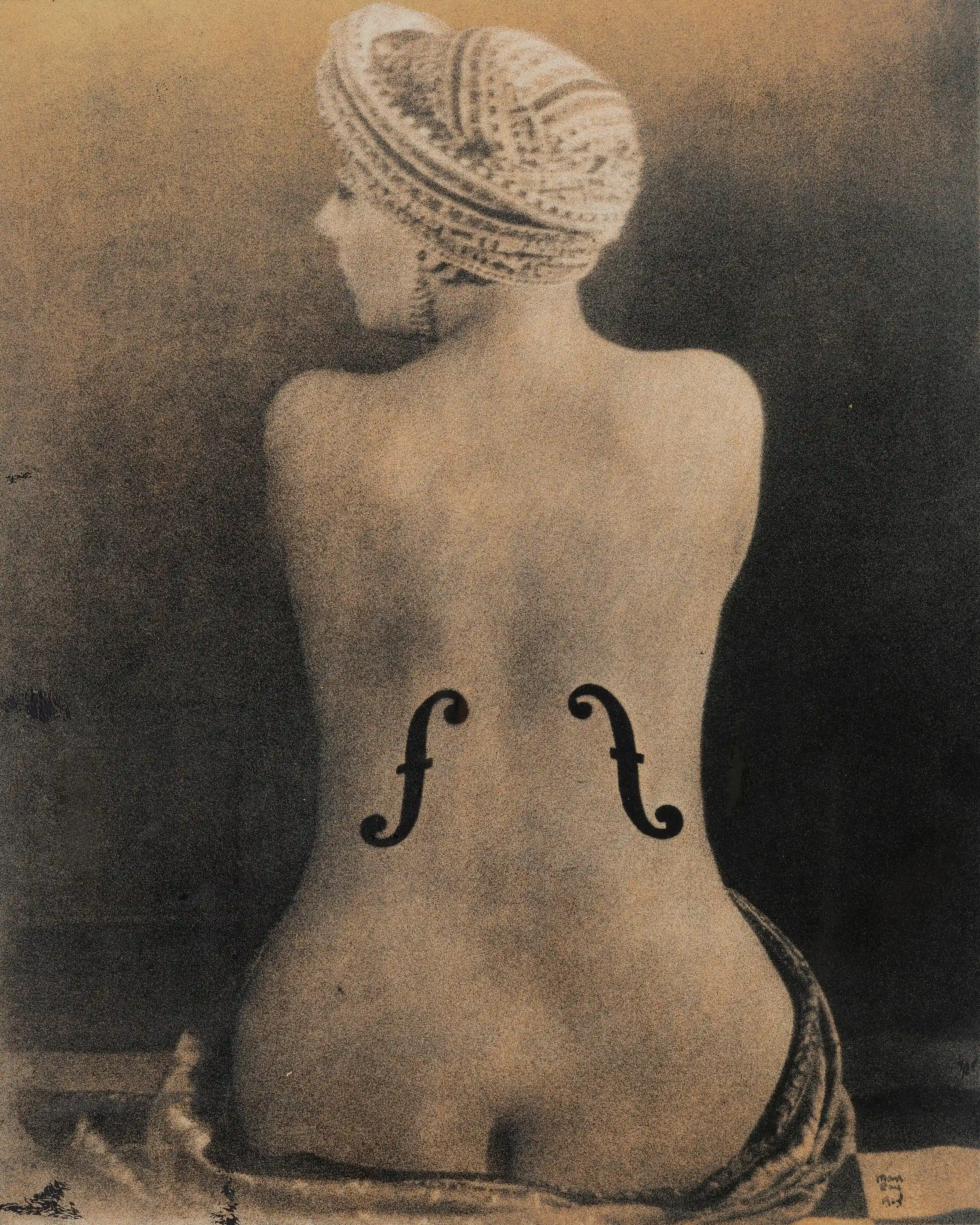
A black-and-white portrait of Kiki de Montparnasse by Man Ray depicting her with violin-shaped sound holes painted on her back is one of the most iconic surrealist images. Produced in 1924 and autographed by the American artist, Le Violon d’Ingres became the most expensive image in 2022 when it fetched $12.4 million (£9.8 million) at Christie’s auction in New York. In a Paris auction of two hundred Man Ray works spanning his whole creative career, including three prints produced in 1970 from the original negative, one of these pieces was sold on Thursday. The collection belonged to a close friend of Man Ray’s. Man Ray oversaw the production of the Violon d’Ingres print. A fierce auction resulted in a sale of the image for €120,000 (£102,000), more than twice the catalogue estimate of €40,000-€60,000.

Several of Man Ray’s photographic prints did not sell, even when the auctioneer set their lowest estimates at a high level for his paintings, drawings, and sculptures. More than five and a half hours passed during the auction, and an estimated €3.65 million (£3.19 million) was raised. Several self-portraits and others portraying prominent literary and artistic luminaries, such as Jean Cocteau, Louis Aragon, Pablo Picasso, James Joyce, Elsa Schiaparelli, and Catherine Deneuve were among the other images that went under the hammer. Marcel Proust was also included, as was the late James Joyce. According to Elodie Morel-Bazin, the European head of photography at Christie’s, the breadth of the artwork up for auction was “marvelous,” and she went on to say, “There isn’t any other complete collections representing the whole range of Man Ray’s work like this and it’s the first to be sold by someone who actually knew him.” “It delves into every aspect of his life, from the methods he employed to the artwork he created.”
“He wanted to use a different technique so it’s completely different from the 1924 vintage print but is still one of the most iconic images in the world,” Morel-Bazin said of the Violon d’Ingres print.
After meeting May Ray in Paris in the 1960s and becoming close with him, Marion Meyer—now president of the International May Ray Association—accumulated the collection. After Man Ray and Juliet’s 1951 return from Hollywood, they made their home in the Latin Quarter’s converted sculpture workshop. The artist’s editor, best friend, and chess partner, Marcel Zerbib, was Meyer’s husband. The things she cherished and want to save were Man Ray’s paintings, objects, and sketches, which were not as sought-after as his photography, she said.Man Ray, whose real name is Emmanuel Radnitzky, was born in Philadelphia. He began his career in American modernism in the 1910s and lived in New York and Paris for a decade before dividing his time between the two. His extensive career covered photography, painting, sculpture, sketching, and other media; he passed away in Paris in November 1976. The surrealist publication Littérature, headed by André Breton, first published the original image of Le Violon d’Ingres on its cover in June 1924. The artist Jean-Auguste-Dominique Ingres captivated Man Ray; the shot alludes to the artist’s love of playing the violin in his spare time and his languid nakedness. French for “hobby,” “le violon d’Ingres” is an idiom.

The actual sales prices for some of the lots much exceeded the catalog estimates. A chess set that was priced at €30,000 sold for €160,0000, while a Pain Peint (painted bread) sculpture with two blue baguettes that was advertised at €30,000 sold for €140,000. Over double the estimate, a 1968 gelatin silver print of Deneuve wearing Man Ray earrings garnered €32,000. In contrast, a print of a self-portrait from 1924 just managed to get €5,000. The main piece of the auction, the 1937 picture Maime quand i qua domi i qua ri, sold for €160,000, which is €40,000 less than the maximum estimate.
A deluge of inquiries for Man Ray’s work certification flooded Juliet after his death. Meyer, the artist’s chosen caretaker for his wife, established the worldwide organization to record his work. “It has been an enormous project, but it is done now,” she said. “There is very little out there that we don’t know about.


Leave a Reply