
In the 1960s, while the world was basking in the glow of post-war economic growth, Air India stood out. The airline made a significant cultural impact and aimed to impress the world with its unique designs. To stand out from other airlines, they branded the airline “the symbol of India.” For this vision to materialize, Air India required something that completely rejected traditional tributes: a work of art that would entice people’s imaginations and elevate flying to an exceptional level. Enter Salvador Dali.
He began in a French accent and yelled, Bury an elephant in the sand, and no one expected what was to come; I certainly did not. This is the chronicle of how an outlandish request culminated in one of the strangest in modern history and virtually impossible exchanges between the Great Dali and Air India.
Air India made for amusement when they proclaimed that they could have their elitist ashtrays created by renowned sculptor Salvador Dali. Dali, of course, was a flamethrower, and with Air India seeking business with an elitist class of abstracts, there would of course be peculiarities, most notable of which is the awkward request Dali instead made: To have an ashtray designed, please furnish me a baby elephant and a stamp and seize from coughing up money, a caricature of bald circles one would assert. It wasn’t Dali who did Dali.
For Salvador Dalí, the elephant was more than an exotic animal. It was a source of interest for him, a sign that adorned his fluid and dreamy paintings. To Dali, the elephant’s impressiveness and weight complemented the tall and thin legs of the animals he painted, which were supposed to be surreal and contradictory. But then a young elephant also brought out cuteness and a vulnerable perspective. In his own words, he famously declared, “I am not strange; I am just not normal.” And as one might expect, he had decided to seek out the most unconventional type of compensation the mind could fathom.
Air India’s Interesting Move…
Dali’s placing such a demand and Air India quickly satisfying it is interesting in itself and quite bold. Some would find the transport of a live animal from one continent to another a breach of sense, let alone a business idea, but Air India took it as a bold chance to promote their brand as trendy. They took pride in their ambassadorial role for India, making it clear that they were not just an airline but also representatives of Indian culture, creativity, and hospitality.
In order to comply with Dali’s request, Air India imported a baby elephant from Bangalore to Gujarat, which was to be given to the artist. This gift was not just about business and brought to light Air India’s maverick mindset, marketing in itself and huge pliancy in both clients and culture. At a time when airlines were using all the same marketing strategies over the years, Dali’s gift to Air India was an act of unparalleled imagination.
The Ashtray: Art in the Ordinary
The resulting artistic piece turned out to be an elaborated ashtray that perfectly encapsulated Dali’s extravagant surrealistic style—designed as a tiny statue of a shell twisted together with a snake. Dali used to amaze everyone with his never-ending urge to stare at the ocean and the creatures and symbols that even challenged the world of imagination. The design beautifully combined grace and quirks, and Dali’s touch was meant to encompass a passion for traveling alongside smoking, which was much more of a practice than a necessity back then.

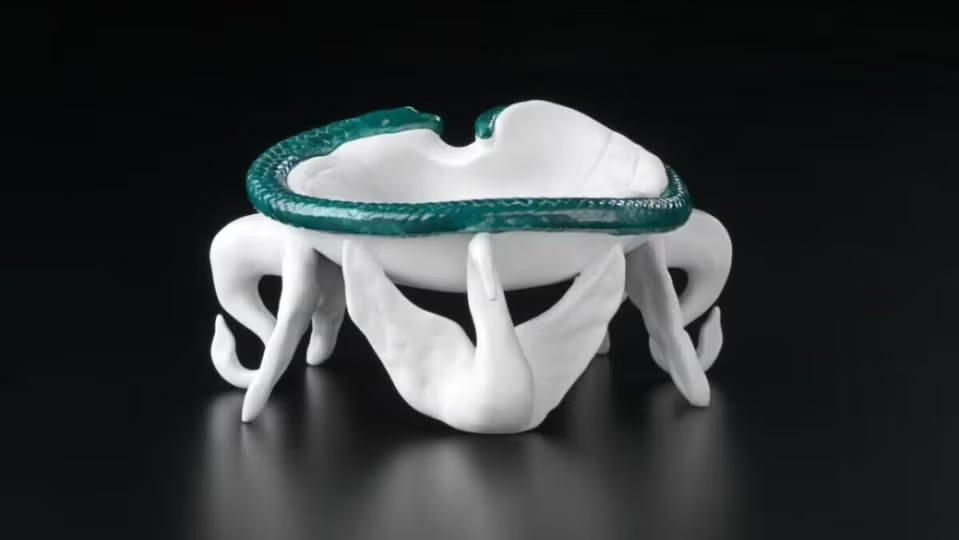
During the 1960s, cigarette smoking during flights was regarded as an extravagant affair. Travelers who paid for the first and business classes were under the impression that ashtrays were as upscale as any other item that was offered on the flight. Its purpose was more than as an accessory. In flight, the Salvador Dali® ashtray was a statement piece of sorts, aiming to capture the spirit of Air India’s greatness—the marriage of fine art to the experience of travel. Therefore, for those who owned it, it became not only a collector’s item but also a small piece of surrealism, a glimpse into the imagination of one of the most daring artists on Earth.
The Arrival of the Elephant: A Surreal Scene in Spain
Just like Dali, the arrival of an infant elephant to Dali’s villa in Spain was a sight to behold. It was quite the attraction to see Dali guiding the young elephant around his estate. People from all walks of life—tourists, reporters, and locals—were eager for these happenings. It was as if they were spectators to the latest chapter of the artist’s remarkable life. So, in a sense, that elephant was also an extension of Dali’s world—an embodiment of all that is surreal, an inhabitant of his dreams made real in the garden of his heart.
The loxodonta became part of the local lore thanks to Dali, who named his baby elephant after the African genus of elephants. Tourists reported that it was amusing but quite baffled the way Dali’s other animals did, notably pet ocelots and anteaters; Dali kept it among his other weird pets. This real baby elephant was an oxymoron and lived up to Dali’s other vivid depictions of baby elephants with “ankyloid’ legs: the heaviness of existence paired with the insouciance of humor.
Dali thinks life is meaningless and admires the elephant.
The imagery of the loxodonta featured quite heavily in Dali’s works. He believed the animal, like himself, possessed many contradictions—the belief that it was central to his narration. Dali envisioned the same vision in his head of his new creation with the use of slender, narrow legs, further accentuating the deep sense of irony, courage coupled with unsteadiness, and security easily replaced with unfurling into the sky. He defined elephants as wise ancient beasts who possess strength along with a surreal stature.
With the request for a baby elephant from Dali, he was expressing his interest in the absurd in a real way. This was not just a random idea, but a theatrical, performative art. The baby elephant, on the other hand, was formulated from Dali’s artistic obsessions and served as a link between the real, the surreal, the abstract and the concrete.
Air India’s Brand Legacy: Making Marketing an Art
This partnership between Dali and Air India was not just a well-crafted advertisement; it was a revolutionary idea about what a brand could be. According to Dali’s imaginings, Air India embraced Dali as their artistic counterpart instead of seeing him merely as an asset, which was, as Air India’s director put it, outstanding ambassadorial common sense. It was a unique case when artist and brand to the dot coincide in their vision—Dali the surrealist explorer, Air India the cultural pioneer.
This ashtray was not just a goal of the in-flight services. Additionally, it established Air India as a company willing to explore new frontiers, whether it was catering to affluent international travelers or collaborating with innovative artists. Today, it is a norm to have branded knick-knacks in a flight, but few can match the adventure that was instigated by Air India’s decision to request Dali to do a design, leave alone the subsequent unusual gift swapping.
Dali’s Legacy and the Art of the Unexpected
The story of Dali and the baby elephant of Air India reveals a fundamental aspect of Dali’s philosophy—that art and life seem to have fun in them, and at times even mystify. In this era of brand mass commercialization and their obsession with order and gains, Dali’s collaboration with Air India stands as a wonderful example of the artistic association at its most whimsical. Sometimes the strangest interactions create the best legacies.
The ashtray, a sought-after item today, testifies to this reality. It serves as a subtle reminder of an era in which artists worked with businesses while retaining their distinctiveness. He designed an elephant table and an elephant ashtray, fashioning two trivial objects into modernistic collectibles. And so Air India, indulging his oddity, became part of history, forever labeled as the company that offered Dali an elephant.
Looking back, we can learn from the partnership between Salvador Dalí and Air India about how to best deal with the unexpected. The surrealist movement was centered on violations of conventions, about all trends being pushed, and much more exploitation of the focus plane. For Air India, it was not simply Dali’s celebrity that they sought after—they appropriated his philosophy, making the brand a surrealist advocate of international travel.
This may sound incredible, but that’s probably what makes it sound appealing. In our civilization, where most of us look at whatever we do in terms of utility and benefits, there is space for the absurd, the odd, and the irrational. There are not many real-life examples that come close to what Salvador Dalí and Air India presented us with—an elephant calf, an ashtray, and a story that still intrigues many years on.
What can be said about the baby elephant? I guess it grew up, like every other living being, but the story remains, a chunk of Salvador Dali’s surreal and, at the same time, outlandish view of life birthed back. But Dali’s ashtray remains a symbol, holding true the notion of impersonating all arts and aviation together with the idea of sheer fantasy. It highlights that even the unlikeliest of transactions can establish a deep connection that is borderless, cross-industrial, cross-time, or even cross-realm.

Leave a Reply