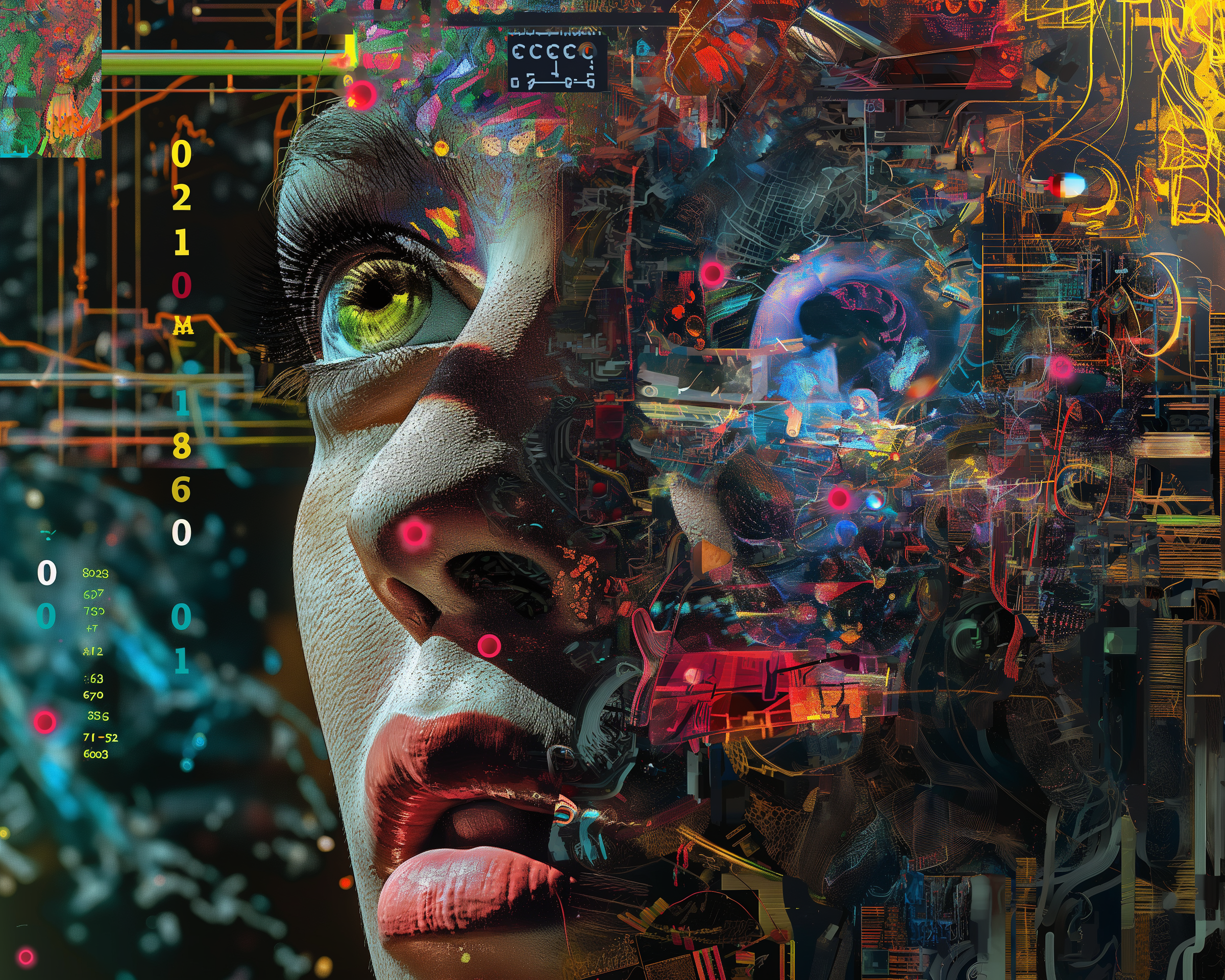
In recent years, a fascinating intersection between technology and creativity has emerged, giving rise to a new form of art that is reshaping the boundaries of artistic expression. Code-generated art, also known as generative art, leverages algorithms and computational processes to create complex, mesmerizing visuals that would be nearly impossible to produce manually. This article delves into the origins, techniques, and impact of this innovative art form.
Origins and Evolution
Early Beginnings: The 1960s and 1970s
The roots of code-generated art, also known as generative art, can be traced back to the early experiments of the 1960s and 1970s. During this period, the idea of using computers for artistic purposes began to take shape, driven by the work of a few pioneering artists and computer scientists.
Frieder Nake and Georg Nees
In the mid-1960s, German mathematician and artist Frieder Nake created some of the earliest examples of generative art. His work involved programming a computer to produce abstract images based on mathematical algorithms. Nake’s approach was systematic, focusing on the interplay between randomness and order, which became a hallmark of generative art.
Around the same time, fellow German Georg Nees was also exploring the possibilities of computer-generated art. Nees, who worked at Siemens, used a Zuse Graphomat, an early plotter, to create a series of artworks that were exhibited in one of the first computer art exhibitions in 1965. These early works laid the groundwork for future explorations in the field.
Harold Cohen and AARON
One of the most influential figures in the early history of generative art is Harold Cohen. An English painter turned computer scientist, Cohen developed AARON, a pioneering art-producing program, in the late 1960s. AARON was designed to create drawings autonomously, and over the decades, Cohen continued to refine and enhance its capabilities.
AARON’s significance lies in its ability to produce art that not only followed a set of programmed rules but also exhibited a degree of creativity and variation. This highlighted the potential of algorithms to generate complex and aesthetically pleasing artworks, challenging traditional notions of artistic creation.
The 1980s and 1990s: Technological Advancements
The 1980s and 1990s saw significant advancements in computer technology and software, which greatly expanded the possibilities for generative art. Personal computers became more powerful and accessible, allowing a wider range of artists to experiment with code-generated art.
The Role of Processing
A major milestone in the evolution of generative art was the development of Processing, a programming language and integrated development environment (IDE) created by Casey Reas and Ben Fry in 2001. Processing was designed to make coding more accessible to artists and designers, providing a user-friendly platform for creating visual art.
Processing democratized the creation of generative art, enabling artists with little to no programming background to explore algorithmic art. Its open-source nature and extensive documentation fostered a vibrant community of users who shared their creations and collaborated on projects.
Fractals and Chaos Theory
The 1980s also saw the emergence of fractal art, inspired by the work of mathematician Benoît B. Mandelbrot. Fractals are complex, self-replicating patterns generated by iterating simple mathematical formulas. The Mandelbrot set, one of the most famous fractals, became an iconic symbol of the intersection between mathematics and art.
Chaos theory, which studies the behavior of dynamic systems that are highly sensitive to initial conditions, also influenced generative art during this period. Artists began using algorithms based on chaos theory to create intricate, evolving patterns that mirrored natural phenomena.
The 2000s and Beyond: Integration with Technology
The 21st century has seen an explosion in the popularity and diversity of code-generated art, driven by rapid advancements in computing power, artificial intelligence, and digital tools.
Interactive and Real-Time Generative Art
Modern generative art often incorporates interactivity and real-time elements, allowing viewers to engage with the artwork in dynamic ways. Tools like JavaScript and WebGL enable artists to create interactive installations and web-based generative pieces that respond to user input or environmental data.
Artificial Intelligence and Machine Learning
Recent developments in artificial intelligence (AI) and machine learning have opened up new frontiers for generative art. AI algorithms, such as Generative Adversarial Networks (GANs), can learn from vast datasets of existing art to produce entirely new works. This has led to the creation of AI-generated art that often blurs the line between human and machine creativity.
NFTs and Digital Ownership
The rise of blockchain technology and Non-Fungible Tokens (NFTs) has also impacted the world of generative art. NFTs provide a way to authenticate and sell digital artworks, giving generative artists new avenues for monetization and ownership. High-profile sales of NFT-based generative art have brought significant attention to the field, highlighting its growing cultural and economic significance.
Techniques and Tools
Code-generated art, also known as generative art, is a creative process that leverages algorithms and computational methods to produce intricate and often unexpected visual artworks. This art form encompasses a variety of techniques and tools that artists use to translate code into stunning visuals. Below, we explore some of the key techniques and tools that define this innovative field.
Techniques
1. Algorithmic Art
Algorithmic art is the foundation of generative art. It involves writing algorithms that define the rules and processes for creating images. These algorithms can range from simple mathematical formulas to complex systems that mimic natural processes.
- Procedural Generation: This method uses algorithms to generate data algorithmically rather than manually. It’s commonly used in video games and simulations to create vast, intricate worlds.
- Iterative Processes: Algorithms that repeat a set of instructions multiple times to gradually build up a complex image. This can include loops and recursive functions that add layers of detail with each iteration.
2. Fractals
Fractals are complex, self-replicating patterns generated using mathematical formulas. They are characterized by their infinite detail and self-similarity across different scales.
- Mandelbrot Set: One of the most famous fractal sets, generated by iterating the equation z = z^2 + c. The resulting images exhibit infinite complexity and are a staple of fractal art.
- Julia Set: Another type of fractal, similar to the Mandelbrot set but generated using a slightly different formula. Julia sets can produce a wide variety of intricate and unique patterns.
3. Cellular Automata
Cellular automata are mathematical models consisting of a grid of cells, each of which can be in one of a finite number of states. The state of each cell evolves over time based on a set of rules that depend on the states of neighboring cells.
- Conway’s Game of Life: A well-known example of cellular automata, where simple rules governing cell birth, survival, and death create complex, evolving patterns.
- Langton’s Ant: A cellular automaton in which an ant moves on a grid, turning left or right based on the color of the cell it encounters, creating intricate paths and patterns.
4. Particle Systems
Particle systems simulate natural phenomena by modeling the behavior of thousands of individual particles. Each particle follows rules that govern its movement and interactions, creating dynamic and fluid visuals.
- Fire and Smoke Simulations: By controlling the behavior of particles representing flames or smoke, artists can create realistic and mesmerizing effects.
- Flocking Behavior: Algorithms that simulate the collective movement of a group of particles, mimicking the behavior of flocks of birds or schools of fish.
5. Genetic Algorithms
Genetic algorithms use principles of natural selection to evolve images over time. Starting with a population of random images, the algorithm selects the most aesthetically pleasing ones and combines their attributes to create new generations of images.
- Fitness Function: A key component of genetic algorithms that evaluates the quality of each image and guides the selection process.
- Mutation and Crossover: Techniques used to introduce variation and combine features from different images, simulating the process of genetic recombination.
Tools
1. Processing
Processing is an open-source graphical library and integrated development environment (IDE) created by Casey Reas and Ben Fry. It is designed to make coding accessible to artists and designers.
- Simplified Syntax: Processing uses a simplified version of Java, making it easier for non-programmers to learn and use.
- Extensive Documentation: A rich repository of tutorials and examples that help users get started with generative art projects.
2. p5.js
p5.js is a JavaScript library that brings the principles of Processing to the web. It allows artists to create interactive generative art that runs in web browsers.
- Web Integration: p5.js enables the creation of generative art that can be easily shared and experienced online.
- Interactive Capabilities: Built-in support for handling user input, enabling artists to create interactive pieces that respond to mouse movements, keyboard input, and more.
3. OpenFrameworks
OpenFrameworks is an open-source C++ toolkit designed for creative coding. It provides a comprehensive set of tools for working with graphics, audio, video, and other media.
- High Performance: The use of C++ allows for highly efficient and performant generative art applications.
- Cross-Platform: OpenFrameworks supports multiple platforms, including Windows, macOS, Linux, iOS, and Android.
4. TouchDesigner
TouchDesigner is a visual programming environment used for creating interactive 3D art, live performances, and installations. It is widely used in the fields of generative art, stage design, and projection mapping.
- Node-Based Interface: TouchDesigner’s visual programming interface allows artists to connect nodes representing different operations, making it intuitive to create complex generative art projects.
- Real-Time Processing: Designed for real-time graphics and interactive applications, making it ideal for live performances and installations.
5. Unity and Unreal Engine
Game engines like Unity and Unreal Engine are increasingly used in generative art for their powerful rendering capabilities and support for complex simulations.
- Visual Scripting: Both engines offer visual scripting tools (Bolt for Unity and Blueprints for Unreal Engine) that allow artists to create generative art without writing traditional code.
- Extensive Libraries: A wealth of built-in tools and assets for creating sophisticated generative art projects, from procedural landscapes to dynamic particle systems.
The Impact and Influence
Code-generated art, also known as generative art, has significantly impacted the art world and beyond. This innovative form of artistic expression, which combines creativity with computational processes, has influenced various aspects of both creation and consumption. Below, we explore the major impacts and influences of code-generated art.
Democratization of Art Creation
Accessibility and Inclusivity
One of the most significant impacts of code-generated art is the democratization of the creative process. Tools like Processing and p5.js have made it possible for individuals without a traditional art or programming background to create generative artworks. This accessibility has broadened the pool of artists and allowed for a more diverse range of voices and perspectives in the art world.
Online Communities and Collaboration
Generative art has fostered vibrant online communities where artists share their code, techniques, and creations. Platforms like GitHub, openProcessing, and various social media groups have become hubs for collaboration and learning. This culture of sharing and open-source collaboration has accelerated the evolution of generative art and allowed for rapid dissemination of new ideas and techniques.
New Aesthetic Possibilities
Infinite Complexity and Detail
Generative art allows for the creation of visuals with levels of complexity and detail that would be nearly impossible to achieve manually. Techniques like fractals, particle systems, and cellular automata generate intricate patterns that captivate viewers with their mathematical beauty and infinite variability.
Dynamic and Interactive Artworks
The computational nature of generative art enables the creation of dynamic and interactive pieces. Artists can design works that evolve over time, respond to user input, or change based on real-time data. This interactivity adds a new dimension to art, transforming the viewer from a passive observer to an active participant.
Fusion of Art and Technology
Code-generated art exemplifies the seamless integration of art and technology. It highlights the creative potential of computational processes and encourages collaboration between artists, programmers, and technologists. This fusion has given rise to innovative projects that span digital installations, interactive media, and virtual reality.
Commercial and Cultural Impact
Influence on Design and Branding
Generative art has found its way into various commercial applications, influencing graphic design, advertising, fashion, and product design. Its unique aesthetics, characterized by intricate patterns and dynamic visuals, make it appealing for branding and marketing. Companies leverage generative art to create visually striking and memorable designs that stand out in a crowded market.
Digital Art Market and NFTs
The rise of blockchain technology and Non-Fungible Tokens (NFTs) has transformed the digital art market, providing new opportunities for generative artists. NFTs allow artists to authenticate and sell their digital artworks, creating a sense of ownership and provenance in the digital realm. High-profile sales of NFT-based generative art have brought significant attention to the field and highlighted its cultural and economic significance.
Challenges and Criticisms
Authenticity and Originality
One of the main criticisms of generative art is the question of authenticity and originality. Since generative art relies on algorithms that can produce multiple similar pieces, some argue that it lacks the uniqueness and personal touch of traditional art. However, proponents argue that the artist’s creativity lies in designing the algorithm and curating the outputs, which still involves a high degree of artistic vision and decision-making.
Human vs. Machine Creativity
The use of algorithms and artificial intelligence in art raises philosophical questions about the nature of creativity. Critics question whether art created by machines can truly be considered “creative” or if it merely mimics human creativity. This debate continues to evolve as AI and machine learning algorithms become more sophisticated and capable of producing increasingly complex and compelling artworks.
Reproducibility and Ownership
The reproducibility of generative art poses challenges in terms of ownership and intellectual property. Since the same algorithm can generate multiple similar pieces, establishing ownership and provenance can be complex. NFTs address some of these issues by providing a way to authenticate digital artworks, but the broader questions of intellectual property and copyright in the realm of generative art remain an ongoing challenge.
Educational and Research Implications
Interdisciplinary Learning
Generative art encourages interdisciplinary learning, bridging the gap between art, mathematics, computer science, and design. Educational institutions increasingly incorporate generative art into their curricula, fostering a new generation of artists who are proficient in both creative and technical skills.
Research and Innovation
Generative art drives research and innovation at the intersection of art and technology. Researchers explore new algorithms, techniques, and tools to push the boundaries of what is possible in generative art. This research often has broader applications beyond art, influencing fields such as data visualization, computer graphics, and artificial intelligence.
Conclusion
The origins and evolution of code-generated art are deeply intertwined with the advancements in computing technology and the creative vision of pioneering artists and programmers. From the early experiments of the 1960s, where rudimentary algorithms produced simple line drawings, to the sophisticated generative artworks of today, this art form has undergone a remarkable transformation. The development of accessible programming languages and tools like Processing has empowered a new generation of artists, democratizing the creation of digital art and expanding the boundaries of artistic expression. As computational capabilities continue to advance, the future of code-generated art promises even more innovative and intricate creations, continually pushing the limits of what can be achieved through the interplay of code and creativity. This journey from the initial exploration of algorithmic possibilities to the vibrant, complex artworks that now define the field highlights the profound impact of technology on the evolution of art, fostering a dynamic and ever-evolving dialogue between human creativity and machine precision.


Leave a Reply