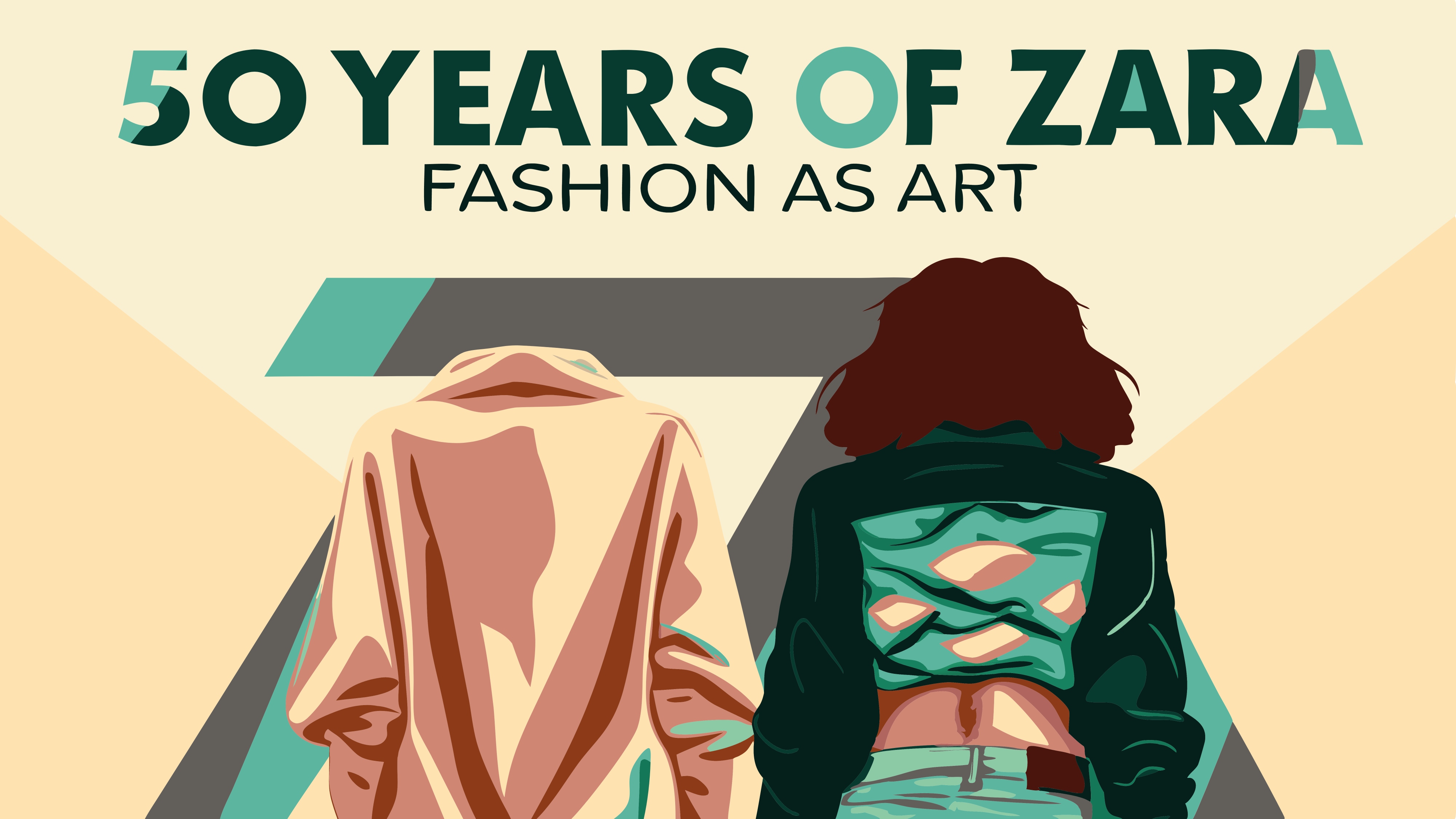
Zara transformed from a single store located in A Coruña, Spain, into an international fast fashion empire under the Inditex group, reshaping our understanding of style and consumption for the past half a century. Looking ahead, we will celebrate Zara’s 50-year mark in 2025, exploring how the brand has shifted from pure commercial undertakings to actively engaging in aesthetic innovation, architectural design, material experimentation, and cultural discourse innovation. Even though Zara is not a typical artistic institution, the brand offers compelling scholarly case studies for art and design because their strategies to store design, rapid production cycles, and global reach in retail construction support art and design production throughout the world. Zara’s, as well as fashion scholars’ influence and inspiration, is examined in relation to milestones in history, retail design, collaboration, materials used, and theoretical frameworks that shape contemporary art.
Background: How Zara Has Changed Over 50 Years
Zara was started in 1975 by Amancio Ortega in A Coruña, Spain, where he opened his first store on Juan Flórez Street, not Calle Serrano as some reports state. He focused on affordable and fashionable garments. Zara developed a fast-fashion model that prioritized responsiveness and offered to make small batches to quickly adapt to consumer demand. Inditex had over 5,692 stores as of 2023, with around 2,000 Zara stores located in 96 countries.
During the 1980s and 1990s, Zara also stood out with sleek, uncluttered store designs, which set them apart from most retailers. They also utilized neutral color schemes, spacious and tidy floors, and industrial-style concrete and glass elements, which made the stores very clean and turned them into sprawling galleries. Zara’s design philosophy echoed the clean lines and functional simplicity, despite not directly drawing inspiration from Donald Judd or Dan Flavin. This development turned Zara into a school example of retail design as shopping got elevated to an experience akin to art.
In the 2000s, Zara began to utilize “fast fashion” models by releasing 20 collections each year. This unconventional approach to fashion commerce ignored the traditional practice of basing collections off of seasonal runway shows. Unlike haute couture brands, Zara focuses on in-store and online marketing instead of runway shows, which means they do not sell their products through glitzy public events. Zara’s model has captivated scholars as well, leading to debates on consumption and time. Researchers such as Agnès Rocamora claim fast fashion brands like Zara shrink the gap between purchase and shopping to the immediacy observed in performing or digital art. This has led to the exploration of underlying themes of style, including authenticity, authorship, and commodification. Zara is simply one of many players participating in this conversation—not the sole instigator.
Zara’s history showcases the balance between cultural influence and commercial needs from a globalized perspective. There is no denying how the democracy of trends has enabled accessibility to high fashion and bluntly combatted the exclusivity imposed by haute couture. This perspective, however, ignores the reliance on rapid production that fast fashion brands heavily utilize. This angle will be approached later in the chapter. From the viewpoint of art and design scholars, Zara’s history stems from the intersection of aesthetics and commerce, revealing how the two.
Designing a Store’s Aesthetic Undertaking Visual Merchandising
Zara’s flagship stores act as vital architectural buildings as they offer a functional and experiential environment design that transcends retail space to showroom space. For more than 50 years, Zara has worked with doctors and in-house teams at its Arteixo headquarters to build stores that capture the essence of contemporary design and improve the shopping experience.
A primary example is the Zara store on Serrano Street in Madrid, opened in 2011. This flagship, located in a historic building, includes high ceilings, polished marble flooring, large windows and plenty of natural sunlight. The design blends modern minimalism with classical architecture and creates a relationship that embodies both and balances two different eras. While not strictly Brutalist, raw finishes like polished concrete to some parts of the industrial and cubist movements that revolve around the use of architectural raw form, layer, and texture.
Another important site is the Oxford Street store in London, which underwent a revamp in 2018. Inditex’s operational goals are met as the store uses reclaimed wood and other eco-friendly lighting as well as energy-conserving lights. Inditex also uses modern, open display cases where mannequins are positioned in motion, suggesting narrative choreography, which draws visitors to engage with the store as an installation.
In New York, Zara’s store at Fifth Avenue represents urban chic style and was opened in 2012. It spans 39,000 square feet and has a very minimalistic upper level that has big windows with refracted light, so floor-to-ceiling glass walls. While the original text’s claim of 3,000 circular apertures that fraise the structure’s western side is unverified, the store does use shadow and light in a dynamic interplay to achieve goals of environmental art. The sleek fixtures that are mounted onto the walls allow the flooring to be open. This, coupled with the modular displays, gives constant rearrangements reminiscent of the space-specific installations.
Zara’s artistic impression is further deepened with the brand’s visual merchandising. Their storefront mannequins are dressed in garments that resemble sculptural pieces and are placed in stories that show some form of movement or gesture. Clothing is presented in an organized manner, separated by color and texture, hanging on minimalist shelves that prioritize aesthetics over practicality. Bags and jewelry are showcased like relics in a gallery, inviting onlookers to engage in deeper intellectual scrutiny. These methods align with retail standards but also demonstrate curatorial skills, turning Zara stores into a specimen for design and anthropology study. As much as the original passage downplayed the art history context as over-exaggerated, it is indisputable that Zara stores are well known for their innovative geometric spatial arrangements in retail architecture.
Collaborative efforts and engagement with different cultures
Zara’s brought forth culturally inspired pieces that were a merge between artistic expression and commercialism, which is why the brand stands out in design and art circles.
Zara has not shied away from pursuing real partnerships that showcase their cultural aspirations, even when the text served misleading collaborations such as Martine Sitbon, David LaChapelle and Lecce mosaics.
Zara launched artist Keith Haring’s estate on a limited edition collection in 2017, which included T-shirts, hoodies, and other items with his iconic prints. The collaboration did not only earn Haring bold recognition but also provided him with mass appeal because it merged high art with streetwear. As another example, in 2020 Zara did a collab with Japanese brand Everlast for a sportswear line blending retail functionality with retro design, catering to urban subcultures, and design lovers.
Cultural heritage was also brought into practice through Zara Home. In 2019, they produced a collection inspired by Moroccan textiles, bringing in craftsmen to amalgamate traditional weaving methods. This, as part of Zara’s “Join Life” sustainability program, aimed to prove the possibility for fast fashion to collaborate with crafting traditions, which raised concerns for cultural appropriation vs. appreciation. Such moves, although designed for profit first, extend commercial branding and sustain cultural criticism.
Zara has aided with cultural projects outside of product collaborations through Inditex’s CSR programs. We do know that Inditex has funded some educational programs in Spain, especially in design and textiles, but it is unclear if they sponsored the Venice Biennale. In 2022, Zara partnered with the Brooklyn Museum to host ap-up event linked to the “Studio Collection,” a sculptural style and premium fabric line. The event featured some installation elements that explained the collection’s design process and invited the audience to think of fashion as a creative discipline. This was not a formal exhibition, but it illustrated Zara’s intent to partake in the activities of cultural institutions.
These efforts have prompted scholars to examine the role of brands in cultural ecosystems. Fast fashion’s accessibility can amplify artistic voices, but it also raises questions about commodification and curatorial autonomy. Unlike Louis Vuitton, who has joined forces with numerous artists, including frequent collaborations with Takashi Murakami, Zara does not extend collaborations as far as luxury brands. However, these are still aimed at strategically integrating Zara into the cultural realm as a point of interest in fashion and cultural studies.
Material Innovation and Creative Production
Zara integrated the development of textiles with in-house production to speed up the rate at which new items are brought to market. Over the past fifty years, the brand has sought out new materials and technologies that improve their fabrics and construction in relation to price, beauty, and eco-friendliness. One example is Zara’s use of laser technology for denim distressing, which was first popularized in the 2010s. The early 2010s saw the adoption of laser technology to engrave intricate images on denim. This method embodies precision conceptual repetition and variation in art, like the works of Agnes Martin. These techniques, although not gallery-worthy, showcase Zara’s industrial design skills and display the brand’s ingenuity.
Through the “Join Life” initiative by Inditex, sustainability efforts such as Zara’s have been noteworthy. It is projected that by 2023, 40% of its fibers will be recycled or sustainably sourced, including organic cotton and Tencel, a biodegradable fabric. Zara launched a line in 2020 that incorporated Refibra, a cellulose fiber recycled material, with industry textile innovators. Inditex does collaborate with biotech company Lenzing, so claims made about “bio fabricated silk alternatives” in 2019, although unverified, are sane given the increasing focus on eco-friendly materials. Zara’s efforts do align with environmental art movements, including those led by Olafur Eliasson, which advocate for sustainable practices. Zara’s efforts do align with eco-focused art but are muted because of the scale of his commercial endeavors.
Zara’s pieces have been utilized in academic research. For example, Alison Gwilt has looked into fast fashion and its textile innovations in materials culture, analyzing brands such as Zara. These studies examine the relationship between garments and the culture surrounding them, from consumerism to sustainability, which contextualizes the work of Zara as artifacts deserving of academic scrutiny.
Theoretical Implications: Zara Within A Cross-Cultural Framework
The global impact of Zara invites consideration for analysis in areas such as cultural capital, commodity fetishism, and globalization in the context of art and cultural studies.
Cultural Capital (Pierre Bourdieu): Zara’s runway stylized look-a-like designs democratizes and broadens high fashion barriers. Ensuring trend accessibility enables Zara to redistribute aesthetic authority which, as researchers like Joanne Entwistle note, can be empowering but also turns culture into commoditized symbols whose merit are hotly contested.
Commodity Fetishism: Zara’s marketing and display windows create spectacles that foreshadow the production’s work and environmental waste. As Debord’s “Society of the Spectacle” describes, these spectacles accentuate supply and demand disconnect. Tansy Hoskins and an array of scholars critique fast fashion for perpetuating this phenomenon with Zara as a poster child.
Globalization and Visual Culture: Zara has opened stores in 96 markets, contributing towards a homogenized global aesthetic that integrates regional traditions and dominant brand imagery. Arjun Appadurai has studied how such brands as Zara generate “global cultural flows” and the blending of region and corporation. This raises issues of cultural preservation versus standardization, which is seen in Zara’s localized collections, such as the Ramadan capsule.
These frameworks situate Zara within wider discussions of power, culture, and creativity, albeit Zara’s impact remains within a lacerating fast-fashion ecosystem.
Effect on Research: Shifting Fashion Studies
Digital Humanities: Zara’s online storefronts and social media presence (having amassed 50 million Instagram followers as of 2023) offers Zara’s stylistic choices and public engagement measurement data for trend and consumer analysis in visual culture. Sentiment analysis and similar tools showcase Zara’s impact on perception branding.
Retailing Anthropology: Ethnographic accounts like Daniel Miller’s Zara study observe axiomatic relations between spatial design and community identity. Shopmoji analysis of shopping as performance provides insight into sociocultural relations.
Material culture: As artifacts of quotidian beauty, items such as Zara’s clothes and furnishings are studied at the intersection of museology and consumerism. Zara allows scholars like Sophie Woodward to examine clothing’s role in the formation of individual and collective identity normative frameworks.
Such approaches give rise to different teaching frameworks that encourage students to explore fashion through archival work, fieldwork, critical theory, and viewed Zara as a prism through which to examine modern society.
Looking ahead: What’s next for Zara?
Zara’s sixth decade now stands on the horizon, bringing with it new possibilities for collaboration with art and scholarship.
Sustainability as Aesthetic: Inditex’s commitment to eco-sustainability embraces eco-art’s principles for social responsibility. Collections featuring recycled materials could stimulate collaborations with artists such as Agnes Denes, who is noted for her ecological interventions.
Digital Embodiment: The virtual stores and augmented reality try-ons that Zara launched in 2018 provide venues for digital performance art, where consumers “perform” identity through digital embodiment of clothing. This may intersect with new media art.
Community-Driven Design: “Join Life” Collection is designed in collaboration with local communities, suggesting culturally diverse participatory frameworks for branding as opposed to heavily marketed corporate imagery, socially engaged art.
With these advancements, it is certain that Zara will continue to remain a captivating case study on the relationship of business to creative culture.
Marking the 50 years of Zara’s operations we analze it as a cultural and economical commercial force where it intersects with art and design. From its strip mall stores to its fabric innovations, Zara provides a richer case study on consumption, globalization and marketing than most brands. Although it might not be the focus of an art history class, Zara is an important case study in the history of retail, visual communication, fashion, brand marketing and heritage. As Zara continues to strive for sustainability and other digital endeavors, the next 50 years is bound to expand its conversations with art and academic work,
inviting inquisitive minds to explore the changing dynamics of fashion and cultural production




Leave a Reply