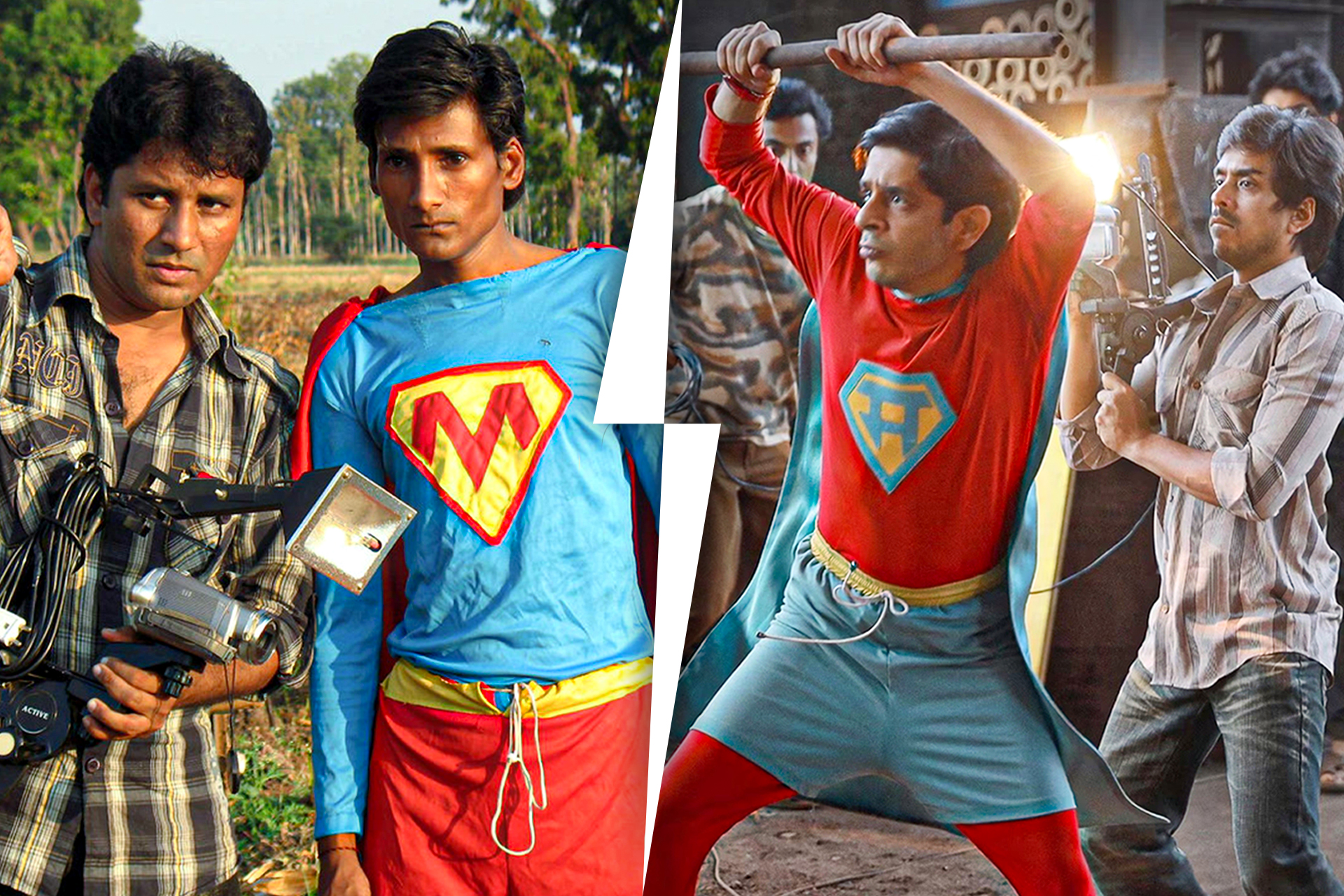
At the narrative core of Superboys of Malegaon, it focuses on Nasir’s transformation from a wedding videographer to the passionate filmmaker he became after making Malegaon ke Sholay and his later amateur films. The screenplay is non-linear, combining his early successes, starting with the 1997 Sholay pastiche, with later marks of friendship decay, such as the 2004 creative schisms, and culminating in a bittersweet 2010 cancer-driven reunion led by Shafique’s diagnosis. The film’s fluid temporal structure intensifies its focus on Nasir’s coming-of-age journey and demonstrates how creative ambition simultaneously fosters and frustrates over time. By telling the story in episodic vignettes focusing on specific work milestones in each, Grover’s script retains focus while exploring other themes like friendship, authorship, and the morality of artistic ownership.
Superboys of Malegaon examines the essence of cinematic agency by juxtaposing collective authorship with individual authorship. Nasir’s initial fervor is infectious and draws his friends into total investment. Still, as the focus sharpens, there is an emergence of fragmentation, revealing conflicting center aspirations. This resonates with postcolonial frameworks of cultural production where subalterns dominate the media to assert local identities and then grapple with the inequitable power structures of the creative industry. Thus, the film goes beyond biographical borders, providing rich meditations on the politics of representation and the price paid for auteurial aspiration.
The Emotion and Character Performances of Superboys of Malegaon
No less than the leads’ performances deeply touch the viewers’ sentiments. Gourav transforms into Nasir with a blend of enthusiasm and vulnerability, which is rare. He does have visionary fervor, but he is also shadowed by the threat of being creatively betrayed. Through a fusion of comic and sober filters, such as his father’s restaurant or his spontaneous on-set performances, Gourav builds a protagonist as a multidimensional character whose flaws become his charm.
Vineet Kumar Singh as Farogh serves as Nasir’s foil: the pragmatic writer yearning for originality in storytelling as opposed to derivative pastiche. Singh’s restrained performance emphasizes the frustration of a collaborative creator whose ‘supporting’ role to Nasir’s performance is rendered largely inconsequential against Nasir’s charm. Together, they embody the struggle of script versus spectacle, illustrating how passionate devotion becomes both creative propulsion and divisive eruption.
Delivering perhaps the most emotional and captivating performance of the film, Shafique—played by Shashank Arora—has the most moving arc. His transformation from a sidelined cast member to “Superman of Malegaon” (the title of Nasir’s homage) showcases redemption through art. Many of Arora’s emotionally charged scenes—especially the ones juxtaposed with candid shots of his cancer treatment—infuse the film with raw emotion and turn what is meant to be the film’s triumphant finale into a collective act of shared release.
The rich social frame of the film is provided by the rest of the cast, including Anuj Singh Duhan as Akram and Riddhi Kumar as Mallika. Every character, from the skeptical financier to the resourceful tailor, captures the spirit of small-town toughness and resilience, reinforcing the film’s thesis that cinema is a collaborative venture fueled by countless, often overlooked, contributors.
Visual Style and Cinematography
Cinematographer Swapnil S. Sonawane’s range includes the glitzy, gaudy vibrancy of Bollywood dreamscapes as well as the stark realism of Malegaon’s industrial backdrops. Sonawane’s handheld camera sequences depict rehearsal energy, and their messy, lo-fi texture fits the film’s style. Covered bazaars and wide axial views of the textile mills situate the story within its socio-geographical context, while close-up images of the sparse cardboard props and the graffiti backdrops reveal the characters’ hypnotic ingenuity.
Modulation of hue tint and balance plays a crucial role in accentuating the shifts in emotion in the film. Saturated pink and red hues evoke classic Bollywood framing and dominate early pastiche sequences. Discord and introspection are set against cooler, desaturated hues, hinting at the more complex, melancholic reality underneath the humorous surface. Dominant elements like the climactic homage to a ship sinking also reinforce the main theme by color usage. The explosive imagination of the group is captured through the use of slow motion and vibrant primary colors fusing to highlight its dizzying impact.
Editing done by Anand Subaya improves the clarity of the narrative. There is rhythmic pulsation that is created through the cross-cutting of rehearsals, candid interviews, and the final screenings. The use of montage sequences, such as the montage of costume construction and script workshops, effectively shows the development over time as well as the work that was done cumulatively in reference to each production milestone. This form of editorial alchemy ensures that form and content are balanced, allowing the viewer’s attention to be on the creative processes involved and the resulting drama.
Sound Design and Music
The aural tapestry that accompanies Superboys of Malegaon is as rigorously nuanced as the visuals. Sachin-Jigar’s score features a blend of bespoke tunes alongside reimagined Bollywood motifs, offering a whimsical foil to the protagonists’ parodying antics. During the parody sections, well-known Bollywood tunes are refracted through low-fidelity instrumentation. In line with the film’s ethos, dhol and harmonium are substituted with acoustic guitar and hand percussion.
The film’s diegetic ambient sounds of looms, rickshaws, and street vendors blend perfectly into the bustling sound and atmosphere of Malegaon. These localized soundscapes seamlessly blend into non-diegetic sounds as well. For instance, a sudden spike in the volume of violins could intensify Nasir’s creative epiphany, while Shafique’s more vulnerable moments are underscored by a lonely flute playing sad tunes. It is vital to note that the sound design does not over-polish everything, leaving mistakes during outdoor shoots and laughter not on set and outdoors.
The combination of in-text spoof conversations and off-text production sound forms a meta-sonic dialogue that enables the audience to appreciate the film and the filmmaking tools simultaneously. This self-reflexive sonic approach underscores the documentary-inspired sensibility of the narrative while also firmly placing Superboys of Malegaon within Superboys of Malegaon: Directorial Vision and Screenplay, the fictional world.
Kagti Reema’s filmography exhibits the unique trait of deeply understanding her characters’ psychologies, a blend of humor with deep seriousness. She relentlessly levies scorn towards her subjects’ naïve blunders appreciating and accentuating the cunning and fierce resolve that help Nasir and his friends to overcome impossible technical and financial constraints.
Sharply witty, sophisticated and setting self-deprecating context on a creatively bankrupt industry- former employee of TVF describes expecting corporate banter punctuated with the freshest friend grope. The oscillation corporate mix Nasir experiences at the family restaurant stylishly reveals his unconscious admission of structure. Depending on tone, sailing to his brilliance and not giving in to jarring reversals reveals a rather polished technique.
Kagti and Grover’s teamwork is especially evident in the scenes exposing the moral contradictions within creative collaboration. The arc of confrontation between Farogh and Nasir, expressly designed for the plot wherein Farogh accuses Nasir of defaulting on paying his share after he didn’t pay royalties to Nasir, is much more than plot. It crystallizes a scathing indictment of authorial vanity. These aspects show that the film is ready to take its own celebratory impulses apart, and that serves the assertive critical self-reflection of the narrative.
Cultural Context and Social Commentary
Superboys of Malegaon offers satisfying entertainment while providing insight into the lesser-known parts of India. Malegaon, which has an organized textile industry and experienced some violence and conflict, appears on film as more than a stereotype. Its precarious economic condition and rich culture help to shape the main characters’ motivations. The film does not shy away from showing civic issues alongside not reducing them to a backdrop, instead seeing creativity as a form of communal resilience.
Superboys of Malegaon documents the grassroots economies of cultural production by community fundraising fairs and artisans to the troupe, including seamstresses making capes and backdrop painters. This film points toward more innovative conversations regarding labor outside of metropolitan areas in India that go against the majority of Bollywood-centric views.
Superboys of Malegaon deals with postcolonial theories of cultural crossbreeding. The metasagistic context of the two Sholays and Supermans provides an Indianized, Westernized portrayal of cinematically dead spaces, hence exhibiting a global-local cultural blend. Such collated aesthetics transcend accusations of subdominance, portraying how sociologically termed inferior civilizational circles are able to impose their dominant cultural artifacts into their narrative.
A Critique and Reflexive Balance
The film is mainly celebratory but retains awareness of its contradictions. Some portions, like the long rehearsal montage, have to be balanced against narrative motion, especially since its more judicious cuts might preserve some dramatic tension. Additionally, the film showcases male friendships, and the women collaborators’ (costume designers and script editors) viewpoints are treated in a rather cursory manner, which, if addressed, could have enriched the film’s social fabric.
These limitations, however, do very little to affect the overall impact of the film. Their vulnerability and self-aware humor ensure that Superboys of Malegaon does not slip into a frivolous pastiche. Rather, the film makes use of its artificiality to scrutinize the ethics of representation, the diverse matters of collaboration, and the communal authorship paradoxes.
Legacy and Significance
In the community screening held some months after the film’s release, it garnered praise as an embodiment of adept fusion of form and content, which was later discussed in depth in film studies seminars. Its addition to the curriculum showcases the value it has to offer as a case study in vernacular filmmaking. This, coupled with the grassroots workshops that sprung up across rural India inspired by its DIY ethos, truly exemplifies the real-world influence of the film.
Analyzing the film, it is clear its reception has centered on its ability to entertain while prompting deeper thinking. The film’s “measured performances blend energy with restraint,” which makes it both easy to enjoy and intellectually stimulating. It was described as a “boisterous heartwarmer about movie-loving underdogs,” receiving accolades for its inspiration along with a testament to the spirit of collaboration at its core. The honors and praise given reinforce the contemporary Indian cinematic culture, claiming Superboys of Malegaon is a transformative storytelling film, overcoming material hardships.
The Impact of Superboys of Malegaon
Superboys of Malegaon reinforces the idea of cinema being one of the many collaborative art forms. The film’s equally sharp and imaginative screenplay, along with visuals and performances teeming with life, elucidates the magic through which everyday people can dream their images into film. This work, although created in a small town, actively draws on deep and wide matrices of culture, history and ideas such as postcolonial hybridity, authorship politics, and collaboration sociology.
Superboys of Malegaon: Major Cast and Crew
Principal Cast
-
Adarsh Gourav as Nasir Shaikh
-
Vineet Kumar Singh as Farogh
-
Shashank Arora as Shafique
-
Anuj Singh Duhan as Akram
-
Riddhi Kumar as Mallika
-
Saqib Ayub as Irfan
-
Gyanendra Tripathi as Nihal
-
Muskkaan Jaferi as Shabeena
-
Anmol Kajani as Nadeem
-
Manjiri Pupala as Trupti
-
Pallav Singh as Aleem
-
Abhinav Grover as Raju
Key Crew
-
Director: Reema Kagti
-
Writer: Varun Grover
-
Producers: Zoya Akhtar; Reema Kagti; Farhan Akhtar; Ritesh Sidhwani
-
Cinematography: Swapnil S. Sonawane
-
Editing: Anand Subaya
-
Music: Sachin-Jigar
-
Production Companies: Excel Entertainment; Tiger Baby Films
-
Distributor: Amazon MGM Studio



Leave a Reply