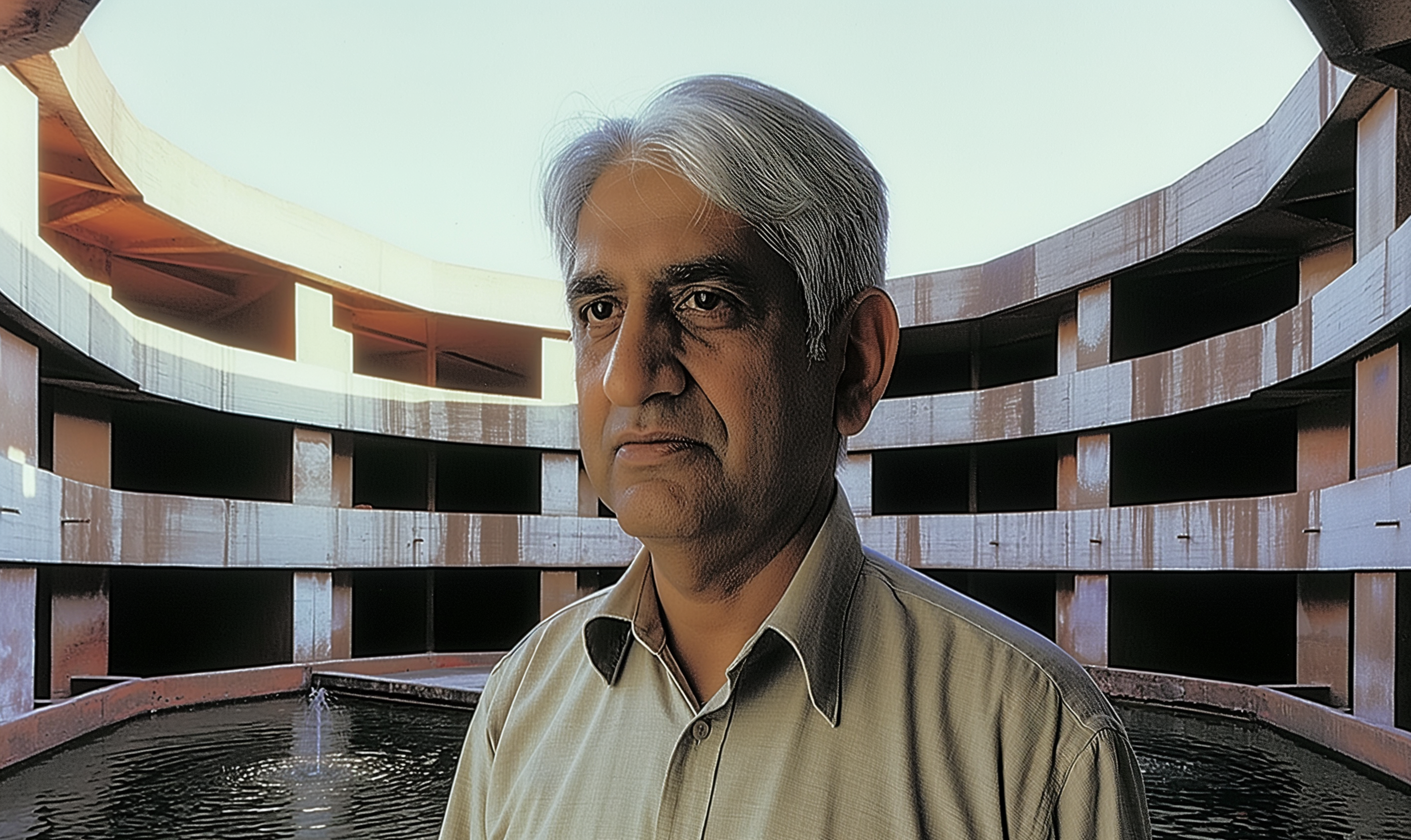
Charles Correa (1930-2015) was not just an architect; he was a maestro who composed spaces that sang the cultural and environmental melodies of India. Born in a time of great change and burgeoning national identity, Correa’s life and career were deeply intertwined with the story of a newly independent nation striving to define its own modernity. His work transcended mere construction, embodying a vision that melded the rich heritage of Indian architecture with the progressive ideals of the post-modern era. Correa’s projects were not only groundbreaking in their design but also in their philosophical approach to space, sustainability, and social context. His legacy is not just visible in the skyline of Indian cities but also in the principles of humane and contextually relevant design that continue to inspire architects around the world. This narrative explores Correa’s journey, his design philosophy, his seminal works, and his enduring legacy through the lens of art criticism, offering architecture students and professionals an insightful look into his creative genius.
The Early Sparks of Genius
Born in the bustling town of Secunderabad on September 1, 1930, Charles Correa’s early life was shaped by the dynamic cultural and historical milieu of India. Growing up in a country on the brink of independence, Correa was exposed to a rich tapestry of traditional Indian architecture and a burgeoning spirit of modernity. This duality profoundly influenced his understanding of space and design from an early age.
Correa’s formal education began in India, but his quest for architectural knowledge soon took him abroad. In the United States, he attended the University of Michigan, where he obtained his undergraduate degree in architecture. This period marked the beginning of his exposure to Western architectural principles and modernist ideologies. However, it was his subsequent time at the Massachusetts Institute of Technology (MIT) that truly ignited his creative genius.
At MIT, Correa was mentored by some of the most influential architects of the time, including Louis Kahn and Buckminster Fuller. Kahn’s philosophy of architecture as a manifestation of profound human values and Fuller’s visionary approach to design left an indelible mark on Correa. These experiences broadened his architectural perspective, challenging him to think beyond mere functionality and aesthetics.
Yet, Correa was not content with simply adopting Western modernist principles. He was deeply aware of the unique cultural and environmental contexts of India, and he sought to create an architectural language that was both modern and deeply rooted in Indian tradition. This realization marked the beginning of Correa’s lifelong mission: to develop an architecture that resonated with the Indian ethos while embracing the advancements of modernity.
Returning to India, Correa embarked on his career with a renewed vision. His early works demonstrated a keen sensitivity to the local climate, materials, and social customs. This sensitivity became a hallmark of his architectural style, characterized by a harmonious blend of tradition and innovation. Each project became an exploration of how contemporary architecture could reflect and enhance the cultural identity of its location.
Correa’s journey from the academic halls of MIT to the vibrant streets of Indian cities is a testament to his commitment to an architecture that is both globally informed and locally relevant. His early experiences and education provided the foundation for a career that would redefine Indian architecture, making him a pivotal figure in the country’s post-modern architectural narrative.
The Stories Behind the Structures
Charles Correa’s architectural masterpieces are not just buildings; they are narratives etched in stone and mortar, each telling a unique story of innovation, cultural synthesis, and contextual responsiveness. His work across various Indian cities and beyond reflects a deep understanding of the social and environmental fabric of each location. Here, we delve into the stories behind some of his most iconic structures, exploring how Correa’s vision materialized into tangible, transformative spaces.
Mahatma Gandhi Memorial Museum, Ahmedabad (1958-1963)

Located on the serene banks of the Sabarmati River, the Mahatma Gandhi Memorial Museum at the Sabarmati Ashram is one of Correa’s earliest and most profound projects. The ashram, once the residence of Mahatma Gandhi, required a design that would reflect the simplicity and austerity of Gandhi’s life and principles. Correa responded to this challenge by creating a series of pavilions interconnected by open courtyards.
The design is a masterclass in minimalism and functionality. The use of locally sourced brick and stone not only grounds the building in its geographical context but also pays homage to traditional Indian construction techniques. The courtyards, inspired by the layout of traditional Indian homes, provide natural light and ventilation, creating a tranquil environment conducive to reflection and learning. The museum’s layout encourages visitors to meander through the spaces, much like the journey of introspection and contemplation that Gandhi’s life epitomizes.
Kanchenjunga Apartments, Mumbai (1970-1983)

In the densely populated city of Mumbai, Correa’s Kanchenjunga Apartments stand as a beacon of innovative residential design. This 32-story high-rise redefines urban living by integrating elements of traditional Indian housing into a modern skyscraper. Each apartment is designed as a vertical bungalow, featuring double-height terraces that act as private gardens in the sky.
The staggered arrangement of the terraces ensures that each unit receives ample natural light and cross ventilation, addressing the climatic challenges of Mumbai. These terraces, a reinterpretation of the traditional verandas and courtyards, provide residents with private outdoor spaces that offer respite from the urban hustle. The building’s form and function are a direct response to the socio-cultural needs of its inhabitants, making it a celebrated example of contextual modernism.
Jawahar Kala Kendra, Jaipur (1986-1992)

In the historic city of Jaipur, Correa designed the Jawahar Kala Kendra, a cultural complex that serves as a vibrant hub for the arts. The design is deeply rooted in the ancient Vedic concept of the mandala, a geometric figure representing the universe. Correa used the nine-square grid of the Navagraha (nine planets) mandala as the basis for the layout, with each square housing different functional spaces such as galleries, theaters, and studios.
The central courtyard, reminiscent of traditional Indian palace architecture, acts as the heart of the complex, fostering interaction and communal activities. The use of bold colors and intricate patterns in the design pays tribute to Rajasthan’s rich cultural heritage. The Jawahar Kala Kendra is a testament to Correa’s ability to create spaces that are both contemporary and deeply evocative of historical and cultural narratives.
Bharat Bhavan, Bhopal (1975-1982)

Bharat Bhavan, situated on the banks of the Upper Lake in Bhopal, is a cultural institution designed to blend seamlessly with its natural surroundings. Correa’s design for this multi-arts complex features a series of sunken courtyards and terraced gardens that mirror the natural undulations of the landscape. This design choice not only minimizes the visual impact of the building on the environment but also creates a series of intimate, shaded spaces ideal for artistic contemplation and performance.
The interplay of light and shadow, a recurring theme in Correa’s work, is particularly pronounced here. The strategic placement of openings and courtyards ensures that natural light permeates the interior spaces, creating a dynamic and ever-changing ambiance. Bharat Bhavan is a celebration of India’s artistic diversity, providing a platform for the performing and visual arts within an architecturally inspiring setting.
Champalimaud Centre for the Unknown, Lisbon (2007-2010)

While most of Correa’s iconic works are situated in India, the Champalimaud Centre for the Unknown in Lisbon, Portugal, stands as a testament to his international influence. This biomedical research facility is designed to foster innovation and collaboration among scientists. The building’s fluid, organic forms and expansive open spaces reflect Correa’s belief in the transformative power of architecture.
The centre overlooks the Tagus River, and its design maximizes the connection to this natural feature, with large windows and terraces offering stunning views. The integration of natural elements within the building’s structure promotes a sense of calm and inspiration, crucial for scientific research. This project highlights Correa’s ability to adapt his architectural principles to different cultural and environmental contexts, reinforcing his status as a global architectural visionary.
The Legacy of a Visionary
Charles Correa’s legacy is vast and multifaceted, encompassing not only his built works but also his profound influence on urban planning, architectural education, and sustainable design practices. His contributions have left an indelible mark on the architectural landscape of India and the world, inspiring countless architects, planners, and students to rethink the relationship between buildings, their environment, and the people who inhabit them.
Urban Planning Pioneer
One of Correa’s most significant contributions was his role in the urban planning of Navi Mumbai, a satellite city developed to decongest the overcrowded city of Mumbai. As the chief architect of Navi Mumbai in the early 1970s, Correa’s vision was to create a well-planned urban environment that could accommodate the growing population while providing a high quality of life. His plan for Navi Mumbai included wide roads, ample green spaces, and well-defined residential, commercial, and industrial zones.
Correa’s approach to urban planning was holistic, considering not only the physical infrastructure but also the social and economic needs of the residents. He emphasized the importance of community spaces and accessibility, ensuring that the city was designed for people rather than just cars. This people-centric approach set a new standard for urban development in India and continues to influence city planning practices today.
Advocate for Low-Cost Housing
Correa was a strong advocate for low-cost housing solutions that addressed the needs of India’s urban poor. He believed that providing dignified, affordable housing was essential for the country’s development. His work in this area includes the design of the Belapur Housing project in Navi Mumbai, which showcased his innovative approach to low-cost, high-density housing.
The Belapur Housing project consists of clusters of houses arranged around shared courtyards, creating a sense of community and belonging. Each unit was designed to be expandable, allowing residents to modify and grow their homes according to their needs. This flexibility, combined with the use of locally available materials and traditional construction techniques, made the project both affordable and sustainable.
Architectural Educator and Thought Leader
Beyond his architectural practice, Correa was a passionate educator and thought leader. He served as a visiting professor at several prestigious institutions, including the Massachusetts Institute of Technology (MIT) and the University of California, Berkeley. Through his teaching and lectures, Correa influenced a generation of architects and planners, imparting his philosophy of contextual and sustainable design.
Correa also authored numerous essays and books, in which he articulated his ideas on architecture, urbanism, and society. His writings, such as “The New Landscape” and “Housing and Urbanisation,” are considered seminal texts in the field of architecture and urban planning. These works provide valuable insights into his design principles and continue to be referenced by students and professionals alike.
Champion of Sustainable Design
Long before sustainability became a global imperative, Correa championed the cause of environmentally responsible architecture. He believed that buildings should work in harmony with their natural surroundings, minimizing their ecological footprint while enhancing the well-being of their occupants. This philosophy is evident in many of his projects, which utilize passive cooling techniques, natural ventilation, and locally sourced materials.
One of the most notable examples of his commitment to sustainability is the Indian Institute of Management (IIM) in Bangalore. Designed in the 1970s, the campus features a series of interconnected courtyards and gardens that create a microclimate, reducing the need for artificial cooling. The use of local stone and the careful orientation of buildings further enhance the environmental performance of the campus.
Global Influence and Recognition
Correa’s impact extended far beyond the borders of India. His work earned him numerous accolades, including the Aga Khan Award for Architecture, the Padma Vibhushan, and the Royal Gold Medal from the Royal Institute of British Architects (RIBA). These honors recognize not only the aesthetic and functional excellence of his designs but also his contributions to the broader discourse on architecture and urbanism.
His projects, such as the Champalimaud Centre for the Unknown in Lisbon, demonstrate his ability to apply his design principles to diverse cultural and environmental contexts. This international project reflects his holistic approach to architecture, emphasizing the importance of creating spaces that inspire and uplift their users.
Enduring Inspiration
Charles Correa’s legacy continues to inspire architects and planners around the world. His emphasis on contextual sensitivity, community-oriented design, and sustainability remains highly relevant in today’s rapidly urbanizing world. Young architects draw inspiration from his ability to blend tradition with modernity, creating spaces that are not only functional but also deeply meaningful.
Correa’s work serves as a reminder that architecture is not just about buildings; it is about shaping environments that enhance the human experience. His vision of an architecture that is responsive to its cultural, social, and environmental context offers a timeless blueprint for future generations.
Conclusion
Charles Correa’s legacy is a rich tapestry of visionary design, thoughtful urban planning, and passionate advocacy for sustainability and social equity. His life’s work has profoundly influenced the architectural landscape of India and continues to resonate globally. For architecture students and professionals, Correa’s principles provide invaluable lessons in creating spaces that are beautiful, functional, and deeply connected to their context. His legacy is not only seen in the buildings he designed but also in the enduring principles he championed, which continue to guide and inspire the world of architecture.

- proteek mandal
- proteek mandal
- proteek mandal
- proteek mandal
- proteek mandal
- proteek mandal
- proteek mandal
- proteek mandal
- proteek mandal
- proteek mandal
- proteek mandal
- proteek mandal
- proteek mandal
- proteek mandal
- proteek mandal
- proteek mandal
- proteek mandal
- proteek mandal
- proteek mandal
- proteek mandal
- proteek mandal
- proteek mandal
- proteek mandal
- proteek mandal
- proteek mandal



Leave a Reply