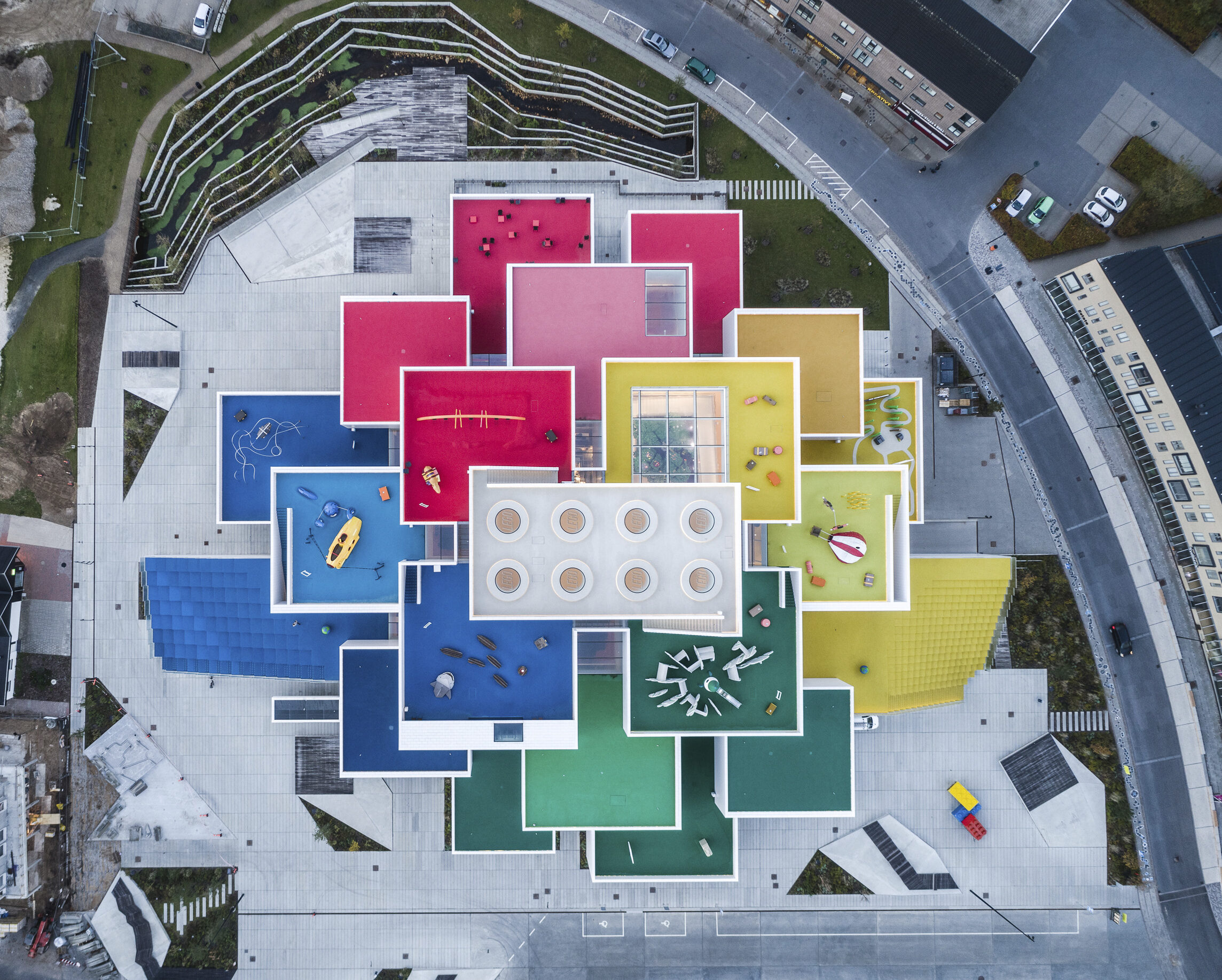
As modern design ever more emphasizes collaboration, eco-friendliness, and community involvement, the LEGO Brand House, situated in Billund, Denmark, demonstrates how functionality and style can not only go hand in hand but also work to promote a certain brand. This was the idea that was brought to life by Bjarke Ingels Group (BIG) along with LEGO’s talented team. This building, which is interactive in nature and is an art piece and a landmark, is welcomed to the broad children’s understanding of the company: play matters.
The Framework: Ingels’ Design Philosophy and Its Application With LEGO
BIG partner and founder Bjarke Ingels has a unique gift to envision abstract spaces into hands-on conceptual frameworks. For LEGO Brand House, Ingels saw that he had all the opportunities to realize architecture in the form of an in-depth interpretation of the celebration of imagination. He conceived of the structure as representing mass under construction—or, as he put it,’structured creativity’, which also serves as a nod to the modularity of Lego bricks. Sticking to the theme, Ingels’ team approached the problem of building a masonry house through the use of geometry and plumb: twenty-one bricks, each representing a feature of a LEGO brand, constitute the brand house. It was at this point that Ingels transformed a commercially popular item into a construction design language that turned a Great American toy into a Great America—toys as inventions.
This modular structure, however, proves to reinforce the brand playfulness LEGO is known for. The different zones of the building’s surface intersect, thus writing the spatial story, turning the visit into the tactile adventure of imagination and assembly—tthe LEGO brick play experience. Ingels further notes that the architectural element has to serve a purpose, but at the same time, it has to inspire and provoke. In other words, he succeeds in turning architecture into the part of the play because in the LEGO Brand House every part, every gap in the wall, every step and every exhibition space has a role to play.
A New Understanding of Cultural Architecture Practice
It shouldn’t be expected from the LEGO Group that the Brand House is both a testimony to the history of the company and a building fully committed to the culture of play. The Group of Companies firmly believes that the real brand house is an example of their motto “Only the best is good enough” in three dimensions. It maintains this position because of constant attention programs with these goals and a focus on the consumers. As Keld Kirk Kristiansen, the owner of LEGO and CEO, Jesper Vilstrup sees it, Nikolaus Pevsner’s Home is more than an anchor shop or a kind of museum for them. For them, it is a meeting place for people of all ages to engage, learn and interact.
The house can be viewed as a national representative in a number of ways, illustrating that LEGO’s intention is to promote creativity, cooperation, and innovativeness across the globe.
Lego Square will enhance this vision of the brand house. The square is built as an area designed for free movement where it serves as an artificial ‘cave’ that facilitates Lego fans from the town and visitors to interact and experience Lego’s philosophy without restrictions. The layout shows how LEGO takes the position that education in all its forms should be fun, interactive and social. This space that is core to most of the visitors is free of structural columns to allow visibility and space integration and in itself becomes a playroom, which makes fun of the new order of construction between a museum and a community center.
From Geometrical Elements to User-Centered Design: The LEGO Brand House Interior
The new visitor experience inside the LEGO Brand House is structured around four color-coded zones, which are situated along the journey path and which highlight different aspects of the “learning through play” ethos of LEGO. This design integration enables the Lego experience throughout the Brand House.
Red Zone for creativity: Participants are encouraged to engage in active design activities, such as building structures out of Legos, where they are free to formulate solutions through individual play.
Blue Zone for cognition: Completeness on the participant’s end sets them through various structured tasks, which enables them to think critically and solve problems in a safe and enjoyable place.
Green Zone for social skills: This is a collaborative zone meant to enhance group interaction and active participation.
The yellow area for emotional development is aimed at eliciting empathy; this area includes displays that promote comprehension and self-expression.
Such areas go beyond the conventional approach of museum exhibits. Each of them involves more than one sense and invites free involvement, expressing that the company’s motto of play is considered the most effective pedagogy. LEGO also features “The Tree of Creativity,” a gigantic work consisting of over 6 million individual bricks that are aimed at achieving the impression of historical growth of creativity. Anchored to the spectacular tree that extends from the ground through the building, the visitors have a chance to experience this masterpiece in the most natural way while being reminded of the ‘LEGO’ history of designs at the same time.
Masterpiece Gallery: The Center for Adult Fans of LEGO
The last floor’s masterpiece gallery is among the most interesting parts of the LEGO brand house. It is here where this gallery comes alive, as it is designed specifically for large-scaled LEGO sculptures made by fans and collectors, which include miniature versions of dinosaurs and architectural buildings made out of thousands of LEGO bricks. Here, Adult Fans of LEGO (AFOLs) are appreciated as not only customers but also as creators, and their works are put on display in an artistic environment. This space has windows that are enhanced with LEGO Studs that connect the public to the gallery and with the well-recognized brand. The Masterpiece Gallery exists as a tribute to the active world of LEGO fans and also as a piece of art; it further elucidates the other side of what LEGO means—not only the childhood…
Sustainable design goes hand-in-hand with the trend of the day that can only be described as an evolution in building materials and building methods. In this regard, these two objectives were successfully achieved in the construction of the LEGO Brand House, as the LEGO Brand House integrates building materials that are environmentally friendly and eco-conscious design principles. The part of the facade that emulates the ridges of stacked LEGO bricks is made out of sustainable tiles. What’s more, steel beams are used to frame the load-bearing concrete core of the building, thereby minimizing the use of non-renewable substances. Such elements are a bid to ensure the low environmental impact of the building so that the Brand House does not run counter to LEGO’s corporate citizenship goals.
Such dioramas exist in the “World Explorer” zone, but only die-hard fans who can locate these Easter eggs—which are actually digital LEGO—will be able to find them. There are even more puzzling interactions: interactive displays meta-bridge the real with the virtual worlds of play. The Brand House is equipped with digital midi cameras that enable its digital display, which enables its visitors to digitally copy the physical construct they built. It is yet another fascination where the brand experience evolves, and more importantly, brand value is created by the self-marketed touch with which the visitors have aimed to freak out the best brand in the world.
RTF | RETHINKING THE FUTURE
LEGO Brand House’s Global Impact on the Billund Region While many might consider the Brand House an architectural achievement, it is much more for Billund than that. The structure, which is said to accommodate around two hundred and fifty thousand guests every year, has placed this town as one of the centers of attraction for families, teachers, as well as fans and supporters from all walks of life. This is how the Band House makes a difference and contributes to the ambition of making Billund more than just a center of attraction for Legoland. It marks a shift of the centerpiece of the town from just being LEGOLAND to some of the many forms of creative tourism. It constitutes part of a larger picture of the Billunds initiative. ‘Children Capital’ aims at connecting communities around the idea of learning and play with the aim of positioning Billund as a one-stop center for young people and their families.
Through its layout, the building aims to unite the local citizens and the foreigners who visit the town by creating a sense of community based on the common LEGO values of creativity, innovation and collaborative work. Such architecture, which embodies activity on the brand’s side where community and culture converge, portrays how branded spaces can integrate and fit into the surrounding areas.
The significance of LEGO Brand House
Through Bricks Culture, LEGO is implementing a new form of architecture that blends elements of art, social purpose and education into a single coherent creation. It embodies the view of architecture professed by Bjarke Ingels that architecture is not only a static structure but also an active idea. Every person who has touched a brick, not as a child, knows that it’s not a toy; it’s rather a spirit tool. Ingels commented on the power of the LEGO brand. It is a tool for creation, exploration and imagination.
To maintain play, to contribute the vision of a child towards a specific goal, and more importantly, to imagine without boundaries—this is what a box building stands for. Following the LEGO Brand, Kid Spaces reinforce the idea that inclusively every individual can contribute towards change through purposeful design; in this case, architecture does enable such changes. LEGO brand house is intended to breakout the concepts where barriers are erased and people can share their ideas to evoke change even in the simplest of an image.
Featured image courtesy : BIG




Leave a Reply