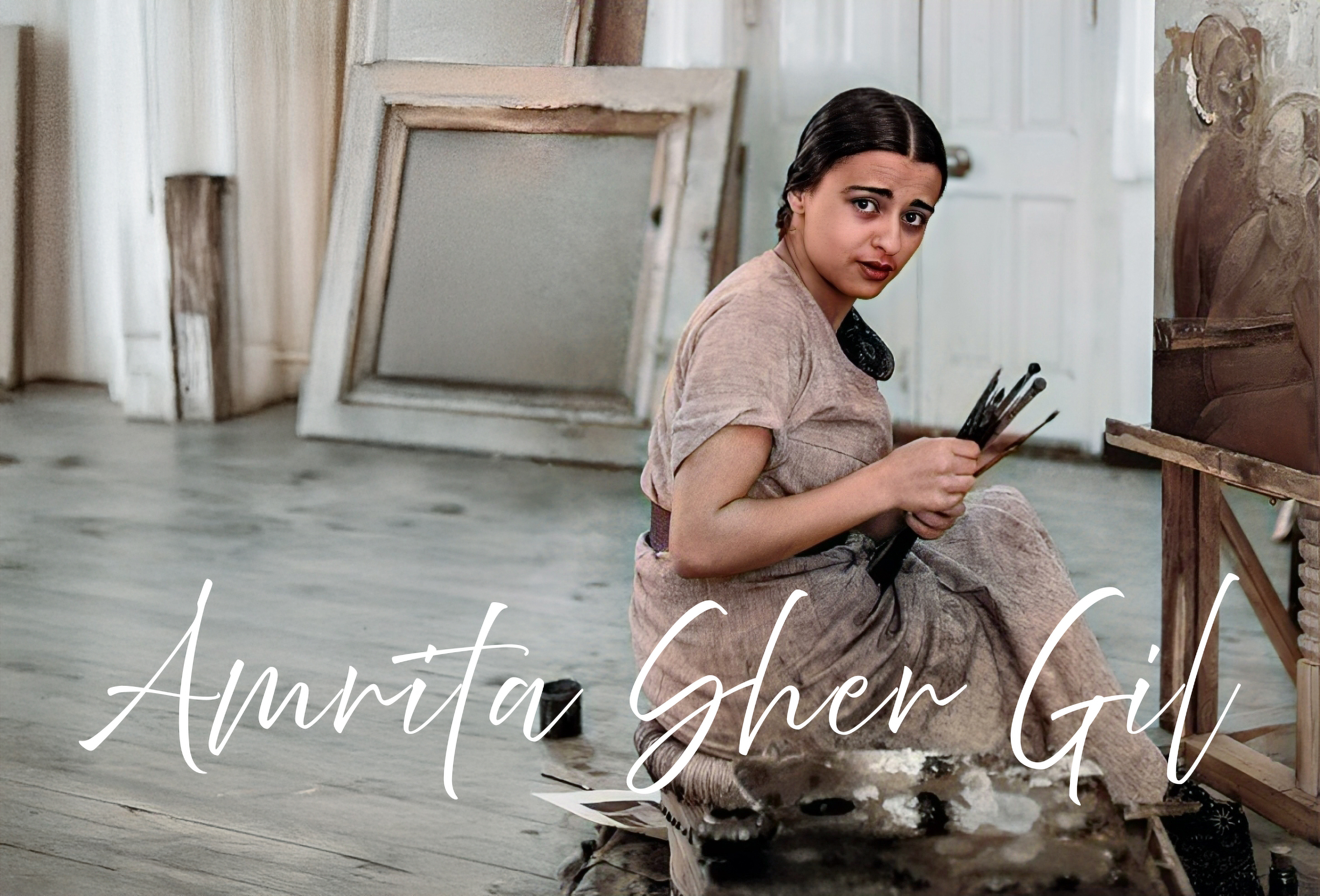
Art history holds some figures whose work constrains them to a certain period of time, yet their work has managed to stand the test of time through means of semiotic and cultural relevance. Amrita Sher-Gil emerges as a quintessential embodiment of this transcendence. Her work evokes intelligence and wonder and works on a global scale because of how her family history allows her to blend different cultures. An artist whose transnational lineage facilitated a sophisticated aesthetic synthesis, Amrita Sher-Gil occupies a unique position in modern Indian art. She did the unthinkable, crafting a new visual style that positioned her in the unique space of being able to speak with a multitude of cultures instead of getting boxed into one. A culture where diverse contemporary traditions molded her into an artist able to paint in a hybrid grammar that reconciled the macro binaries of east and west, alienation and intimacy, modernity and tradition. In short, her art explores the different facets of liminality, existing as a slice of life in a world where obstacles from multiple cultures and profound doses of beauty meet.
Capitalism, culture, and nationalism. Question: Introduction to Sher-Gil and Her Work
Sher-Gil gave birth in 1913 to an opera singer and a Sikh nobleman. This made her early life extremely exposed to a wide range of cultures. She moved between India and Hungary, which made her very observant of the differences between Indian traditions and European modernism. The intersections of Western and Eastern European painting provided exhilarating inspiration; however, she was somewhat restricted because of her Hungarian Indian identity. Her identity was formed by the different borders she had to walk to and from.
Sher-Gil’s early modern childhood was rich in cultures. This made her establish emotional connections with her surroundings. She attended Paris’s highly lauded École des Beaux-Arts from the year 1929 to 1934, a decision that transformed her profoundly. She was extremely fascinated and influenced by modern post-impressionism expressionism. Developing a more expressive and colorful approach to painting by abandoning the heavily detailed approach to painting was a major leap in artistry for her. However, her Western education did not suffice in attending to her multifaceted self. This has propelled her to quickly leave India and begin dismantling her education to reconstruct it in the context of India’s culture and politics.
The year 1934 served as an inflection point: an epistemic boundary where an artist impacted by European modernism transformed into an artist using Indian aesthetics in her work. This homecoming was not only a journey back to her roots but also an intellectual and artistic rebirth where India became both the subject and the narrative. From this point onward, her works would try to grasp the aesthetic, social, and existential aspects of Indian life, making her a significant figure in the development of modern Indian art.
The Aesthetic Turn: Reconfiguring Visual Narratives
Sher-Gil’s homecoming was not only a shift in space but also a shift that was internal within her and was deeply related to her art. She ceased to be simply an external participant in the European modernist movements and actively integrated Indian art as her diasporic identity. Her new engagement with Indian art, which included everything from the delicate precision of Mughal miniatures to the flowing expressivity of Ajanta murals, marked the beginning of an ideological and visual transformation that would aim to unify her hybrid identity with the socio-political framework of India.
This stage was marked by her new attempt at design. This design attempt consisted of her embracing the color scheme of the natives by replacing the cooler detached colors of European modernism with warm tones that were characteristic of the subcontinent. Her compositions tend to be more and more flat. She did not try to imitate the depth of Western art, but simpler and more stylized ways that highlighted the emotional and existential gravity of the subjects. Furthermore, Sher-Gil’s evolution as an artist revealed deep ethnographic concern and sensitivity—understanding of the marginalized and dispossessed—which, in her representations of rural India, was strikingly profound.
Three Girls (1935) and Bride’s Toilet (1937) illustrate her changing style and shifts in her ideology. Rather than adopting the idealized figurine central to colonial and nationalist portrayals of women, she used chilling self-reflection. These figures are not seen as passive objects of desire, nor are they emblematic allegories. Instead, they are unique individuals whose expressions reveal a dignity that is quiet and resigned. These women—who are firmly rooted in their socio-economic contexts—stand in solidarity with a host of other women, bound by an unspoken and collective struggle that is bigger than their individual selves. In this phase, her work crystallized into an impossibly sophisticated articulation of social realism that mingled her personal experiences with the collective memories, creating a facet where history, identity, and aesthetics endlessly quarreled.
Sher-Gil’s work also consists of more nuanced subversive feminist undertones, enabling the direct gendered subversion we see in the modernity era and Sher-Gil’s work. As seen in her paintings, Village Scene (1938) and Group of Three Girls (1935), Sher-Gil’s works portray women in a way that counters the objectifying gaze put upon them by both colonial ethnographic painting and indigenous art.

Her creations are not simply subjects of womanhood but masterpieces with deep psychological nuances. Each figure’s expression is embedded with self-reflection, calm strength, and silent rebellion. These women occupy the threshold of non-being, at once unassumingly submissive but also vehemently radical, boldly aware of their reality and forcing the audience into the depths of their conscience.
By meticulously coloring and forming her paintings, Sher-Gil was able to position the female figure outside the traditional boundaries of authority and subservience. Her portrayal of Indian women in scenes of solitude and resignation challenges the attempts to construct a singular and simplistic identity for Indian women. Instead, he portrays their existence as a robust reality infused within the broad socio-political context of India’s pre-independence era. Sher-Gil’s work unwaveringly challenges gendered perceptions, placing women in a realm of fear that transcends time.
Mortality and Mythmaking: The Enigmatic Demise
The hurdles that came with the premature passing of Sher-Gil’s artistic voyage dying at the age of 28 in 1941 not only left a creative force harnessed in her but also cast more disparity towards her legacy. Different sources speculate that a dampened and harsh socio-political medical tragedy led to such a mystic death, but the circumstances remain obscure. Such speculations intensified the aura surrounding her death and legacy in conjunction with her work and life.
Yet the void left by her has perplexingly ensured the enhancement of her fragments of work, since her pieces of art have been critically retrieved, categorized and recontextualized within the discussions of postcolonialism, modernism, and feminism in art history. As a modern-day Indian figure, her legacy has posthumously died, but it resides within the framework of hybridity, gender representation, and aesthetic synthesis as a globalized transnational. In contrast to her truncated, idealistic, and profoundly impactful work, ethnographic poems serve as an inexhaustible engagement with critical issues, ensuring that Sher-Gil becomes an unmatched figure in the complex discourses of art history and culture.
Elder They Left Behind and The Truth Of Story Interpretation
The limited quantity of Sher-Gil‘s work makes up for it in abundance when it comes to the broad range of interpretations we can form. The government of India’s classification of her paintings as national treasures highlights the profound fame they have for her. Today, her works are enshrined in major institutions such as the National Gallery of Modern Art (NGMA) in New Delhi, where they are vital in conversations about amalgamation, as well as post-colonial identity and the powerful sentiment of how art is created.
Sher-Gil’s paintings are a powerful force in today’s art, beyond being mere archival objects. At the center of discourse about identity, representation, and history, every subsequent generation of artists has engaged with them. Her visual narratives, influenced by the intersection of European modernism and native elements, are a more than sufficient starting point for artists grappling with post-colonial modern artistic identity.

She profoundly influenced the Progressive Artist Group, where her approaches produced attempts to bridge modernist abstraction with native art. Sher-Gil’s pioneering synthesis of visual vocabularies anticipated and informed their efforts to cultivate a uniquely South Asian modernism, without colonial and nationalist iconographic paraphernalia. At the same time, her work reflects modern responses to violence inflicted by nationalistic and modern colonial structures.
Sher-Gil is a key figure in the adoption of transnational aesthetics, gendered embodiment, and sociopolitical critique in South Asian art because her artwork aligns with the constant discussion between new and old concepts of art. Make no mistake, Sher-Gil rooted her work in history, but she fearlessly reinterpreted it in a radical way, meaning his legacy will never merely be commemorative. Rather, through his art, Sher-Gil participates in the vibrant contemporary dialogue of global modernism, relativism, and idealism, thus guaranteeing his relevance to contemporary art criticism and practice.
An Ever-Present Conversation
Sher-Gil’s work brings us the opportunity to go beyond just admiring her paintings. She engraved herself deeply in the cultural as well as the political scenario of the Indian subcontinent during colonialism and to understand her, we must consider everything: postcolonial aesthetics, gender, and all other ideologies. Every single stroke of her brush on the canvas is a complex representation of her stance toward identity, tradition, and art.
No expert was ever able to completely understand her life and death, which makes her a mystery—a mystery that does not resolve with such simple labels. Her experiences prompt multiple explanations and interpretations, which influence countless fields such as technology, politics, and fashion. And people continue to build upon her impact today. She straddles between cultures and modernism, which makes her an essential figure.


Leave a Reply