Last updated on September 9th, 2024 at 05:30 pm
Both Roy Lichtenstein and Andy Warhol left behind visual legacies that are inextricably intertwined with the ideas of Pop Art. These legacies share a liberal appropriation of the aesthetics of American popular culture as well as an intense preoccupation with the superficial wonder of perpetual commercialization. The affectless, deadpan, authorless style that these two artists have become famous for (the Ben-Day revisions and the flat colour fields) is the result of an attempt to establish such a style, yet it nonetheless exposes the very detectable branding of its creators.
Nevertheless, in spite of the fact that they primarily focused on modern, everyday material (such as ads, comics, celebrities, and soup cans), both Lichtenstein and Warhol frequently turned their attention to the history of art. In the late 1960s, Lichtenstein started experimenting with classical motifs, and throughout the course of the next decades, the distinguishing characteristics of futurism, cubism, surrealism, and Expressionism showed up often in his work. In a similar manner, Warhol transformed singular historical works of art (or rather, their reproductions) into recognisably Warholian icons during the 1980s. His renditions of works by artists such as Lucas Cranach, Giorgio de Chirico, and Edvard Munch, in addition to his Details of Renaissance Paintings series, formed the backbone of Warhol’s final, extremely productive decade.
The care that both Lichtenstein and Warhol were paying to art history, and in particular to picking and then copying historical visual tropes and themes, is evident in both artists’ interpretations of Claude Monet’s painted series of Rouen Cathedral (1892-1895). This series of paintings was created by Monet between the years 1892 and 1895. In his Rouen Cathedral V series from 1969, Lichtenstein reduced and, in a way, effaced the core of Monet’s works by flattening the intricate layers of densely impastoed colours into forms that approximated Ben-Day dots. This allowed Lichtenstein to create a sequence of paintings that resembled Ben-Day dots. Warhol used the Cologne cathedral as the subject for a set of four screenprints in 1985. The architectural motif was printed purposefully out-of-register on a flat colour backdrop, resulting in bright and nearly vibrating copies of Monet’s shimmering pastel landscapes. The investigation into the nature of repetition and seriality is of more importance to Lichtenstein and Warhol than the subject matter of the cathedral itself, regardless of whether it is in Rouen or Cologne. Both of these painters used an iconic picture, which was one of the defining characteristics of the Impressionist movement and was known to the audience as well as the artist due to the image’s overexposure in the commercial world, and re-invested it with a sardonic energy and visual significance.
It is precisely this preoccupation with repetition and seriality, with perpetuating a succession of recognizable images, that is central to the investigation of art history that both of these artists have undertaken, and it is this preoccupation that strikes the greatest irony in their appropriation of Expressionist themes.

Andy Warhol’s The Scream (After Munch), 1984
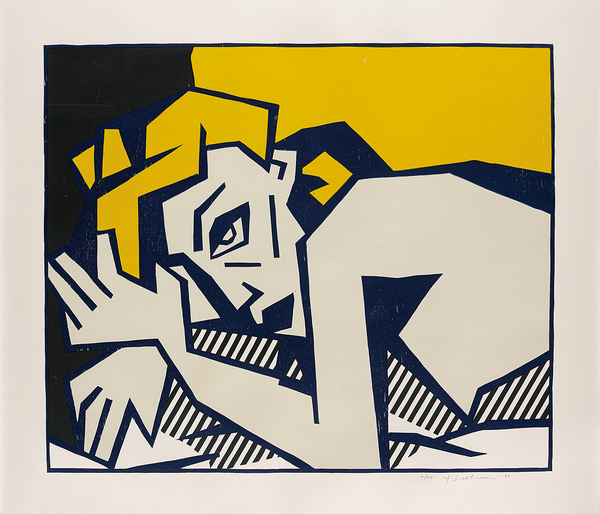
In addition, Lichtenstein drew a number of little drawings with a pencil that he later utilized as templates for woodcuts. Woodcuts were a popular medium among Expressionist painters such as Emile Nolde and Max Pechstein. Lichtenstein followed in their footsteps. The Expressionist Woodcut Series, which was completed in 1980, was the pinnacle of this investigation. This series of seven woodcuts includes themes that echo the Expressionist masterpieces, such as Dr. Waldmann, which recalls Otto Dix’s Dr. Mayer-Hermann, 1926, and Reclining Nude: an addition to Lichtenstein’s arsenal of iconography that has hitherto omitted nude figures. Both of these motifs can be found in this set of woodcuts.
Warhol, on the other hand, drew his inspiration from the work of a single Expressionist artist, Edvard Munch, in contrast to Lichtenstein, who engaged with the tropes and motifs of Expressionism as a holistic movement. It might come as a surprise to learn that Warhol opted to model his work after that of Munch initially. The superficial, synthetic surfaces of Warhol’s brightly coloured paintings and screenprints don’t appear to have much in common with the profoundly existentialist and emotionally charged work of Munch. In point of fact, Robert Rosenblum once made the observation that it would be difficult to find an artist who, on a psychological level, more symbolized a rejection of Warhol’s poker-faced emotional numbness than Edvard Munch did.
And yet, in the fall of 1982, Galleri Bellman, which was located on 57th Street, displayed a stunning show of 126 paintings and prints by Munch. The title page of the exhibition catalogue included a copy of Munch’s 1895 lithograph The Scream. Warhol went to see this show numerous times, and in 1983, a partner at the gallery contacted him with the idea of commissioning a series of paintings and screenprints based on four of Munch’s lithographs: The Brooch (Eva Mudocci), Self Portrait, Madonna, and The Scream. These lithographs were chosen as the basis for Warhol’s new works. The last of these four prints was the one that sparked the idea that eventually became The Scream (After Munch), which Warhol created in 1984.
Despite the fact that their creative styles appear to be worlds apart, Warhol jumped at the chance to collaborate with Edvard Munch on one of his most instantly recognised subjects: The Scream. By the time Warhol started working on this commission, Munch’s version of “The Scream” had already been the subject of the artist’s own repetition and appropriation. In this version, Munch re-interpreted and modified the theme for new artistic purposes. In an undated letter to Axel Romadahl, Munch noted, “I have often repeated my pictures; however, it is always a progression and never the same.” I layer one painting on top of the other. The Scream was, without a doubt, a particularly fascinating theme for Warhol, who considered Munch’s extensively used and rapaciously commodified images as ready-made, prime for his own modification. This motif already had a history of being re-appropriated, so it was already familiar to Warhol.
When Warhol initially began his work on the translation of Munch’s foundational theme, he began by having pictures of the original print blown up so that he could trace the enlarged images of the reproduction. This allowed Warhol to work more efficiently. At this point, Warhol started removing portions from Munch’s composition. He chose the aspects of the work that would serve as signifiers of the original and then simplified those aspects into essential graphic shapes. Signposts, which are chosen notations taken from the original, are all that are left in the current lot.
Warhol diverted attention away from Munch’s story of anxiety, in the same way that Lichtenstein attracted all attention to the surface of his Expressionist Woodcut Series, and therefore removed his work from the original emotive Expressionist works. In this way, Lichtenstein distanced his work from the original emotive Expressionist works. Instead, he investigates the theme in terms of the myriad formal components that make it up. He does this by contrasting warm and cold hues in order to achieve the highest possible level of visual dynamism and dissonance. The different lines and forms of the composition are given emphasis and distinction in their visibility, which results in a palpable vibration of colour. Warhol makes deft use of overprinting and overlapping to produce a slightly out-of-register picture that dances before the viewer’s eye and keeps their attention firmly focused on the surface of the screenprint. This is an example of Warhol’s creative use of screenprinting techniques.
When copying the iconography of Expressionism, Lichtenstein and Warhol took two quite different approaches: Lichtenstein analysed the ideas and aesthetic of the movement as a whole, whereas Warhol focused on the work of a particular artist. However, the difference between the original and the variant is represented in a palpable way in Lichtenstein’s Expressionist Woodcut Series as well as in Warhol’s The Scream (After Munch), which oscillates in authorship between Pop and Expressionism. Both of these works were created by Lichtenstein. Both artists make fun of the themes and aesthetic language of Expressionism by repeating forms without including a story, and as a result, they produce famous examples of pop art that are characterized by their focus on surface, colour, and sarcasm.


Leave a Reply