
With Nature Morte set to showcase new artwork at the upcoming India Art Fair 2025, it marks a contribution towards an already existing dialogue probing into hybridity, materiality, and the ever changing relationship between nature, technology, and history. The exhibition is set to take place at Booth A1 from February 6–9, where Indian art will be set side by side with established and emerging international artists, putting India at the center of a broader global conversation. It is not only fielding a stand-alone exhibition but also utilizing the intellectual capacities of multiple commercial solo exhibitions around its Delhi and Mumbai galleries, enhancing the theoretical and artistic contours of the selected works. This only enhances the depth of and approach towards a particular symposium within the gallery that challenges conventional boundaries of an exhibition, making it so that the audience is invited into the intersection of the past, present, and future. Nature Morte is positioning itself as a key place to consider contemporary art making and its shifting boundaries by combining diverse artistic and theoretical approaches that bring together conceptual and material engagement with an artwork.
Conceptual Trajectories in Nature Morte’s Curatorial Framework
Hybridity and The Dialectics of Duality
When examining the presentations made at Nature Morte, great care is taken to study the dualities of being. This inquiry goes beyond superficial formal juxtaposition and delves into a complex philosophical socio-historical inquiry. In the works of Bharti Kher, the two-sidedness of gender, impersonated in an androgynous sculptural form, is interrogated with regard to Ardhanarisvara. The myth dismantles binary identity structures with the idea of a ‘man-woman.’ By combining male and female traits, this piece subverts patriarchal norms and contexts and compels us to think about the performativity of gender and the intersection of cultural stereotypes.
On the other hand, Raghav Babbar’s painting serves as a point of reference and a mixture of the historical art and modern identity of India. There is an Indian cultural heritage that coexists with British 20’s art. And it is here, from this postcolonial geography, that subjectivities are produced and fought over. For Babbar’s work, the application of modern British art styles to Indian paintings raises questions of diaspora, cross-national culture, and the amalgamation of cultures in modern art.
This approach to dualism is not limited purely to formal aesthetics but also enables positioning these artworks within vital theoretical discussions of hybridity, migration, and the complex construction of cultural identity on a world scale. By placing these artistic activities within a transhistorical and transgeographic context, Nature Morte’s curatorial tribalism encourages the public to challenge ideas of fixed authenticity, inheritance, and the self in a world that is now contemporary, interdependent, and ever-changing.
Technological Mediation and the Anthropocene Discourse
The tension between reality and non-reality is captured visually as a prominent theme in Thukral & Tagra’s Arboretum series, which embodies natural essences of flowers in block pixel geometry. This set of organic and synthetic straddles between unrestrained nature and rigid computer civilization, creating a dispute. This aesthetic approach is an intervention in the language of nature—a critique of the radically changing ecological boundaries shaped by man. Through morphing into an algorithmic way of presentation, Thukral & Targa’s art emphasizes artificial intelligence and digital anxiety in direct proportion to nature’s equilibrated pace of life.
At the same time, Manu Parekh’s gestures suggest a poetic quality where feminine motifs merge with botanical ones; nature becomes a physical representation of spirituality and life-giving. Parekh’s energetic brush strokes and vivid color schemes evoke a paradoxical relationship between femininity and land. His work reestablishes a sacred pre-industrial state of being where flora and the human figure are one, and nature is not mechanized, but rather, draws from indigenous knowledge systems that honor femininity. These works reinterpret traditional aesthetics through modern sensibilities.
These artistic dialogues critically engage with the contemporary discourse of the Anthropocene, where digital infrastructures, extractive economies, and ecologically hostile zones coexist in unprecedented ways. Both Parekh’s work and the Arboretum boldly challenge the latest aspects of humanity’s dependence on the environment and the potential for human progress while acknowledging that the relationship between humans and nature is more intricate than the notion of technological dominance. Through different but harmonizing approaches, these artists address an urgent conversation about sustainability, ecological awareness, and the intertwined destinies of the living world and the artificial.
Archival Reconfigurations of Space and Temporality
Singh’s Architectural Montages breaks down the logic of spatial thinking by completing the overlapping of imaginary regions, historical landscapes, and photography. This goes deeper into the historiographic conflict between memory, forgetting, and place-making. In the same way, Singh’s work dismantles the politics of architectural construction by claiming that all time and space documentation. Singh’s work oscillates between realities that are real and phantasmagoric.
The same applies to Braun, who, alongside other important Indian cultural icons, made Satyajit Ray and Vikram Sarabhai part of his historical research and simultaneously worked on movies and television science fiction. He expands his work’s memory across time and distance. He tackles the issue of how history is remembered or reinvented. His investigations simultaneously reclaim India’s past or modern done and undone history while also opening up alternative possibilities for India’s future.
Through a markedly different material syntax, Remen, Chopra, and W. Van Der Vaart approach Persian and Afghan carpet traditions, suggesting a mix of craftsmanship and migration narratives, displacement, and cultural intermixture. Van Der Vaart transforms this work into a contemporary palimpsest, replacing traditional motifs with connections to new identities forged within diaspora and transnational culture, where the old world is layered over one’s identity as a superimposed history.
In Ayesha Singh’s case, her site-specific intervention for the facade of the India Art Fair foregrounds feminist historiographies in architecture. Ayesha Singh’s project reveals how the systemic denial of women’s involvement in building spaces is undone through architecture. Singh reclaims architectural agency by utilizing spatial interventions that change the structures of herstory in India, where the assumed presence of female architects, Indian heritage, craftswomen, and laborers is not just acknowledged but celebrated.
Together, these varied approaches to history, materiality, and place work in tandem to construct a counter memory and a critical geography of dominance and its narratives through contemporary art. These artists do not only challenge the authenticity and the ‘truths’ of the historical documents, but with their works, they also render different ways through which cultural memory may be engaged in, in a world where nothing seems to remain constant.
Featured Artists and Their Conceptual Contributions
Nature Morte has achieved curation that deals with a host of artistic methods and tactics of a number of theoreticians. Some notable ones are:
Dayanita Singh—Architectural Montages: An exploration of how people remember spaces, focusing on how the memory is constructed, stored, and reinterpreted through photography. Singh’s work reframes spatial and architectural memory by challenging the so-called static notions of the built environment that contemporary photography is tethered to and instead offers remixed urban terrains made up of modular and ephemeral structures situated between absence and presence. Singh creates a technologically advanced architecture with her signature book installations and photographic archives. Instead of asserting institutional definitions of documentation, Singh’s techniques transform the inflexible space of a building into a pliable one and turn the viewer into an active participant within the melting space. Through such defiance, she addresses the power relations in the production of spatial documents and elevates photography to an important role during the reshaping of one’s history, identity, and memory.
Bharti Kher—The Watchman (2018): An offering to the sculptural meditation on the idea of gender hybridity and its fluidity suffused with the myth of Ardhnarisvara. By fusing male and female, Kher undermines deeply set binary genders and interrogates the traditional and modern ‘to do’ discourse. The piece embodies her dominant practice, which uses found objects, bindi patterns, and creature-like sculptures to question the social order in a material and conceptual hybrid style. The Watchman is more than an abstract juxtaposition; it is a statement about cultural memory, transformation, and how fluid identity is sculpted within changing socio-political realities.
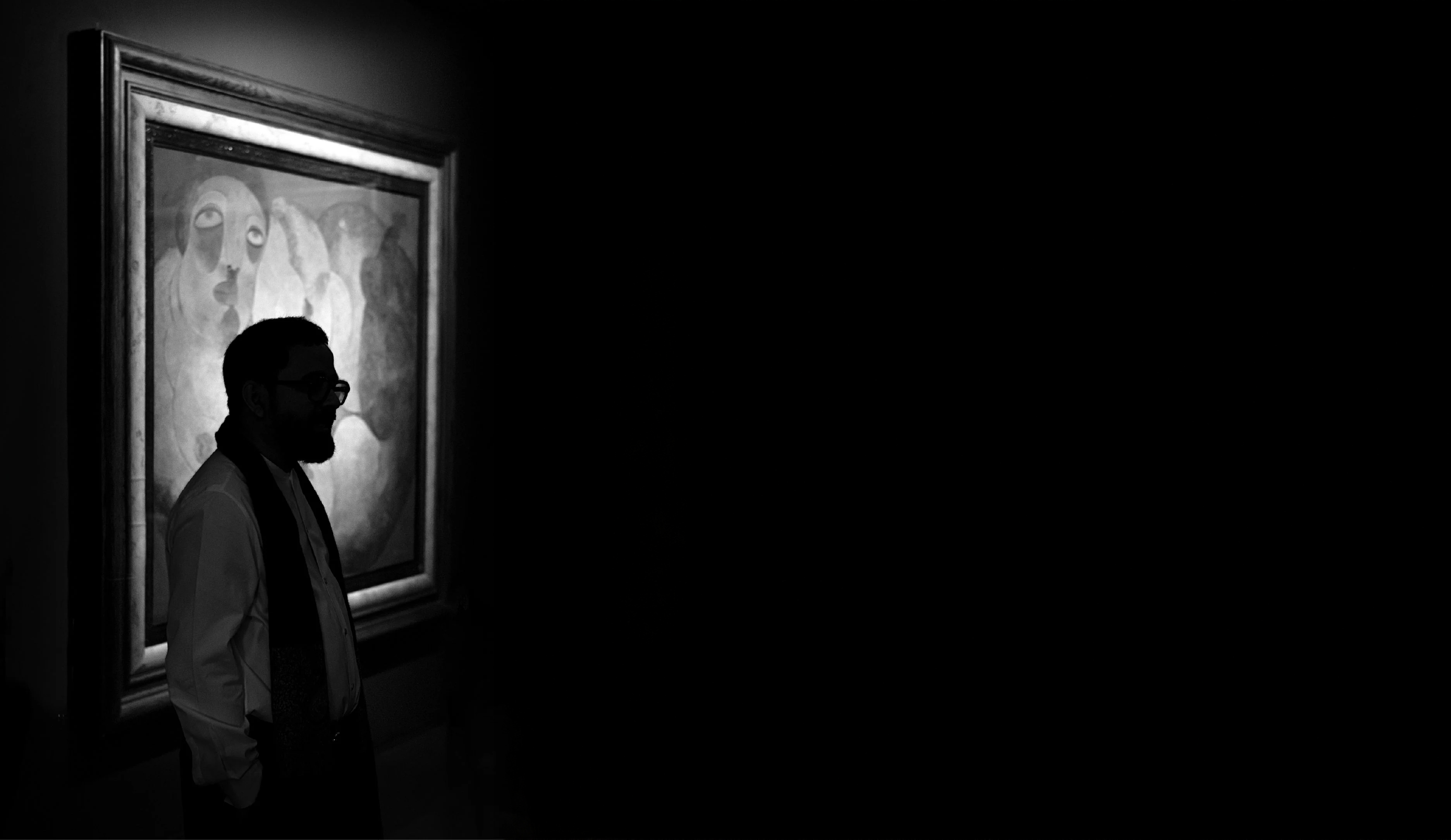
Raghav Babbar—He artistically critiques imaginary paintings presented by British Modernist Britain and its dialogue with postcolonial identity formation. The amalgamation of indigenous and colonial aesthetics creates a sophisticated discourse on hoarding, hybridity, memory, and cultural negotiation. His art poses questions regarding how historical norms of artistry continue to inform contemporary subjectivities of their bearers by placing them in shifting, borderless, multidimensional, elliptical spaces that are at once superimposed on each other like the past and the present, the global and the local. With his figure-like style shaped by Indian socio-political themes, Babbar deploys compositional techniques of 20th-century British portraiture to shed light on the complexities of life in exile and new identity in a transnational world, making his work a captivating commentary on structural violence and the Morrison’s visual culture of colonization.
Manu Parekh—Flowers from Heaven Series: An exploration of nature expressing feminism through spirituality, fertility, and cosmic energy. The signature vivid expressionist chromaticity of Parekh’s work intermingles with deeply emotive expression. His prominent, bold brush strokes and glowing color palette define nature as a sacred mother and force of generation. His compositions often consist of heavenly images, floral motifs, and human forms that flow into one another, emphasizing life, creation, and the renewal’s cyclic rhythms. Using his unique imagery, Parekh dismantles the fragile separations between the physical and the spiritual, giving room for artistic pondering on the nature of the feminine and the natural world. His art draws inspiration from Indian culture but uses such traditional references as contemporary problems of ecological attention and metaphysical thinking.
Thukral & Tagra—Arboretum series: A deep examination of the conflicts between biological systems and digital frameworks emphasizing new forms of mediation and disruption of natural systems. The series correlates pixelated digital and biomorphic elements to suggest the increasing complexity of human involvement with ecological realities. The works explore the effects of artificial intelligence, data mapping, and algorithmic architecture on natural environments and their unsettling impacts on sustainability, nature’s commodification, and the blurring line between organic and synthetic. Blending traditional depictions of flora with modern digital elements, Arboretum responds to the Anthropocene epoch—a term used to capture the ecological disruption and monstrous omnipresence of technology, resulting in drastic changes to how we perceive nature.
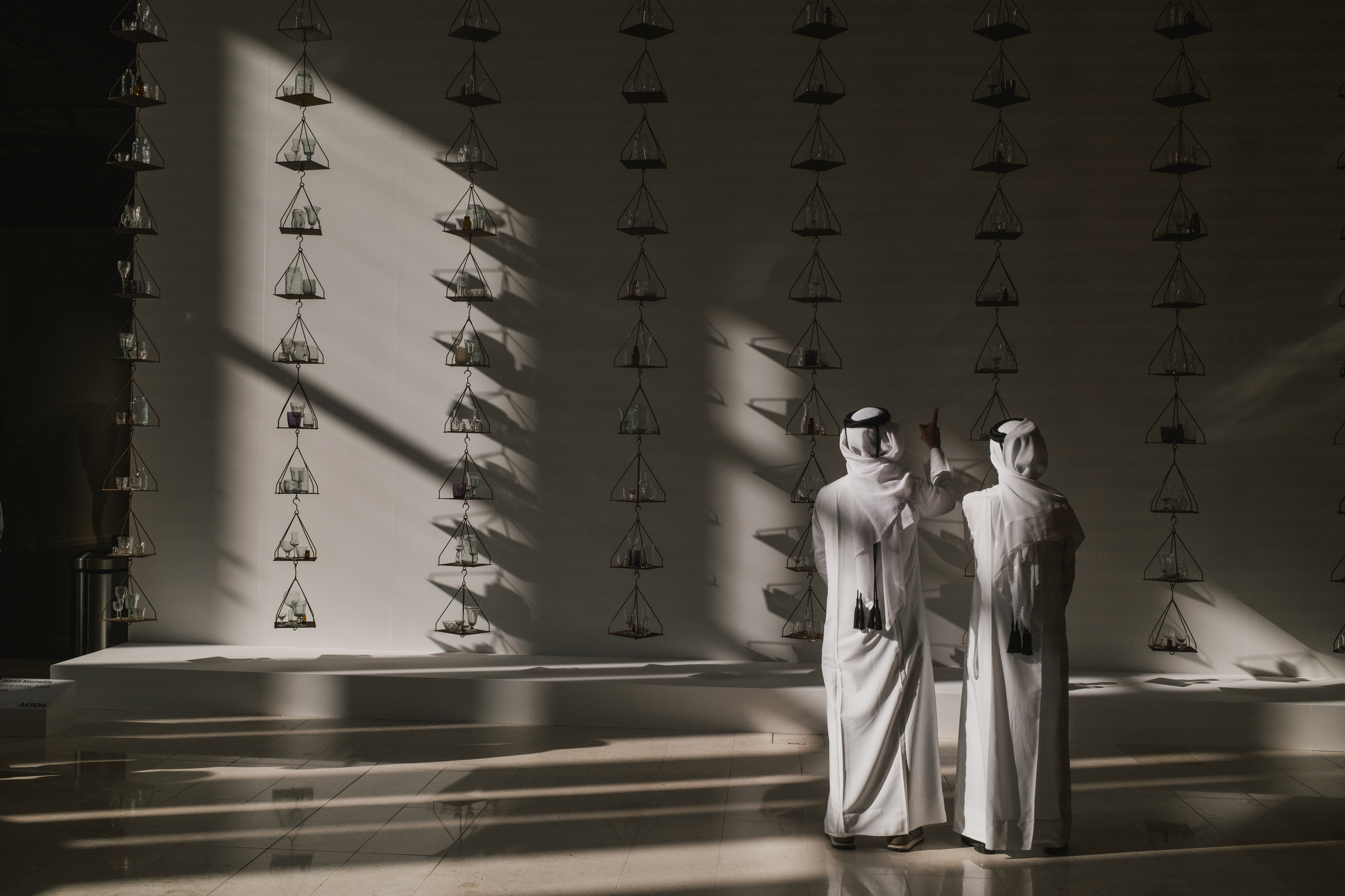
Matti Braun is an interdisciplinary creator whose pieces focus on silk, glass and film. He customarily intertwines history and politics in a transnational context. His philosophy employs communication across cultures. His works stem from intersections of culture and history, fiction, literary and cinematic narratives, and explorations of materiality and abstraction. While incorporating glass and silk, which signifies modernity, cultural significance, and the history of trade, Braun creates an interplay of the past and present. Braun’s compositions attend to silenced histories, implanted futurities, and lost stories. It makes it possible for viewers to accept imbalance in historical succession and its consequences in present art. Matthew Braun uses these materials to comment on culture while edging out space and time, marking his work as a point of vibrant multicultural emulsion.
Oliver Beer: Resonance Painting series – Through the lens of ‘vibrational physics,’ Beer conducted a deeply thought-out investigation into the nature of sound using art and technology. Using the principles of musicology and fine art, Beer observes the auditory entity in relation to material resonance and spatial perception. He carves out intricate visual patterns full of harmony and structural resonance within surfaces. By manipulating the natural frequencies of objects, he is able to capture sonic vibrations revealing the everyday materials’ hidden intricacies. These transient sonic imprints vividly illustrate sound as more than just an auditory experience. It turns sound into an intrinsic visual component of matter and therefore creates a new form of scientific inquiry. Resonance Painting compels the viewer to perceive and engage with the artistry beyond its surface. For this reason, Beer’s work positions the discussion in a wider philosophical discourse around perception, temporality, and the tangible essence of sound in space.
Concurrent Projects and Solo ShowsThe Nature Morte booth at the India Art Fair features a solo presentation in the form of a booth alongside the rest of the solo presentations and parallel projects that best highlight the intellectual and aesthetic of the gallery.
In New Delhi, Sagarika Sundaram’s Polyphony is a hallmark in Sundaram’s interdisciplinary work. She redefines fiber art by softening its rigid boundaries through combining felt-making with corporeal and spatial memory. Polyphony investigates textiles’ dual role as meta-narratives and as transformative agents through large-scale sculptural installations. The movement is not simply aesthetic but structural, as Sundaram’s work challenges the conventional divide between soft and firm by morphing volume, shape, and the manner in which the piece is layered or compressed. Textiles are personal and collective memories. Morphology of Polophony forces the viewer into reflection on how textiles slash the divide between witness and memory.
Remen Chopra W. Van Der Vaart’s Aurum Lazuli (New Delhi) – This exhibition provides profound insight into the changes and continuities in the history of textiles. By reinterpreting Persian and Afghani carpet traditions, Van Der Vaart creates a visual story that embodies themes of displacement, cultural inheritance, and memory. Aurum Lazuli integrates textile art with modern sculptural approaches to critique the notion of heritage as petrified and instead reinterprets it as a responsive and changing entity to time and space. The works in the exhibit highlight the decay and fragility of historical artifacts through layering techniques, underscoring how cultural legacies are preserved and dissolved at the same time. van der Vaart engages in a very fundamental question in the art world: merging minute details and craftsmanship with the abstract amorphousness fosters the question of how identity, history, and artistic narrative intertwine, seriously contemplating the blur between material culture and impermanence.
Let us today learn something through Parul Gupta. The work entitled In Praise of Limits (Mumbai) brings a fresh perspective to the duality of the minimalist and maximalist perceptions. The exhibition attempts to span the bounds of spatial perception and the coordinates between shifting constraints and expansions. She combines space phenomenology with extensive methodologies, such as sharp linear constructs, shallow surfaces, and optical surrealism, to subvert customary understandings of dimensionality or depth. Her works embody breath with distinctive meditative engagement by bracketing reductive geometric abstraction and oscillating between dynamic maximalist density. Gupta integrates meticulousness by repeating contours and variable shifts in perspective to orchestrate an immersive experience that morphed stagnant compositions into progressive visual fields. She shifts the viewer’s focal point to cognitive mapping of form and shifts the viewer’s perception of his or her spatial awareness. The exhibition places itself within an assignment of broader reasoning on material limitation as a driving force for conceptual innovations and how these constraints are boundless with creativity.
An ecological critique of material consumption, spontaneous artistic creation, and environmental damage, Asim Waqif’s art piece Make-Shift seems to have deep layers. This work looks into the combination of urban debris, industrial garbage, and the wasteful aesthetics that challenge art in not only its traditional form but also its sustainability. In the act of repurposing found materials, Waqif disengages with adaptive reuse and creates strong, interactive structures that catalyze discourse regarding humanity’s participation in the constructed environment. Make-Shift does not only make a statement about overconsumption but also exists as an answer to certain social and spatial conditions, intermeshing architecture, protest, and sculpture. Its stark materiality and construction-driven approach allow the work to challenge contemporary notions of decay, organic metamorphosis, and impermanence, changing the ways we consider the role of such notions in current artistic endeavors.
Ayesha Singh’s India Art Fair Facade—A potent spatial intervention that extraordinarily captures and expands the narrative of women’s contributions in India and challenges their erasure from history. Singh’s work is deeply engaged in archival excavation and aims to unearth overlooked accounts of female architects, artisans, and laborers whose works were concealed under imperial narratives. The structure serves as a site of resistance, revealing and redefining architectural, structural, material, and spatial compositions within a modern feminine perspective. Singh generates a space between time and the need for a contemporary refashioning of architecture to address a feminist view by layering symbolic motifs and architectural pieces adopted from historical structures. The structure does not only serve to remember supposed erased narratives but also changes spaces to put women at the center of India’s architectural narrative, welcoming debate on who gets to be visible and recognized in the making of space.
Vibha Galhotra’s Orbis Unum—an endeavor that analytically articulates post-national concepts and that explores the engineered nature of international boundaries and nationalism. Galhotra undermines the socio-political implications of the marked separation of boundaries through the purposeful deletion of symbolic boundaries. Her work is one that is critical of globalization and its endeavors, engaging deeply in the philosophy of global engagement that critique nationalism attempts to promote. Orbis Unum is a fundamentally new world distinct from that which is shaped by political borders and nationalistic claims. It does not impose it with the use of political maps, sculptures, flags, and other forms of nationalism; provocative art pieces deconstruct nationhood, challenging the viewer to reconsider citizenship, community, and humanity in a world that is constantly faced with wars, migration issues, and other geopolitical strife.
Nature Mort’s presentation for the India Art Fair in 2025 has the potential to change the discussion surrounding South Asian art, at least from a contemporary perspective. As the exhibition elicits critical engagement with the postmodern aesthetics of hybridization, it deals with the dualities of ontology, technological mediation, archival remembering, and material experimentation. Nature Morte’s contributions dismantle what it means to create art by speaking through diverse hybrid forms of sculptural installation and algorithmic abstraction. It is not just an exhibition on art, whether at the fair or elsewhere, but rather a critical idea in need of further exploration. This notion challenges viewers to think about the boundaries of culture, art, history, and the future, framing the debate within a larger context of hybrid artistic citizenship and contemporary curatorial practices.
Nature Morte
India Art Fair
6–9 February 2025
Booth A1
NSIC Grounds, New Delhi


Leave a Reply