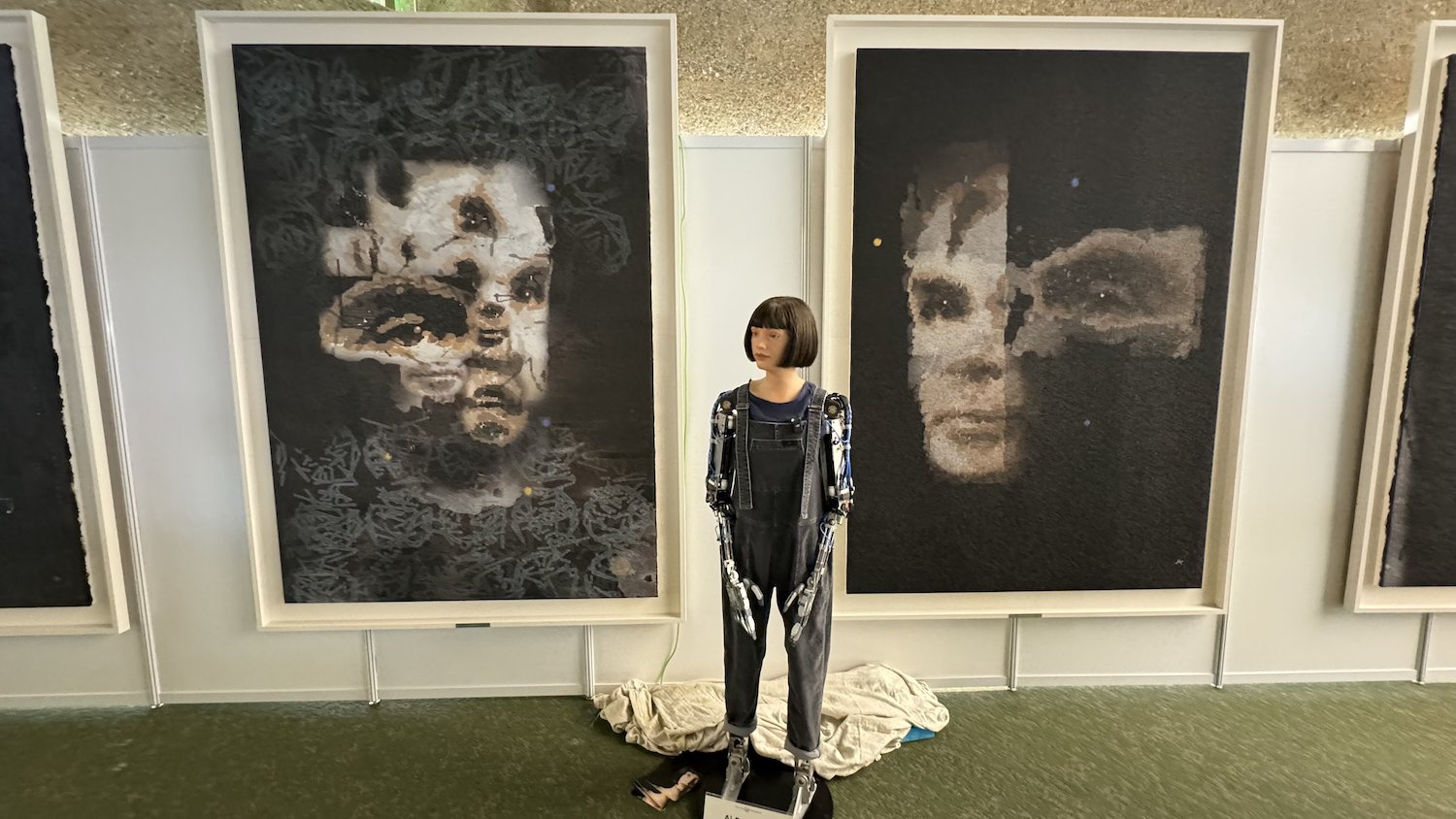
A new era was set in the world of art on November 7, 2024, when the work of Ai-Da, the first ever hyper-realist robot artist, was able to sell in a New York’s auction at Sotheby’s for the astonishing sum of $1 million. There were other bidders from across the globe who took a keen interest in the painting, A.I. God: Portrait of Alan Turing. This softens the ground, creating a terrific example for AI-created artistic images. The sale is not just a great economic success but also a controversial achievement that prompts interesting problems for the future of art—the issues of authorship and artificial intelligence in creativity.
Ai-Da: A Robotic Artist And Her Story
In the words of British art gallerist Aidan Meller, Ai-Da is much more than just a machine; in fact, she is a multi-faceted artwork herself. Her story started in the year 2019 when Aidan Meller teamed up with engineers, roboticists, and AI researchers from Oxford University and Engineered Arts. Her design was meant to have full autonomy over her painting abilities, as she was built with precise AI algorithms equipped with HD cameras coupled with robotic arms powered by hydraulics. This treatment allowed Meller’s creation not only to visualize but also to process information as well as actively engage in painting where no. The direct interaction of human hands with the painting was a necessity rather than a standard norm.
Ever since Ai-Da was created, she has continued painting portraits,Ever since Ai-Da was created, she has continued painting portraits, making sculptures, and producing abstract paintings that have never been witnessed before in the art industry for all good reasons. ulptures, and producing abstract paintings that have never been witnessed before in the Ever since Ai-Da was created, she has continued painting portraits, making sculptures, and producing abstract paintings that have never been witnessed before in the art industry for all good reasons. stry for all good reasons. Having the ability to create a painting or piece of art autonomously, Ai-Da was equipped with algorithms that were programmed to understand visual cues and respond to her paintings.
Apart from being called a technological wonder, Ai-Da virtually indicates the rearranging of the unknowns about creativity and how it can be expressed. Now, what does this mean for art to be created by a non-human? Ai-Da’s works implicitly aim to push the art industry towards a more human-centered understanding of the arts and creativity in general, rather than merely providing additional entertainment.
The Significance of A.I. God: Portrait of Alan Turing
Sotheby’s Canvassed on A.I. God: Portrait of Alan Turing for Money captured interest much more than the cost of its art. It extends beyond its tangible execution. It measures about 2.2 meters and is a disjointed, semi-abstract depiction of Turing’s head against a geometric design. The color palette and the color, as well as the composition, give credit to the life and work of Turing and acknowledge the mathematician as the “father” of computer technology.

Throughout history, cryptography has progressed due in part to Turing’s contribution along with his work regarding algorithms and machine learning. In turn, such advancements made the revolution in AI possible. Ai-Da’s work fuses patterns generated by the machine, shaped creatively through the ‘eye’ of Turing’s Bombe machine, and reflects the dualities that marked Turing’s life: an act of genius and social withdrawal, an act of invention and a persecution, a great idea and its limitation. This may adequately encapsulate how Turing viewed the technology he was instrumental in developing as well as Turing’s view on what AI should play in humanity, a view that Ai-Da herself might endorse.
There have been catastrophic effects for Turing’s devices.
Sotheby’s suggests that A.I. God would be priced between $120-180 thousand, which of course is a good amount considering it is debuting from a machine. However, this did not happen because a more industrial-scale bidding war brought to light the actual amount that Ai-Da was able to achieve. After almost half an hour and 27 biddings, Ai-Da was about to reach 1 million dollars, which practically doubled her estimate of Ai Davidal.
The importance of this sale goes further than simple economics. With Ai-Da’s record as the first robotic artist to surpass 1 million in sales, new discussions have been started on AI and its relevance in art. The centerpiece of this auction was your AI-generated work and the reaction it evoked from art collectors, curators, and the art world in general, which has now begun to evolve. What started off as a simple exercise of imagination using technology has now grown into a phenomenon that raises concerns regarding the rights pertaining to ideas and designs as well as authorship in a contemporary society dominated by machines.
Understanding the Consequences. AI Art: realistic and emotional
Ai-Da’s accomplishments are now at the core of a bitter debate within the artistic community. Detractors of this form of art point out its greatest flaw, emotion and depth; AI lacks both, and those are critical elements of any art. Throughout the ages, art has been honored as an embodiment of an artist’s life story, emotion, heritage, and generally the rich and complex human experience. In their perspective, Ai-Da’s creations, regardless of how good they are, lack the emotion and intimacy required.
Some people raise the point that AI art presents a peculiar way of looking at humanity that needs additional exploration. They argue that Ai-Da’s art is significant for the reason that it allows to see creativity differently, as an algorithm embedded in a machine that can be interpreted but in human terms. According to this view, the meaning of AI art does not lie in the artwork but in the interaction between humans—the viewers, the artists, and AI developers—and the artwork. Artworks of Ai-Da are therefore to be considered as works of culture that show a different way of integration between AI and art, thus enriching the understanding of art.
The Road Ahead: The Age of AI and Art Together
This journey Ai-Da’s sale marks an important point in time for a ready and active AI-competent era. More and more AI artists are on the rise, with each of them leading the progression of this technology-art interaction in varying ways. This phase of the journey might see AI not just engaging in making pieces of art but possibly engaging in changing directions of whole art styles.
Cultural institutions are now tasked with establishing some framework to address the greater absurdity that is law, philosophy, and commerce, assuming there are distinctions to be made within AI-I art. Why shouldn’t these AI works be treated as independent artifacts? If machines create art by themselves, how should authorship and intellectual property be regarded? Does AI-generated art ever acquire the same intrinsic value created by a human being?
Ai-Da’s turning of A.I. God into a million-dollar A.I. sure does make her a historical figure within the bizarre interdisciplinary realm between art and technology. The future acceptance of AI art galleries, museums, and private collections across the globe is bound to her success. Her achievement may send the message that the looks of the art world aren’t only going to belong to humans; instead, they may belong to many cutting-edge creators in the near future.
image courtesy : https://www.ai-darobot.com/


Leave a Reply