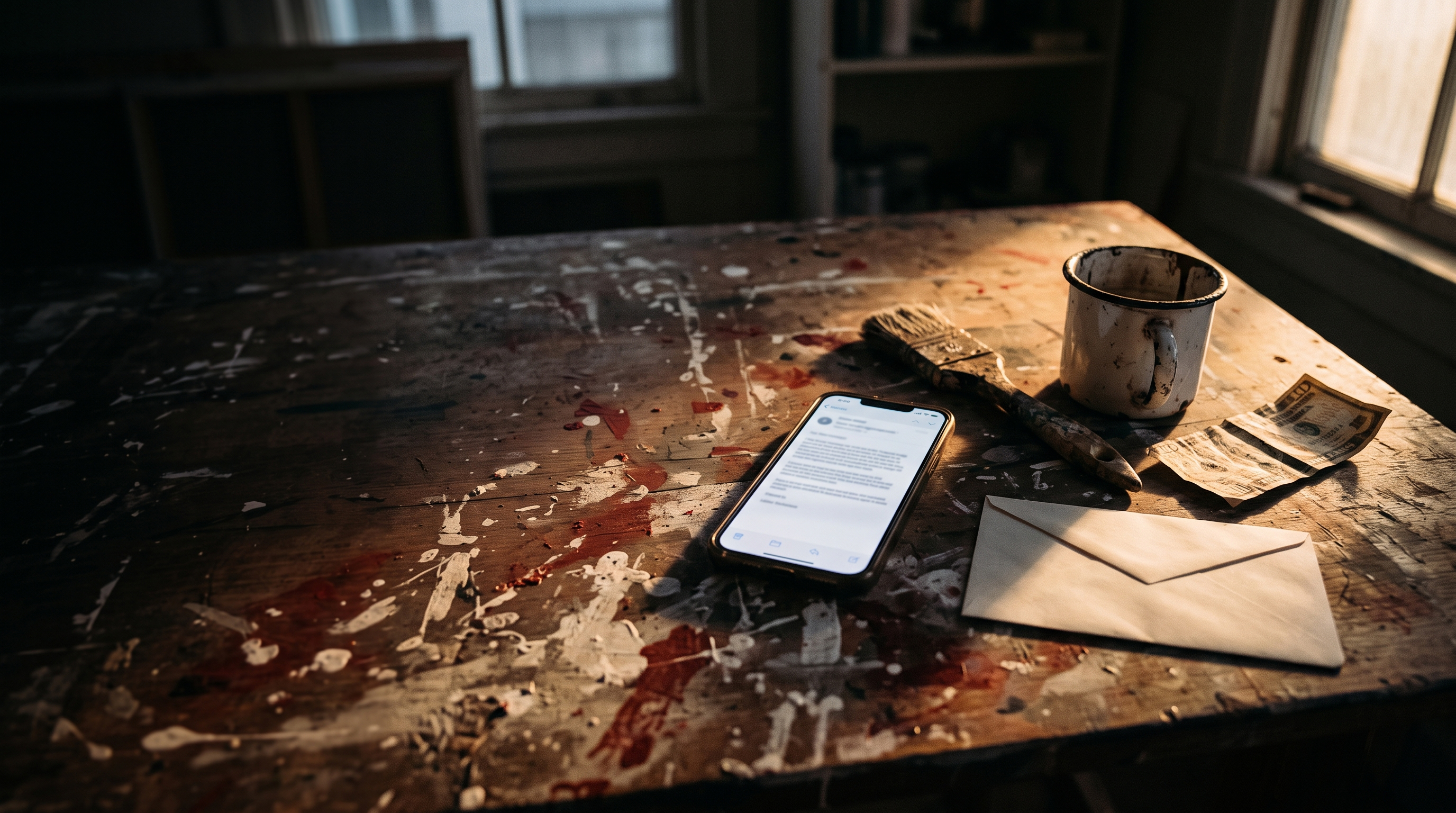
The Email That Arrived at Dusk: Abstract Magazine Summer Residency
It came in the evening, which is when these things always come. June 5. The light going amber over Delhi, the day’s work drying on the board, and then the phone buzzing with a subject line that reorganized the rest of the year.
“Hello SANYAM,” it began—the name in capitals, the way a mail merge field renders when nobody has bothered to sentence case it. “My name is Emily, and I am a member of the artist selection team for our summer residency in Georgia.”
What followed was not a form letter and did not read as one. It read as a hand extended across a continent. Last year, the message said, you expressed interest in our Summer Residency in the South of France, and I wanted to reach out personally because we would be delighted to welcome you to this year’s residency in Georgia. Two cohorts of twenty artists. A historic villa. Two weeks each: August 3 to August 16, and August 17 to August 30. Transportation, accommodation, meals, and art materials fully covered.
And then, in a parenthesis carrying more weight than any other four words in the email: complete this short form (free of charge).
Within six days that email—and the many others like it—would detonate across Reddit and Instagram, draw the attention of Artnet News, and force the Abstract Magazine Summer Residency into a defensive posture it has still not entirely climbed out of. But on the evening of June 5, in a room in Delhi and in rooms in Los Angeles and London and Hanoi, it was simply the best news many people had received in a long time.
Anatomy of a Warm Approach
Read it cold, as a document, and the June 5 message is a small masterpiece of persuasive engineering. Every element does labor.
The callback does the heaviest lift. By invoking a prior application—”Last year, you expressed interest”—the email converts a stranger into a returning acquaintance. It implies a file. It implies that somebody, somewhere, kept your name. For an artist whose submissions usually vanish into portals that never acknowledge receipt, being remembered is not a small thing. It is the whole thing.
Specificity does the rest. Vagueness is the tell of a con; this email is dense with the texture of logistics. Two groups. Twenty artists each. Exact dates. A villa. Later, a full program: pottery and clay-modeling workshops, yoga sessions, wine tastings, and excursions to cultural sites in the region. Nobody fabricating a phantom bothers to schedule yoga. Then scarcity—forty seats worldwide for a magazine with more than a million followers—and finally the removal of all friction. Free of charge. No card, no gate, nothing to lose. The only ask at the door is time, and artists have been trained to give that away.
Variants of the approach circulated in parallel. The version most widely screenshotted online, as reported by Artnet News, went further than the one Bajaj received: it told recipients that their application had been reviewed the previous year and placed on a selection shortlist and that the writer was reaching out personally to invite them directly to participate in this year’s residency. Different words, identical architecture. You were seen. You are wanted. Come.
The Second Email, and the Fifteen Dollars
Bajaj completed the form. It was, as promised, free.
The second email arrived with the tone of a hospital corridor conversation going unexpectedly well. Thank you for completing the form; the information had been incredibly useful in organizing candidates by practice and preferred dates. And then the sentence that mattered: you have successfully passed the preliminary stage of our selection process and have been included in a group of artists currently in the final stage of review by our selection committee.
Final stage. Committee. A date attached—the review would continue until July 1, after which all selected participants would receive official confirmation. The villa returned. The workshops returned. The wine tastings returned. And then, near the bottom, past the point at which most readers have already begun mentally rearranging August:
“To proceed to the final stage of review, please complete a quick form and pay the application review fee of $15 USD using the link below… This fee helps cover the costs of reviewing and administering residency applications for this season.”
Fifteen dollars is a trivial sum and an enormous one, depending entirely on where it sits in a sequence. Presented on day one, alongside forty other open calls, it is a line item to be weighed. Presented on day two, to someone who has just been told they cleared a preliminary stage and stand within one committee meeting of a villa in Georgia, it is not a prize. It is a formality standing between a person and something they have already begun to imagine.
This is the structural heart of the Abstract Magazine Summer Residency controversy. The fee did not appear where fees are compared; it appeared where fees are no longer compared—after the commitment, after the flattery, after the identity shift from applicant to near-participant. Behavioral economists call it escalation of commitment; door-to-door salesmen called it the foot-in-the-door technique. Either way, the parenthesis on day one was not a description of the process. It was a description of the first step of it.
There is a second, stranger wrinkle. Artnet News reported that the residency’s open call, promoted on Instagram in May with a deadline extended through June 15, carried a $25 application fee. The invitation track that reached Sanyam carried $15. Two prices, two doors, one selection — and no published explanation of how the two funnels related or whether they competed for the same forty beds.
Everyone Was Chosen, Which Means Nobody Was

The illusion held for as long as recipients believed they were alone. It ended, as such things now end, in the comments. By the second week of June, Reddit threads titled “Summer Residency scam” were accumulating replies in a rhythm familiar to anyone who has watched a rumor become a consensus: I got this too. I also just got the invite. So we’re all here. Instagram posts lamenting the lack of clarity drew hundreds of thousands of views. Artnet reported that many recipients had not applied to the 2026 edition at all and that some had never applied to any edition—a detail that quietly reframes everything, because an email cannot credibly reference last year’s application to someone who never made one.
Consider the denominator. Abstract Magazine’s Instagram account carries roughly 1.1 million followers; the Summer Residency account had amassed some 233,000. The residency offers forty places. Nobody outside the organization knows how many invitations went out on June 5, and that opacity is not incidental—it is the single fact that would settle the entire dispute, and it is the one fact nobody has published.
Run the arithmetic as a thought experiment rather than an allegation. If a thousand people received the June 5 email and a fifth of them paid to advance, the review fees alone would outstrip the cost of a flight to Tbilisi. At ten thousand, the figure becomes something else entirely. None of that establishes intent. All of it establishes why intent is being questioned—and why an organization running this model should publish the denominator voluntarily before anyone thinks to ask.
“I wanted it to be real, two weeks in a Georgian villa with everything covered is every emerging artist’s dream. But the contradictions stacked up fast: ‘free of charge’ became a fee, my follow-ups went unanswered, and then it seemed like everyone had been ‘selected.’ The excitement curdled into a knot in my stomach.”
— Sanyam Bajaj, artist
“Curdled” is the correct verb, and it is worth pausing on. What Bajaj describes is not the disappointment of rejection, which artists absorb weekly and professionally. It is something more corrosive: the retroactive humiliation of having been happy. The knowledge that the feeling was manufactured, that it was issued in bulk, that somewhere a spreadsheet contained your excitement as a row.

The Silence
An organization’s response to a crisis is usually more revealing than the crisis itself. Here it was nothing, and then it was worse than nothing.
Artists who replied asking for clarification reported that their messages went unanswered; others reported hard bounces. When Artnet’s reporter attempted to reach Abstract Magazine and the Summer Residency at their listed general addresses, those communications bounced too. The magazine’s founder, Roman Sviridov — whose eponymous gallery operates between Kyiv, London, and Brugherio, Italy — did not respond to a request for comment, nor did Emily Hart. Independent writers had hit the same wall a full year earlier.
Then came the decision that converted a communications failure into a scandal. Comment sections on the organization’s social channels were closed. Users who had posted criticism were blocked.
Be fair about this: closing comments during a pile-on is standard crisis practice and often the humane choice for staff. But in a dispute whose entire subject is whether an institution will make itself legible to the artists it solicits, it is also the most inflammatory available move. The organization had been accused of speaking to thousands of people without listening to any of them. It responded by disabling the listening apparatus.
For nearly a week, the loudest thing in the story was the absence of a voice in it.
The Statement
On Wednesday, June 10, Abstract Magazine finally posted. Its position was narrow and, on its terms, coherent: the June 5 email had signified advancement to a further stage of review, not acceptance into the residency.
“Not being immediately selected for a residency is understandably disappointing, but it is not a reason to assume fraud or misconduct,” the statement read.
That sentence is defensible as a general proposition and almost perfectly calibrated to enrage the specific people reading it, because it answers a charge nobody was making. The artists were claiming they had been accepted. They were claiming that a document engineered to produce exactly that feeling had made them feel selected, at scale, and then invoiced them.
In consumer-protection frameworks across most jurisdictions, the test for a misleading commercial communication is not what the sender privately intended but what a reasonable recipient would understand it to mean, in context, as a whole. This is not a legal finding, and this article should not be read as one. It is simply the standard against which several thousand people instinctively measured the email—and found that its wording and its explanation did not meet in the middle.
The Ghosts of Château de Forbin
The most consequential reporting to emerge from the affair concerns not this year’s residency but last year’s—and it complicates the simple story in both directions.
The inaugural edition took place at Château de Forbin, in Marseille; eighteen artists were tagged in the residency’s Instagram photographs. When Artnet contacted several former residents to corroborate an account posted publicly by London-based artist Yutaro Inagaki, they confirmed the residency had in fact happened—people went, stayed, and worked. Inagaki himself declined to call it an outright scam while describing a pattern of red flags that had left participants uneasy.
But they also confirmed that it had not happened as promised. Neither the advertised art materials nor the gallery representation materialized. Abstract Magazine, the Summer Residency, and Sviridov did not respond to a request for comment on those claims.
This finding should reorganize the conversation. On the available evidence, the Abstract Magazine Summer Residency is not a phantom. It is something more common and harder to police: a real event wrapped in a promise larger than itself. Fraud is a crime with a definition. Over-promising is a business model with a marketing budget.
The unnamed elements sustain the doubt. A villa in Georgia was announced without an address. Partner galleries and curators were counted—fifty of them, in earlier promotional material scrutinized by independent writers—without one being named. Deadlines were extended and extended again. Each is individually explicable. Collectively they describe an organization that has chosen, repeatedly, the version of every disclosure that cannot be checked.
When the Alibi Becomes the Target
As the controversy escalated, the eighteen artists tagged in last year’s photographs were engulfed. One Instagram commenter said plainly that they mistrusted anyone claiming to have attended and enjoyed it. A Reddit user rendered the suspicion in four words that spread fast: the artists are props.
The organization had made itself unreachable, so the crowd pressed against the only human faces it could find. Former participants describe being inundated. Taos-based painter Boramie Sao, speaking to Artnet, made the observation that ought to end the discussion: it is hard to understand taking backlash for a residency you applied to, were invited to, and attended—and perhaps people aimed their questions at working artists simply because working artists were reachable, when the only party able to answer was not.
The Economics of Hope
Strip away the villa and the yoga and a question remains that the art world has avoided for a decade: what, exactly, is an application fee? Sometimes it is legitimate cost recovery: juries take time, jurors deserve payment, and platforms cost money. Plenty of respected open calls charge, say why, and publish who read the work.
The structural problem is that fee revenue scales with the number of applicants while the product scales with the number of places. Those two curves have nothing to do with each other. An organization with forty beds and an unlimited mailing list has no financial reason to narrow its funnel and every reason to widen it — and no obligation, anywhere, to disclose the ratio. As George McCubbin, the London painter who received an acceptance for a residency he does not recall applying to, put it to Artnet, the episode raises real questions about the pay-to-play model adopted across submissions, exhibitions, and residencies alike.
The remedy is not complicated, and parts of the sector already practice it. Publish applications received and places awarded. Name the jury before the deadline, not after. State the venue. Separate the invitation from the transaction by at least one unpressured step. None of this requires regulation; all of it requires an organization to decide that the artists it solicits are counterparties rather than traffic.
Syd Wilson, the Los Angeles artist who applied last year and not this one, described to Artnet the feeling of the stars aligning—and then the specific heartbreak of losing what a first real opportunity represents: credibility, seriousness, and the sense of a door opening onto more doors. That is the commodity being transacted here, and it is worth considerably more than fifteen dollars.
Red Flags: A Working Field Guide
None of the following proves misconduct. Any two together should slow you down; any four should stop you.
- An unsolicited invitation referencing an application you do not remember making.
- A first step advertised as free that becomes a fee at the second step.
- No named jurors, selectors, or committee members anywhere on the site.
- A venue described by type — “a historic villa” — but never by name or address.
- Partner galleries counted but never listed.
- Contact addresses that bounce, or no contact route attached to the program itself.
- Comment sections disabled and critics blocked during a dispute.
- No published data on applications received versus places awarded in this or any prior cycle.
The Knot
July 1 was the date. It sat in the second email like a hinge—final selection results will be announced on July 1—and for a few weeks it organized the summers of an unknown number of people.
Bajaj’s follow-up questions were never answered. He is, by any measure, among the luckier people in this story: the sum at stake was fifteen dollars, and he never sent it. What was taken was smaller and harder to itemize—a week of believing and the particular quality of attention a person gives to an August they think is going to change something.
The Abstract Magazine Summer Residency may well run this summer. Twenty artists, then twenty more, may sit in a Georgia courtyard with clay under their fingernails and a glass of saperavi, and the photographs may appear in November, and it may have been exactly what it said it would be. The evidence from Marseille suggests something real happens, and something promised does not.
But an opportunity that requires this much faith is not an opportunity at all. It is a lottery with a warm cover letter. And the burden of proof does not sit with the artist reading an email at dusk, hoping. It sits, entirely and permanently, with the institution that wrote it.
Frequently Asked Questions
What is the Abstract Magazine Summer Residency controversy?
In early June, a large number of artists received an email from the Summer Residency’s selection team that many read as acceptance to a fully funded two-week residency in Georgia. When recipients compared notes online, it emerged that the message had gone out in bulk — including to people who had never applied. Abstract Magazine later stated the email indicated advancement to a further review stage, not acceptance.
Is the Abstract Magazine Summer Residency a scam?
No regulator or court has made any finding of fraud, and Abstract Magazine has publicly rejected the characterization. Artnet News reporting, corroborated with several participants, indicates the 2025 edition at Château de Forbin in Marseille did take place, although promised art materials and gallery representation were not delivered. The substantiated criticisms concern misleading communication, undisclosed mass emailing, non-responsiveness, and fee structure—not a non-existent program.
How much did the residency cost to apply to?
The publicly promoted open call carried a $25 application fee, per Artnet News. The invitation-track message documented for this article requested a $15 application review fee at the second stage, after an initial form advertised as free of charge.
How can artists verify a residency before paying a fee?
Contact the previous cohort directly. Require a named venue, named jurors, and published application-to-place ratios. Treat a fee that appears only after an apparent selection as a serious warning sign, and check that the organization’s contact addresses actually receive mail before you send money.
Editor’s note: This investigation draws on primary documents supplied by artist Sanyam Bajaj—the June 5 invitation and the subsequent fee request—alongside reporting by Artnet News and independent writers who examined the program in 2025. Abstract Magazine has stated publicly that the June 5 email indicated advancement in a review process rather than acceptance.


Leave a Reply