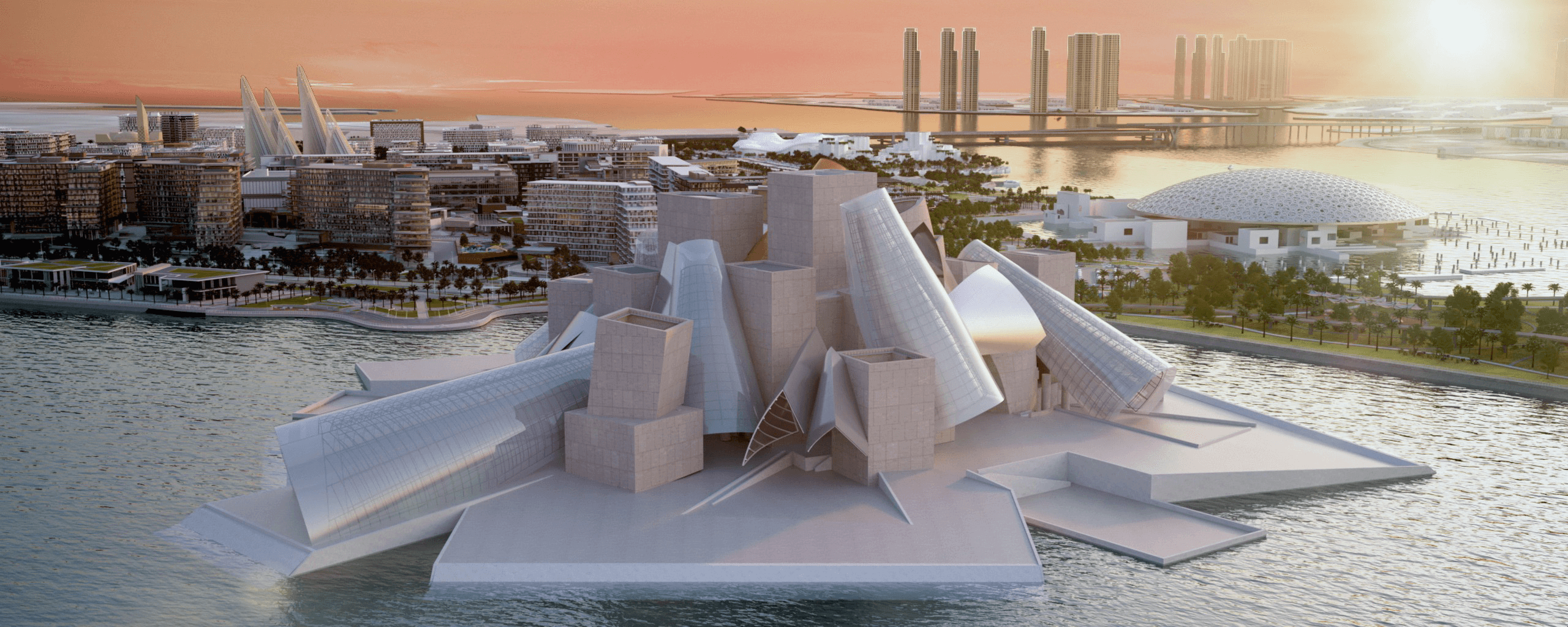
Two decades after it was announced, the largest museum in the Guggenheim constellation finally has a date. What arrives on Saadiyat Island in December is not simply a bigger Bilbao — it is a deliberate argument about where the center of modern art history sits.
Key takeaways
- Guggenheim Abu Dhabi opens to the public on 11 December 2026, confirmed by the Department of Culture and Tourism – Abu Dhabi (DCT Abu Dhabi) on 28 July 2026.
- It becomes the largest institution in the Guggenheim network, joining New York, Venice, and Bilbao.
- The building—the last major museum designed by Frank Gehry, who died in December 2025—spans 80,000 square meters, with 30 galleries, 11,600 square meters of indoor gallery space, and 23,000 square meters of outdoor exhibition area.
- The permanent collection, assembled since 2009, covers art from the 1960s to the present, hung thematically rather than chronologically.
- The opening closes a twenty-year development saga and reopens long-running debates about labor conditions, soft power, and the geography of the canon.
A twenty-year wait ends on Saadiyat Island
When DCT Abu Dhabi announced on 28 July 2026 that the Guggenheim Abu Dhabi would admit its first visitors on 11 December, the news landed with the peculiar force of something both long expected and repeatedly deferred. The project was unveiled in 2006. Construction began in 2011, stalled amid the global financial contraction and a series of contract disputes, and resumed in earnest in 2019. A completion target of 2025, set in 2021, slipped once more before settling on this December.
That chronology matters. Few museums of this scale have spent twenty years in public view without ever opening a door, and the interval has shaped the institution in ways its founders could not have anticipated. A collection begun in 2009 has been built through the rise of the global South in curatorial discourse, the decolonial turn in museum studies, the Arab uprisings, a pandemic, and a wholesale reordering of the art market’s geography. The Guggenheim Abu Dhabi that opens in December is, in this sense, a museum conceived in one art world and delivered into another.
Mohamed Khalifa Al Mubarak, chairman of DCT Abu Dhabi, framed the opening as “a defining moment in our cultural journey,” locating the museum within the emirate’s broader conviction that culture functions as durable infrastructure rather than decoration. The institution is a partnership between DCT Abu Dhabi and the Solomon R. Guggenheim Foundation, whose director and CEO, Dr. Mariët Westermann, has described the holdings as simultaneously rooted in the region and drawn from every continent.
Frank Gehry’s posthumous masterwork
Gehry died at his Santa Monica home on 5 December 2025, aged 96, roughly a year before the completion of what will stand as his largest museum. The building, therefore, arrives as an unintended memorial, and it will be difficult for any critic to write about it without measuring it against Bilbao—the 1997 project that made “the Bilbao effect” a term of art in urban economics and a source of anxiety in museum studies.

The architecture, by the numbers
The museum occupies a total built-up area of 80,000 square meters at the point where Saadiyat Island meets the Gulf. Inside are 30 galleries, arranged around a towering central atrium, comprising roughly 11,600 square meters of interior exhibition space — about 125,000 square feet — supplemented by an unusually generous 23,000 square meters of outdoor exhibition area, close to 250,000 square feet. That outdoor-to-indoor ratio is one of the design’s quietly radical propositions: it assumes sculpture, commissions, and public programs will spill into the landscape rather than remain sealed behind climate control.
Ten cones and an environmental argument
The building’s signature gesture is a cluster of ten sculptural cones rising to heights of up to 88 meters, nine sheathed in stainless steel mesh and one clad in onyx and glass. Gehry described these volumes as forming a skyline rather than a facade, and their logic is climatic as much as sculptural: the cones channel airflow, cast deep shade across circulation routes, and reduce the cooling load on a building sited in one of the world’s harshest thermal environments.
Read generously, the cones translate the vernacular of Gulf wind towers and courtyard shading into Gehry’s late idiom. Read skeptically, they are a familiar deconstructivist vocabulary scaled up for a desert coastline. Both readings will be tested in December, when critics finally walk the atrium instead of the renderings. Gehry’s presence on Saadiyat will extend further still: he also designed Dar al Funoon Abu Dhabi, the performing arts venue revealed for the same cultural district in June 2026.
Inside the Guggenheim Abu Dhabi collection
The curatorial premise is the more consequential story. Since 2009, the museum has assembled a permanent collection of modern and contemporary art from the 1960s to the present, spanning painting, sculpture, installation, photography, moving image and new media. Previously announced holdings include works by Jackson Pollock, Mark Rothko, Andy Warhol and Jean-Michel Basquiat—the load-bearing names of postwar American art, and precisely the names a Guggenheim outpost is expected to supply.
But the institution has been explicit that these canonical works are not the organizing principle. Al Mubarak has said the collection was assembled with a deliberate emphasis on artists who have received less international attention because of geography or gender, and that Pollock and Warhol will hang alongside contemporary practitioners from Southeast Asia, wider Asia, North and Central Africa and the Arab world. The stated center of gravity is West Asia, North Africa, and South Asia, with the rest of the world radiating outward from it — an inversion of the standard museological arrangement in which those regions appear as annexes to a European-American narrative.
A thematic, non-chronological hang
Stephanie Rosenthal, director of the Guggenheim Abu Dhabi project, has previously pledged to build one of “the most progressive institutions of the 21st century.” The display strategy reflects that ambition. Rather than a linear chronology or a division of galleries by nation, the museum will organize its holdings around themes including abstraction, popular culture, land, language, and storytelling, examining artistic exchange across cultures through what Rosenthal has described as a somatic approach—one shaped by the visitor’s bodily movement through space rather than by dates on a wall label.
Curators trained and based in West Asia, South Asia, Southeast Asia, Latin America, Europe, and the United States have worked on the framework, and Rosenthal has been candid that reaching agreement on a term as basic as “modernity” was not always harmonious. That friction is arguably the most interesting thing about the project. A thematic hang that reads Emirati land art against American minimalism, or Arab calligraphic abstraction against abstract expressionism, is a genuine art-historical proposition, not a diplomatic gesture—and it will be judged as such.
An early indication of range came in 2015, when Seeing Through Light: Selections from the Guggenheim Abu Dhabi Collection presented works by Yayoi Kusama, Rachid Koraïchi, Robert Irwin, Monir Shahroudy Farmanfarmaian, and Douglas Wheeler. Alongside the permanent collection, the museum will present new commissions, research initiatives and multilingual public programming spanning music, dance and food. Details of the opening exhibitions and commissioned works are expected in the coming months.
Saadiyat Cultural District and the arithmetic of soft power
The Guggenheim does not arrive alone. It joins Louvre Abu Dhabi (2017), teamLab Phenomena Abu Dhabi, Zayed National Museum and the Natural History Museum Abu Dhabi in what is now among the densest concentrations of major cultural institutions anywhere on earth — five flagship museums within walking distance, a density unmatched in London, Paris or New York.
This is the culmination of a cultural strategy first articulated in the mid-2000s, when the emirate committed to diversifying away from hydrocarbons by purchasing, in effect, a fully formed museum ecology. Critics have long characterized the approach as culture by acquisition. Its defenders point out that every great museum city—Vienna, Paris, New York—assembled its institutions through concentrated wealth and political will, and that objecting only when the wealth is Gulf wealth is an argument that struggles to survive examination.
What is genuinely untested is whether the Bilbao effect replicates at this density. Bilbao worked partly because a single extraordinary building landed in a city that had none. Saadiyat is attempting something closer to instant critical mass, betting that adjacency compounds rather than dilutes attention.
The unresolved question of labor
No account of this museum is complete without the campaign that has shadowed it since before ground was broken. The Gulf Labor Artist Coalition, formed in 2010 after Human Rights Watch reported on conditions for migrant workers on Saadiyat Island, has pressed the Guggenheim Foundation for enforceable protections: an end to recruitment-fee debt bondage, decent housing, wage guarantees, grievance mechanisms, and genuinely independent monitoring.
A petition first published in 2011 has drawn more than 2,400 signatories, and the coalition has called on artists to withhold work and sales from the museum until its demands are met. The developer overseeing Saadiyat’s construction issued an Employment Practices Policy, but the coalition has consistently argued that a non-binding pledge with contractor-commissioned monitoring is not the same as an enforceable standard. The Foundation’s board withdrew from negotiations in 2016, citing what it characterized as shifting demands; protest actions inside and outside the New York rotunda punctuated the intervening years.
Fifteen years on, the boycott’s practical reach is uncertain—the collection was evidently assembled regardless—but the ethical question has not been retired by the passage of time. Coverage of the December opening that treats the building purely as an aesthetic event will be incomplete. Coverage that treats it purely as a labor scandal will be equally partial. The interesting critical work lies in holding both.
What the opening means for the art world
For the Guggenheim Foundation, the museum resolves an institutional question that has hung over the network since the collapse of the Helsinki proposal: whether the franchise model has a future beyond Bilbao. For Abu Dhabi, it completes the anchor tenancy of a district a generation in the making. For artists and curators from West Asia, North Africa and South Asia, it creates an acquisition budget and a permanent display platform of a scale the region has not previously had — with all the gravitational distortion that implies for regional markets, biennials and career trajectories.
And for art history, the wager is straightforward. If the thematic hang succeeds, the Guggenheim Abu Dhabi will function as a working demonstration that the postwar canon can be rewritten from a different vantage point without being flattened into pluralism. If it fails, it will be an expensive and beautiful confirmation that the canon travels better than its critics hoped.
Planning your visit
- Opening date: Friday, 11 December 2026
- Location: Saadiyat Cultural District, Saadiyat Island, Abu Dhabi, UAE
- Nearby institutions: Louvre Abu Dhabi, Zayed National Museum, Natural History Museum Abu Dhabi, teamLab Phenomena Abu Dhabi
- Best time to go: December through March, when outdoor exhibition areas are comfortable
- Tickets and opening exhibitions: to be announced; check guggenheimabudhabi.ae and abudhabiculture.ae
Frequently asked questions
When does the Guggenheim Abu Dhabi open?
The museum opens to the public on 11 December 2026, as announced by the Department of Culture and Tourism – Abu Dhabi on 28 July 2026.
Who designed the Guggenheim Abu Dhabi?
Frank Gehry, the Pritzker Prize–winning architect of the Guggenheim Museum Bilbao and Walt Disney Concert Hall. Gehry died on 5 December 2025; this is the largest museum of his career.
How big is the Guggenheim Abu Dhabi?
It has a total built-up area of 80,000 square meters, including 11,600 square meters of indoor gallery space across 30 galleries and 23,000 square meters of outdoor exhibition space—making it the largest museum in the Guggenheim network.
What art will be on display?
Modern and contemporary art from the 1960s to the present, including Pollock, Rothko, Warhol and Basquiat shown alongside artists from West Asia, North Africa, South Asia and Southeast Asia, organized thematically around abstraction, popular culture, land, language, and storytelling.
How many Guggenheim museums are there?
Four: New York, Venice, Bilbao, and, from December 2026, Abu Dhabi.
Where is the Guggenheim Abu Dhabi located?
In the Saadiyat Cultural District on Saadiyat Island, Abu Dhabi, within walking distance of Louvre Abu Dhabi, Zayed National Museum, the Natural History Museum Abu Dhabi, and teamLab Phenomena.


Leave a Reply