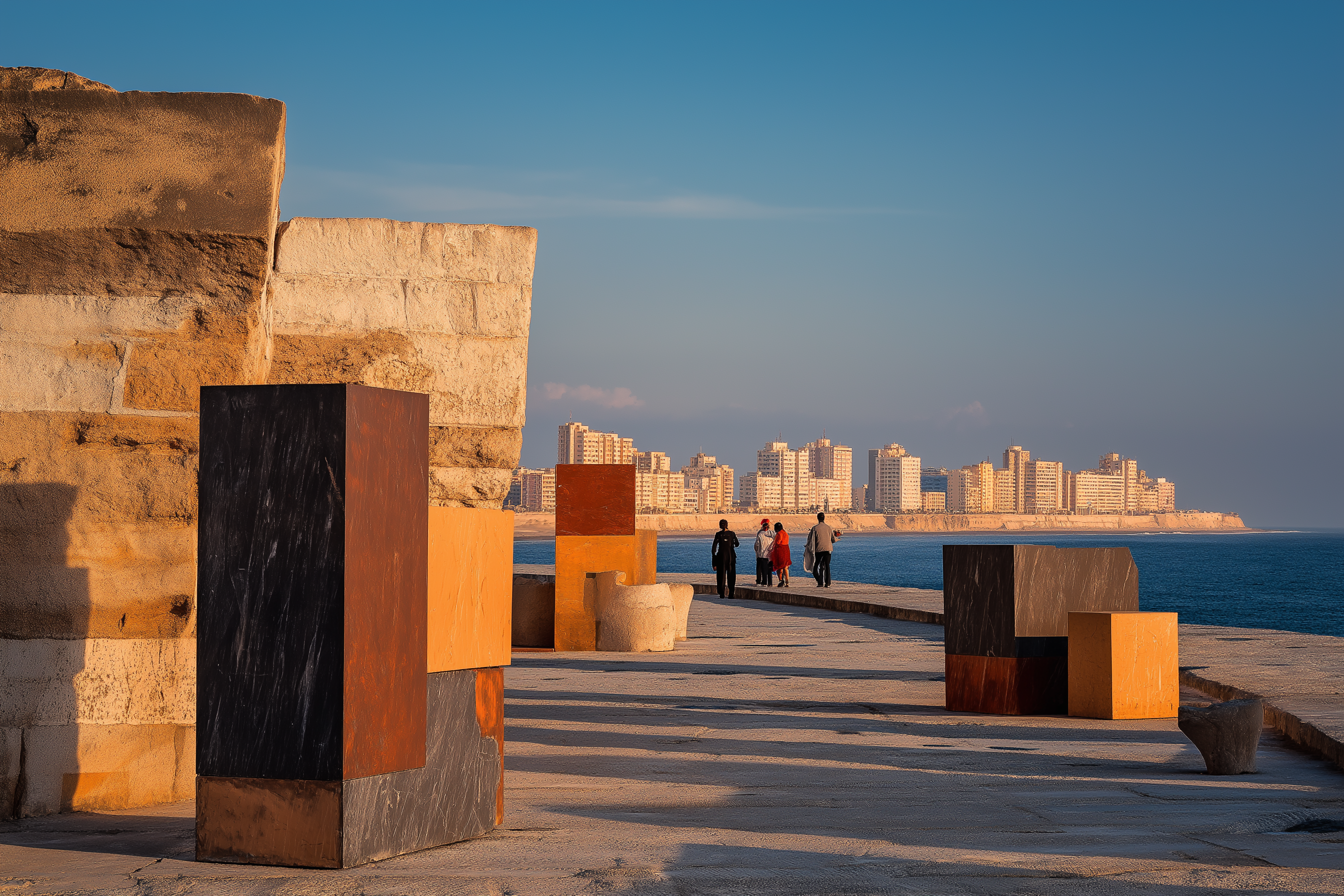
The Alexandria Biennale for Mediterranean Countries is a wonderful example of how art, politics, and the building of regional identity can all come together, despite its long history and periods of inactivity. Founded in 1955, this groundbreaking event is the first art biennale on the African continent and one of the oldest in the world, coming after the famous Venice and São Paulo biennials. This historical precedent holds significant importance in comprehending the original goal of the Biennale and its ongoing, albeit evolving, significance.
The Biennale was originally meant to be a place for artists from different Mediterranean countries to talk to each other. Its main goal has stayed very much the same, even though the region has seen many political changes in the last seventy years. Its history, from its ideologically charged beginnings under the Nasser regime, through times when it struggled to stay relevant and had to stop for long periods of time because of regional unrest, to its expected and very different revival in 2026, is a reflection of the changes that have happened in the Egyptian state that created it and have always supported it through very different political regimes. This long-lasting state support shows that people still believe in the strategic value of big cultural events as tools for national projection and international cultural diplomacy, which is often called “soft power.” In fact, President Gamal Abdel Nasser established the Biennale as a “political tool for national promotion” as part of his larger cultural policies to create a unified Egyptian identity after independence. The planned return in 2026 is also part of a national strategy to “revitalize Egypt’s cultural institutions and re-establish its role as a leading hub for Mediterranean and African art.” This study demonstrates that the overall goal remains unchanged, despite the evolving methods employed to achieve it.
This thorough study will look at the Alexandria Biennale’s different historical periods in depth. It will argue that the Biennale’s evolution is a powerful way to look at how art has been used for political purposes, how regional identities have been negotiated in a world where power is constantly changing, and how people are constantly trying to stay culturally relevant in a world that is becoming more connected.
The Nasserist Dawn: Shaping Identity Through the Alexandria Biennale (1955-1970s)

The Alexandria Biennale did not happen by chance; it was a planned and very strategic cultural project by the new Egyptian Republic. The creation of this festival was a strong political decision meant to be the foundation of a new national identity that was carefully being built after the revolution and the end of colonial rule. During this first era, the Biennale was used as a sophisticated tool in the global cultural landscape of the Cold War to show the world a picture of Egypt as modern, independent, and culturally vibrant.
The Nasserist Project: Art as a Key Part of Nation-Building and Pan-Arabism
The Alexandria Biennale for Mediterranean Countries opened on July 26, 1955. It was a carefully planned political event that had a lot of meaning outside of art. President Gamal Abdel Nasser personally opened the event, and the date was significant because it was the third anniversary of the 1952 revolution. The deliberate timing established a strong connection between the new artistic platform and the emerging political order. The event was more than just an art show; it was a real cultural expression of a revolutionary state that was actively defining itself and its place in the world. The dominant ideas of Nasserism, anti-colonialism, and the growing “third worldism” movement heavily influenced the Biennale. It was an important part of a cultural policy that aimed to create a modern national image that was both uniquely Egyptian and clearly different from the colonial past and the old monarchical regime.
The Alexandria Biennale is the first time an African country has used the biennial format as a “political tool for national promotion.” This was a strategic use of cultural capital that would become more common across the continent only in the following decades. For Egypt and other newly independent countries that were part of the growing Non-Aligned Movement, showing modern art on an international stage was a strong statement of their cultural and political independence. As scholars have wisely pointed out, it was an “important recognition of their struggle for decolonization, national sovereignty, and independence.” The Biennale’s institutional framework made its link to the state even stronger. Hussein Sobhy, the general manager of Alexandria’s municipality, came up with the idea for the event and made it happen. The main venue was the Alexandria Museum of Fine Arts, which had just opened a year earlier, in 1954, as a modernist architectural statement.
A Post-Colonial Map of the Mediterranean
It was a bold and political move to make the “Mediterranean” the main focus of the Biennale. Nasser’s Egypt made a conscious and deliberate effort to take back and redefine a region that had been controlled and defined by European colonial powers and their Orientalist stories. The event was planned to “imagine and reinscribe the Mediterranean as a much more polyvalent space, a transnational rather than regional one,” and it did so deliberately to break with the Eurocentric cultural politics that had been in place in Egypt before the revolution in 1952. The Biennale’s organizers actively built what has been called a “fluid geographical space, imbuing it with changing meanings and malleable boundaries,” which was a conceptual re-mapping of the region that directly challenged the West’s long-standing “hegemonic cultural code.”
The Alexandria Biennale brought together artists from both the northern and southern shores of the Mediterranean, including European countries like Greece, France, and socialist Yugoslavia, as well as Arab and African countries like Lebanon, Algeria, and Egypt, the host country. The goal was to create a new, post-colonial map of cultural exchange, with Alexandria at its center. The goal of this project was to break down the long-standing Orientalist view that has shaped Western views of the region and to suggest a new way of looking at it based on shared histories, intertwined cultural legacies, and shared post-colonial goals. Despite the Biennale’s intended focus on the Mediterranean region, its underlying ideological currents were distinctly transnational. They connected the Mediterranean’s specific context to the larger political project of “third worldism” and made a key “region of encounter between North and South.” In this context, the Alexandria Biennale acted like a cultural Suez Canal, a strategic asset for controlling the flow of regional narratives and showing Egypt’s cultural and political leadership in the newly independent world.
The Vanguard of Modernity: Early Artists and Aesthetic Directions at the Alexandria Biennale
The first editions of the Alexandria Biennale were crucial for the early leaders of Egyptian modernism, whose art was a big part of how the new nation expressed itself visually. Inji Aflatoun, Gazbia Sirry, and Adham Wanly were well-known artists who took part in the early Biennales. Their paintings played a big role in showing what it meant to be Egyptian in a way that was both modern and authentic. These artists deeply committed themselves to capturing the subtleties of local life, the richness of Egyptian heritage, and the social realities of their time. They did this while also engaging with current international artistic trends and movements. Their work created an important visual discourse that often ran parallel to, and sometimes subtly diverged from, the state’s official political project.
The early Alexandria Biennale was mostly about painting, with a focus on artistic movements like Abstract Expressionism, which was very popular in the international art scene at the time. Egyptian artists and cultural planners wanted to join the global art conversation on their own terms, so they used popular styles. Their choices showed that they were committed to modernity and did not want to use only native artistic forms. The event’s visual identity, even in its more practical parts, showed that cultures were having a complex conversation with each other. For example, the cover of the 16th edition catalog in 1987, designed by Miriam Abdel Aleem, had a striking dual-language design in which original Arabic lettering skillfully imitated the look of a modern Latin typeface. This was meant to represent a creative fusion of artistic traditions and a bridge between East and West. The Alexandria Museum of Fine Arts, which was the main venue for the Biennale, was another example of this consistent commitment to a modern, international aesthetic. Its very architecture showed that the new state was embracing contemporary culture as an important part of its national project.
Moving through Changing Sands: The Alexandria Biennale from the 1980s to the 2000s
The middle period of the Alexandria Biennale’s history was a time of change that was often difficult to manage. The Nasserist era’s political and cultural certainty gradually gave way to a more fragmented and globalized world order. The institution had to deal with its own big legacy while trying to stay relevant and respected around the world as national priorities changed and the international art calendar became more crowded and competitive. This time was mostly marked by a slow, and sometimes hesitant, move away from its original role as a purely state-driven ideological platform toward a more modern, professionally curated model. This change would eventually lead to the important and mostly successful 25th edition.
The Persistence and Transformative Forces in a Post-Nasserist Egypt
After Gamal Abdel Nasser died in 1970, Egypt’s politics and economy changed a lot over the next few decades. For instance, the country began to adopt more liberal, market-oriented policies and align itself more with the West. This changing national landscape made the Alexandria Biennale’s original, ideologically driven mission a complicated problem. In addition, the Cairo International Biennale, which started in 1984, became Egypt’s second major state-sponsored art event. At first, it focused on showing Arab art, but over time it grew to include the international art scene as a whole. Cairo’s ascent to prominence as Egypt’s political and cultural hub pushed Alexandria to the periphery. The process, which had begun decades earlier, was now accelerating.
During this period of transformation, the Alexandria Biennale struggled to maintain its distinct identity and its standing as an international event. Even though it was still organized and held occasionally, it became less and less important in the global art world, falling into what has been called a state of relative “oblivion in the international circuit.” The event’s initial significance, which was based on the clear geopolitical binaries of the post-colonial era—colonial versus post-colonial, East versus West—became less and less relevant and less resonant as the global political landscape became more complicated and interconnected. Without a strong and clear ideological reason, people might have considered the Biennale to be a small-town event that was a throwback to a time long ago. However, this time of drifting and relative obscurity ultimately set the stage for the dramatic and necessary reforms of the 2000s. These reforms came about because more and more people realized that the institution needed to completely change itself to survive and stay relevant in a rapidly changing art world. The 25th Edition of the Alexandria Biennale, held from late 2009 to early 2010, is often regarded as a significant turning point in the institution’s history.
Many people view the 25th Alexandria Biennale, which occurred from late 2009 to early 2010, as a pivotal moment in the institution’s history. It was a major modernization and a true “rebirth.” The Biennale’s organizers faced increasing existential pressure to regain its former status and prove its relevance, so they made a series of major changes that were a deliberate and strategic break from the institution’s long-standing traditions. The most important change was the unprecedented appointment of the well-known Egyptian artist Mohamed Abouelnaga as the curator. The appointment gave him a lot of freedom to choose the artists and works that would be shown.
This important decision marked a major break from the Alexandria Biennale’s traditional and increasingly out-of-date model of “diplomatic representations,” in which artists were usually nominated by their countries’ consulates or cultural attachés. The Biennale did a good job of keeping up with the standards and practices of the global contemporary art world by getting rid of this historically state-centered system and switching to a curator-led model that is recognized by professionals. The organizers said there was “no leeway left for mistakes” and that the Biennale needed to be “repositioned” in the global art world. Those statements made it clear that this was a planned and strategic move. The main goal was to change the event from a mostly symbolic tool of foreign policy into a credible and respected place for professional curatorial practice and cutting-edge contemporary art. This strategic shift was made even stronger by the formation of collaborative partnerships with well-known international institutions like Tate National in the UK and the Sharjah Biennial in the UAE. These institutions helped organize important curatorial workshops in Alexandria to coincide with the opening of the Biennale, which boosted its international profile and professional credibility even more.
The awarding of the prestigious Grand Prize of the 25th Alexandria Biennale to Alexandria-born artist Wael Shawky for his groundbreaking and conceptually difficult video work, Telematch Crusades, strongly confirmed the artistic success of this new model. The choice of a complex and highly intellectual video installation as the top prize by the Biennale demonstrated its full support for modern art and its dedication to recognizing new ideas and deep thinking. This award was a big boost to Shawky’s career. It made him much more visible around the world and eventually led to his being chosen to represent Egypt at the very prestigious 2024 Venice Biennale. The 25th edition clearly achieved its goal of showing “an up-to-date panorama of artistic practices in the Mediterranean region.” These events restored the Biennale’s artistic credibility and showed that it could once again be a “relevant meeting point for contemporary art in Egypt” and the surrounding area.
Interruption and Introspection: The Alexandria Biennale After the Revolution (2011–2025)
The time right after the famous and seemingly game-changing 25th edition was the most chaotic and uncertain in the long and varied history of the Alexandria Biennale. The institution’s future was closely tied to the dramatic changes in Egypt’s politics during the 2011 Egyptian Revolution, a time of great political upheaval, and the instability that followed. The Biennale’s subsequent hiatus, marked by a brief and ultimately arduous return in 2014, exemplified the significant difficulties and intricate challenges facing Egypt’s cultural sector during this tumultuous period. This time of interruption was disruptive, but it also forced a necessary time of reflection and critical reevaluation. Overall, it showed that the long-standing state-sponsored model was not sustainable and opened the door to a radical rethinking of the institution’s future direction.
The Alexandria Biennale and the 2011 Revolution: A Time of Break and Big Problems
The 2009–10 revival of the Alexandria Biennale instilled a lot of positive energy, but the 2011 Egyptian Revolution completely halted it. The planned 2011 edition of the Biennale was quickly canceled because of the country’s “precarious political situation” and the “financial pressures” that followed the widespread uprising and period of instability. The planned 2011 event was officially called off, and the long period of political uncertainty that followed under President Mohamed Morsi made it difficult to organize any large-scale international cultural event, both logistically and politically. There was a big five-year gap between the 25th and 26th editions because of this. This long absence made it obvious how deeply the institution was rooted in the national fabric and how vulnerable it was to the same powerful forces that were changing the country’s political and social landscape.
During this time of state-sponsored cultural paralysis, there was an unexpected rise in independent, artist-run projects and alternative cultural platforms all over Egypt, especially in Cairo. The rise of new platforms like the “Something Else OFF Biennale Cairo” offered a more flexible way to show contemporary art and a strong alternative to the perceived stagnation and bureaucratic inertia of official state-funded cultural institutions. This big change showed that the Egyptian contemporary art scene was becoming less centralized. Artists, independent curators, and grassroots groups were taking the lead in making important places for art shows, critical discussions, and cultural production that weren’t directly controlled or overseen by the government.
The 26th Edition (2014), titled “The Will of Change,” focused on the theme of Unstable Ground.
The Alexandria Biennale’s brief and ultimately difficult return in the summer of 2014 was a direct and often moving artistic response to the deep social and political changes that happened during the Arab Spring. The 26th edition, called “The Will of Change,” gave artists from all over the Mediterranean region a chance to deal with and artistically process the recent giant changes in society and politics and their complicated effects. The art on display often dealt directly and honestly with the revolutionary moment, looking at important issues like social justice, the role of religion in politics, and the many different ways that political change happens and the problems it brings. For example, Tunisian artist Ziad Zitoun’s powerful stencils directly addressed the important role women played in calls for change in society. Kais Salman’s paintings, created by the Syrian artist, showed grotesque and disturbing figures that seemed to hint at the complexities and contradictions of political Islamism after the uprisings.
The Egyptian artist Huda Lutfi won the Grand Prize at the 26th Alexandria Biennale for her powerful 2012 video installation Biyadaat. Olu Ougibe, the head of the international jury, said that the work’s strong and repeated images of military boots connected strongly with the recent wave of uprisings and military interventions in the region. He called it “probably the most striking and equally attached to the biennale’s theme.”
Even though the 26th edition had clear artistic merit and a consistent theme, its organization and execution faced huge logistical and financial problems that turned out to be impossible to solve. Mostafa Abdelwahab was the third curator of the event. Two of his predecessors had to leave because of different organizational and political pressures. The Biennale faced numerous political and financial challenges, such as the refusal of some international partners who had previously pledged financial support and the abrupt reduction of the Alexandria Business Association’s funding from EGP 260,000 to just EGP 5,000 on the eve of the exhibition’s opening. The head of the jury also said in public that the exhibition seemed to be very limited because there weren’t many submissions, which made it seem like “all the entries went on the wall” instead of going through a strict and selective curatorial process.
Looking back, the 26th edition of the Alexandria Biennale should not be considered a long-term revival of the institution but rather as a final, very creative but ultimately unsustainable burst of artistic energy in the face of overwhelming adversity. It was a product of the revolutionary period’s hopes and dreams, but it was ultimately destroyed by the same political and economic instability that inspired its theme. The fact that it was followed by an even longer break—twelve years—clearly shows that it didn’t fix the institution’s deep structural and systemic problems. The 2014 Alexandria Biennale was the last time an old, heavily state-dependent model worked in Egypt, which had changed a lot and become more unstable. This made the long pause and the need for a radical shift to a new way of doing things both necessary and inevitable for the Biennale’s future survival.
Reimagining a Legacy: The Alexandria Biennale’s Return in 2026
The 27th Alexandria Biennale will be the biggest and most important change in the institution’s long and varied history, taking place in September 2026 after a long break of twelve years. This revival is not just a return of a dormant event; it is a complete and ambitious rethinking of the Alexandria Biennale’s main purpose, organization, and interaction with the city. This new chapter wants to actively fix the deep-seated structural weaknesses and systemic vulnerabilities that caused the event to be put on hold for so long in the past. It does this by introducing a new funding model, making a clear and compelling curatorial vision, and using a strategic approach that deeply connects the event to the history and culture of Alexandria itself.
The Public-Private Partnership Model: A New Framework for a New Era
The most important and potentially game-changing change for the 2026 revival of the Alexandria Biennale is the switch from its historically dominant state-funded operational model to a public-private partnership that can adapt and withstand changes. This new way of funding is both a practical and necessary response to Egypt’s “difficult economic situation” right now. It is also a strategic move to provide the event more operational independence, financial stability, and administrative flexibility in the future. This method is gaining popularity as one of the few viable models for large global cultural institutions. These institutions are having a harder time because public sector support is shrinking and they need more diverse sources of funding.
The newly formed organizing committee for the 27th Alexandria Biennale is a perfect example of this mixed structural approach. It includes important people from Egypt’s Ministry of Culture and a group of well-known private patrons who are active in the international contemporary art scene. Some of these important private sector people are Mai Eldib, Ahmed Shaboury, Hisham El-Khazindar, and Rasheed Kamel. Their involvement brings not only a lot of money but also a lot of knowledge about managing contemporary art and making connections around the world. The Egyptian government and the Alexandria governorate have given the revival its first important seed money. However, for the new model to last, it will need a lot more money from big local businesses, private donors, and possibly even international charitable groups. This intentionally diverse funding base is meant to protect the Biennale from the political and financial instability that caused its last collapse and provide the curatorial team more freedom to make artistic decisions.
Curatorial Vision for 2026: “This Too Shall Pass” as a Framework for Reflection
Moataz Nasr, a well-known contemporary artist who was born in Alexandria but has lived in Cairo for a long time, has been given the job of artistic director for the highly anticipated 27th edition of the Alexandria Biennale. The 2026 Biennale’s main theme, “This Too Shall Pass,” is compelling and can be interpreted in many ways. It is a wonderful framework for artistic inquiry and public reflection. It can be considered a deep meditation on themes of resilience in the face of adversity, the cyclical nature of history with its inevitable periods of both prosperity and decline, and the enduring human capacity for renewal and hope. These ideas are especially relevant to Egypt’s recent turbulent political history and to Alexandria’s own rich and complex history, which has seen times of enormous cultural growth and later times of relative obscurity.
Moataz Nasr’s plan for the 2026 Alexandria Biennale is to use a strategic dual approach. The main event of the Biennale will feature about 50 to 55 carefully chosen artists. This is in keeping with the institution’s long-standing focus on the wide range of artistic practices in the Mediterranean basin. In addition to this main exhibition, Nasr also wants to put together a number of smaller, more focused “capsule exhibitions” that will be strategically placed in different museums and cultural institutions in Alexandria. These smaller shows will be all about showing off the work of up-and-coming Egyptian artists, giving the next generation of creatives a crucial place to show their work. This two-part plan is meant to honor the Alexandria Biennale’s long history of encouraging artistic dialogue in the region and to make a direct and significant investment in the future health of the contemporary art scene in Egypt. Nasr has expressed his intention for the 2026 Biennale to “make a significant impact and create ripples.” His rhetoric clearly shows that he wants to wake up the Egyptian art scene, which he thinks has been stagnant for too long, and bring the Alexandria Biennale back to a place of high international standing and critical acclaim.
The Alexandria Biennale: Bringing Back Alexandria’s Cultural Importance
The Alexandria Biennale will return in 2026, but it’s not just an international art show. It’s meant to be a major cultural and urban intervention that will help rebrand and revitalize the city of Alexandria itself. After years of political and economic instability, this ambitious project is considered an important part of a larger national effort to revitalize Egypt’s cultural sector as a whole and make it more appealing to people from other countries. Other well-known projects that are part of this national cultural strategy are the long-awaited full opening of the Grand Egyptian Museum (GEM) near the Giza Pyramids and the critically acclaimed “Forever Is Now” series of contemporary art exhibitions held at various ancient heritage sites across the country. The main strategic goal is to make Egypt a leading and dynamic center for both Mediterranean and African art again by creating a lively and intriguing conversation between its rich history and its modern art.
The decision to strategically bring back the Alexandria Biennale is a big and planned investment in Alexandria’s cultural future. It is meant to stop the worrying “cultural drain” that has seen many artists, curators, and other creative professionals leave Alexandria for Cairo, where they think they will find more opportunities and excitement. The 2026 Biennale’s curatorial plan purposefully avoids the traditional model of a single, centralized museum venue in favor of strategically activating multiple historically and culturally important sites spread out across the city. The planned use of places like the ancient Roman amphitheater, the famous modern Bibliotheca Alexandrina, the historic 15th-century Qaitbay Citadel, and other architecturally important sites along the historically important Fouad Street physically embeds the contemporary art event within the city’s rich and layered historical narrative. The organizers of the Biennale want it to be an event “for Alexandria itself,” so they are carefully choosing venues that will attract a wide range of people, not just the “art crowd.” By using contemporary art to draw attention to these important heritage sites and encourage local people to get involved, they hope to spark a renewed sense of civic pride, help people rediscover the city’s rich history, and ultimately start a larger process of cultural and urban regeneration in Alexandria.
The Alexandria Biennale’s Story as It Unfolds
The Alexandria Biennale for Mediterranean Countries is not just a recurring exhibition of contemporary art; it is a living archive of the Mediterranean region’s deep political and cultural changes over the past seventy years. Its cyclical history, which includes times of ambitious founding visions, long periods of crisis and dormancy, and strategic moments of major rebirth and reinvention, is a very close match for the complicated path of Alexandria, the city that hosts it, and Egypt as a whole. The Alexandria Biennale has always reflected the conditions, aspirations, and anxieties of its time. It started as a confident and assertive expression of post-colonial cultural identity and national aspiration, and now it is a more flexible and adaptable public-private partnership.
The 27th Alexandria Biennale, which will take place in September 2026, will be a significant and highly anticipated test case for the institution’s future viability and relevance. Its long-term success will depend on whether its new hybrid funding model can acquire long-term, stable sources of money and keep a certain level of curatorial independence and artistic integrity. It will also be a big test of how well a large-scale contemporary art event can be a real catalyst for urban cultural renewal and how it can reclaim and bring new life to a city’s rich and complex cultural story. The results of this ambitious revival will not only shape the future of a historically important institution, but they will also provide useful and possibly transferable insights into the future of critical cultural dialogue across the Mediterranean Sea, the lasting power of art to change public space and collective memory, and the viability of new operational models for cultural production in the 21st century. The Alexandria Biennale has a long and intriguing history that is far from over. The next chapter will be verycrucial interesting because it will show how the Mediterranean region’s culture is changing and how it is still making a difference in the global art world.




Leave a Reply