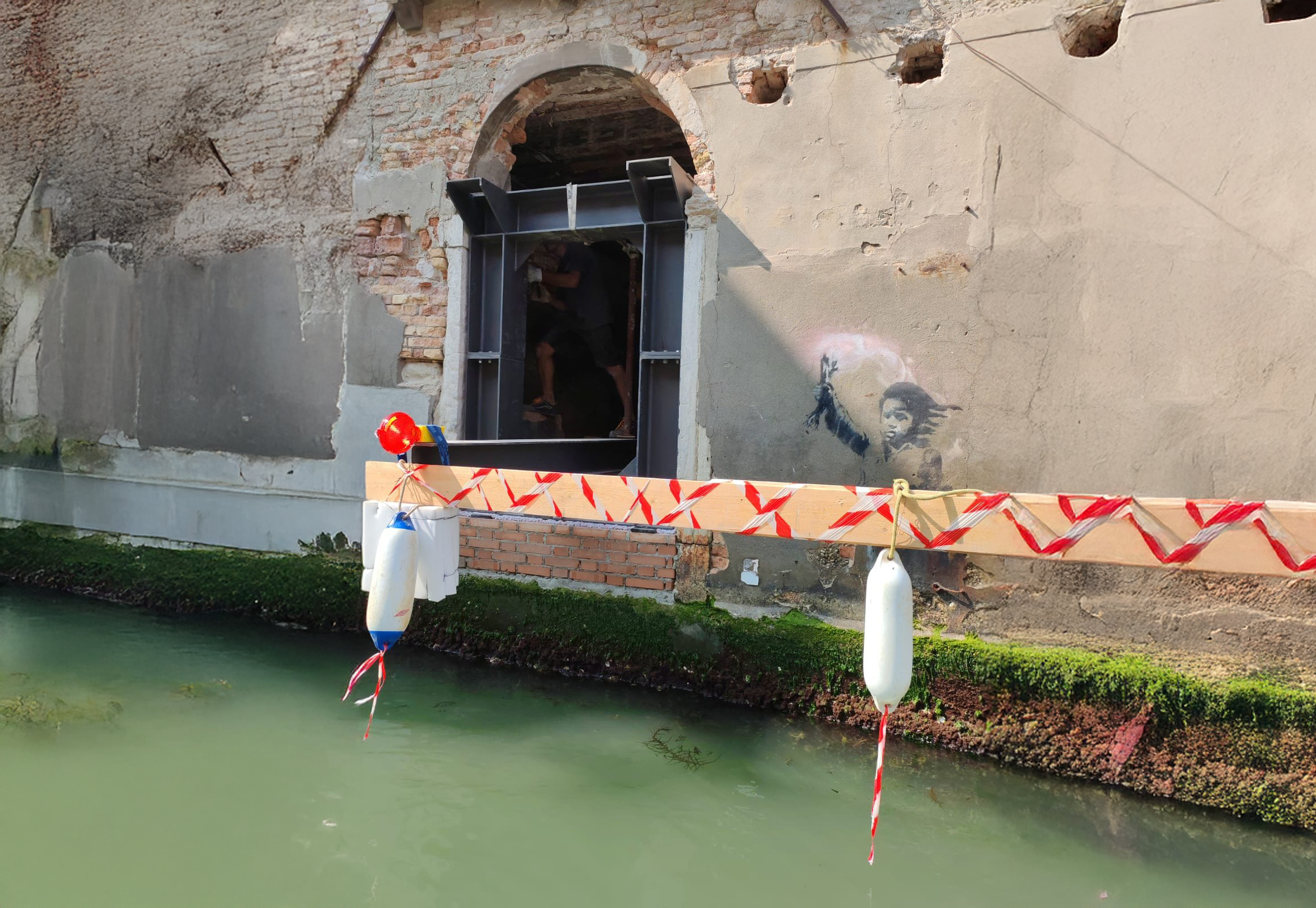
A team of restorers on a barge used angle grinders and hand tools to carefully cut out a piece of a 17th-century palazzo wall during the night in Venice. Their prize, which was hidden from view by a tarpaulin, was the fading picture of Migrant Child, a dynamic Banksy mural, had languished on the canalside for six years. The new owner of the building, the banking group Banca Ifis, paid for the operation, which was called an “innovative rescue” to save one of only two works of art in Italy that are officially linked to the mysterious artist. But this act of preservation is full of contradictions. By taking the mural off the wall, its saviors may have also freed its spirit. The artwork’s power was tied to the fact that it was fragile, site-specific, and falling apart.
Let’s look at the complicated clash of art, business, and preservation in the case of the Venice Banksy mural. It looks at the heated debate it has sparked and what is ultimately lost when preservation becomes decontextualization. For people who love art and collect it, the story of Migrant Child is an important example of how the value, ownership, and even definition of street art have changed in the 21st century.
The Fading Signal: A Look at the Migrant Child Banksy Mural

The Banksy mural emerged unexpectedly during the Venice Biennale in May 2019, immediately making a powerful impact. The stencil showed a young child in a life vest, with their feet seeming to be in the canal’s real water, holding a fizzing, neon-pink distress flare in the air. The symbols were a clear reference to the ongoing refugee crisis in the Mediterranean. This is a common theme in Banksy’s work, which uses the innocence of children to criticize problems in society.
The way the mural looked wasn’t a general comment; it was a direct response to a humanitarian crisis that was happening right then and there. In 2019, the year the art was made, about 1,336 people died or went missing while trying to cross the Mediterranean. About 11,500 refugees and migrants arrived in Italy by sea that year, and 20% of them were children. These numbers turn the life vest and flare from simple symbols into painful reminders of real-life loss and desperation.
The canvas Banksy chose was just as important as the picture itself. The mural was put on the crumbling wall of the Palazzo San Pantalon, which hasn’t been lived in for a long time. It was put just above the waterline. This place was sure to ruin the artwork because the city is always fighting with water. Being around humidity, salt spray, and the occasional Acqua alta (high water) was not a risk that needed to be avoided; it was an important part of the story told by the artwork. Around 2025, about a third of the work had faded. The art’s story was unfolding, and the physical damage wasn’t damage. The image slowly fading away was a strong symbol of how the public’s memory of the crisis and the lives it represents is fading.
Should we keep a Banksy mural or let it die?
Italy’s Ministry of Culture announced in 2023 that the Banksy mural would be restored. This sparked a heated debate about what street art really is. The medium’s natural shortness is at odds with the traditional ideas of how to protect cultural heritage.
Some people said that protecting the mural would go against what it was meant to be. Street art is meant to be temporary and site-specific and interactive with its surroundings. The Venetian Architects Association strongly supported this point of view, saying that the mural’s slow fading away was a deep and deliberate metaphor for the fate of migrants who died at sea. To save the picture meant to end this story. Evyrein, a local street artist, agreed with this, saying to Euronews, “Banksy was no fool.” He knew very well that the thing he made by the water wouldn’t last. “Restoring it goes against the grain.”
On the other hand, supporters said that the work had taken on a “public value” and become part of the community’s symbolic heritage. They said it was a major tourist attraction by a world-famous artist that needed to be protected. Italy’s then-Undersecretary for Culture, Vittorio Sgarbi, who oversaw the restoration himself, supported this point of view. Sgarbi had to deal with a big legal problem: Italian heritage law says that the state can’t restore works by living artists that are less than 70 years old. His answer was to get a private company, Banca Ifis, to pay for and carry out the project, which closed the “regulatory gap.”
Sgarbi’s reason for going against what the artist probably wanted to do was a brilliant move in terms of both law and morality. He said that Banksy lost any moral right to have his wishes respected because he painted the mural on a historic building without permission, which is considered vandalism. Sgarbi said, “Anyone who abuses a listed historic building cannot expect anyone to respect what he has not respected.” This logic uses the artwork’s transgressive origins as the very reason for its capture and institutionalization, setting a strong precedent for the future of unsanctioned public art.
The New Patrons: How a Bank Got a Banksy Mural
Banca Ifis, a banking group that bought the abandoned Palazzo San Pantalon in 2024, was the private company hired for the “rescue.” The whole thing is run by Ernesto Fürstenberg Fassio, the bank’s chairman, came up with Ifis Art, the bank’s cultural arm. The bank’s actions are based on a business philosophy it calls the “Economy of Beauty.” This idea changes the way we think about investing in art and culture from being a charitable act to being a strategic asset that brings in real money. The bank’s research shows that this “Beauty” sector made up 29.2% of Italy’s GDP in 2023. Companies that invest in art see their productivity rise 1.4 times faster than their competitors.
This way of thinking is the best way for the bank to act. A company has used and incorporated a Banksy mural, which strongly opposes capitalism and was meant to be a “public gift,” into its plan to make money. The words “rescue” and “preservation” do a beneficial job of hiding an act of acquisition and appropriation. The intervention is not just about saving art; it’s also about showing how the “Economy of Beauty” works. It turns a protest symbol into a huge source of cultural capital and brand value for Banca Ifis.
The Surgical Removal of a Banksy Mural
Federico Borgogni is a crucial choice for the project’s restorer. Borgogni is an expert with a specific and useful track record: he was in charge of taking down Banksy’s 2021 work. Aachoo! from the side of a house in Bristol, UK. The Aachoo! case is a very important example. The Banksy mural was also taken out of its public setting, where it was supposedly meant to be sold at auction. It was then scanned by forensic experts and sold as 4,900 fractional NFTs, bringing in about $4.9 million. Borgogni’s involvement links the Venice project to more than just an academic heritage context; it also links it to a new, specialized, and very profitable business that collects and sells street art.
Banca Ifis called the removal method “innovative” and said it was the “first time” it had been used in Italy. The whole wall slab, including the plaster and structural support, had to be cut out to make room for the mural. In traditional conservation, this is the same as Stacco a massello is the most invasive and extreme method of removal, and it should only be employed as a final resort.
After being taken off, the detached slab was brought to a lab where it will be put on a new, stable honeycomb support panel. Missing parts will be filled in and pictures will be added back in. But a key decision was made: the mural’s bottom, which was most damaged by canal water, will is not going to be fixed. Banca Ifis said it was “so ruined that it would be a question of completely recreating that part, which is not our intention.” This choice is a deep cleaning of the story and the art. The water damage showed that the artwork was talking to its surroundings. The restorers will cut this part to make the object cleaner, more stable, and more display-ready. However, the removal will cut off its strongest connection to its context.
A New Gilded Cage: What Will Happen to the Banksy Mural
The planned change to the artwork’s home is similar to the change to the artwork itself. Banca Ifis has hired Zaha Hadid Architects (ZHA), a world-famous firm, to lead the full restoration of the Palazzo San Pantalon. The goal is to turn the building into a space for contemporary art exhibitions.
People love Zaha Hadid Architects for its unique way of restoring old buildings. They often mix their signature fluid, futuristic shapes with the old buildings’ shells to create a dramatic conversation between the old and the new. The Hotel Romeo Roma is an example of how ZHA adds modern “second skins” and carves out dynamic voids in old buildings. This approach keeps the original fabric while making a whole new interior world. The palazzo won’t be restored to its original state; instead, it will be turned into a high-concept architectural statement. The building’s “derelict” and “neglected” look, which made for a gritty, real background for Banksy’s raw intervention, will be gone. The mural’s journey from protest to luxury asset is complete now that ZHA is involved. If the Banksy mural ever comes back to the building, it won’t be a problem in a public place anymore. It will be the main attraction at a high-design, high-culture venue that is being paid for by a bank and designed by a “starchitect” firm. Its rebellious energy will be completely contained, and its original message of gritty reality will be absorbed into a world of high-class art consumption.
An artwork is lost.
Taking the migrant child out of the Palazzo San Pantalon was more than just a technical step; it changed everything. The Banksy mural has gone from being a temporary piece of protest art to a permanent, mobile, out-of-context, and corporate-owned cultural asset. The “rescue” has saved the physical picture but ruined its meaning. The conversation with the crumbling wall, the lapping water of the canal, and the corrosive Venetian climate has been cut off. The choice not to replace the part that was damaged by water ends this act and cuts off the work’s most direct link to its message.
The artwork has taken on a new meaning, one that ironically reflects the very things it used to criticize. It’s now about how capital can buy and change culture, how rebellion can become institutionalized, and how the physical object is more important than its conceptual soul. The Venice Banksy mural is a perfect example of a 21st-century parable. It shows how street art’s rebellious spirit clashes with the art market’s insatiable hunger. The bank has promised that the work will be shown in a public, free space, not a “closed museum.” But the situation has already changed for beneficial reasons. The flare is no longer fizzing in the damp air of Venice. Instead, it is kept in a lab where its wild energy is tamed. The art world still needs to answer one question: has it been saved or put out of business?


Leave a Reply