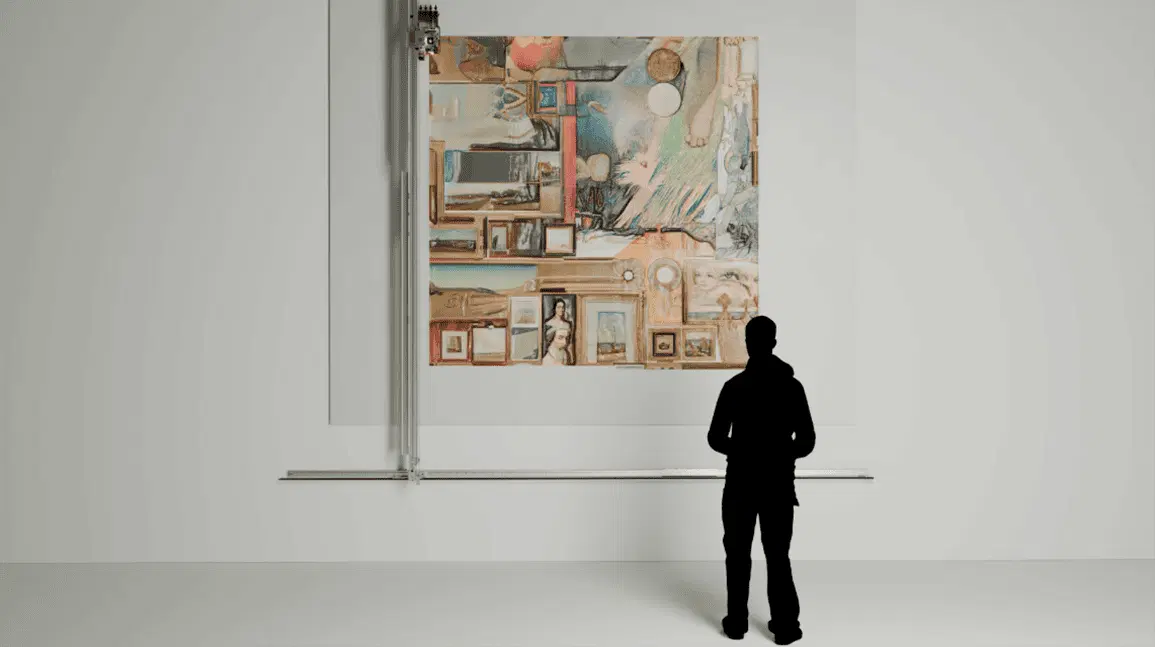
Christie’s AI art sale is bound to transform how we perceive an auction house; the sale created anticipations months prior to the actual launch. As they prepare for the launch of the much-anticipated “Christie’s AI art sale,” the sale has already rekindled debate about copyright issues and the legal responsibilities of a cultural institution in the contemporary age.
Exploring Creativity and Ethos in Christie’s AI Art Sale
By featuring pieces produced with highly developed artificial intelligence, an already existing “art sale” poses a threat to humanity’s creative identity. Copyright legislation was originally made to provide protection to the creative masterpieces of an individual, but with the new technology portraying becoming increasingly easier through the use of AI systems, the demarcation of authorship and creation with machine aid is increasingly becoming vague. A counterpoint would be that “mass manipulation” using AI technology, in which an artist’s self-expressive contour is lost, is fundamentally problematic and infringes upon an artist’s legal and ethical sense.
Although advocates of AI-powered artistic creation argue that the whole process is transformative as disparate visual elements are melded to create completely new compositions, legal scholars note that the truth is that the human portion is oftentimes relegated to just being a prompt dispenser or editor of what the machine produces. In this regard, the Christie’s AI art sale raises concerns about whether such outputs should be considered original or are nothing more than the disassembly and reassembly of previous creative work.
Ethical and economic implications
Fundamentally, everything wrong with the Christie’s AI art sale is shocking not just in a legal clashing sense, but also morally and socially. To most artists, their output is the product of effort, feelings, and sociocultural representation brewed for many years. To be told that their works have been used to teach AI models without even being paid or given a courtesy credit is seen as most dangerous. An open letter advocating against the auction, which attracted over 3,500 signatures, lambasted the Christie’s auction in principle as serving a system that commodifies human artists’ rights and creative work, stripping them of value. Words like “mass theft of human artists’ work” capture the disappointment surrounding the issue, signaling the fact that the Christie’s AI art sale has dire consequences on the economy of art and the livelihood of artists.
Economically, the auction is expected to be quite profitable, with value estimates topping $600,000 for a single collection of over 20 lots. Still, that financial achievement might incur a hefty price. If the market for AI-generated artwork becomes too dominant, traditional artists could find their work’s worth to be much lower than what they feel it should be, and a decline in stature and payment might follow. The consequences are particularly severe for illustration, photography, and fine arts, all of which require a high degree of human imagination. Therefore, the Christie’s AI art auction is not simply a case of a new technological innovation, but a more complex phenomenon that could instigate profound changes to the economic balance of power within the creative industries.
Fair Use and Exploitation
One of the most difficult discussions concerning the sale of art at Christie’s is if there was any copyrighted content used while training AI models. Is this training fair use or pure exploitation of the creator’s work? Supporters of generative AI argue that the training process is transformational by nature. They argue that the training of AI with millions of images produces AI outputs that are entirely different from those images. The argument goes that the human artist, through meticulous curation of prompts and edits, guarantees that there is enough originality in the resultant work for copyright protection.
On the other hand, numerous artists and legal analysts argue that AI’s use of unlicensed copyrighted content is like property theft. No matter what changes are made to the final product, the process of reaching that product involves misuse of creative work. This argument regarding fair use and excessive use is the epitome of the legal lack of clarity in concern to the sale of AI art by Christie. The latest rulings from the United States Copyright Office made it clearer that works that display considerable amounts of creativity executed by a person are protected by copyright, while products created to a large extent by computer programs without much human contribution remain unprotected. This split in law is the center of the issue, which seeks to determine to what degree the changes that AI causes may disregard what the initial creators claim their rights to.
Clashing Opinions in the Art Community Regarding Christie’s AI Art Sale
The sale of AI art at Christie’s received completely differing responses within the art community. On one hand, a group of revolutionary artists and tech enthusiasts consider the auction to be the beginning of a new digital renaissance. They believe that AI is, in fact, a powerful tool for artistic expression when used properly. For these advocates, the sale of AI art at Christie’s illustrates how technology can enhance human abilities to create by providing new ways to construct and alter visual stories. They emphasize that the imaginative component is still deeply human; in this case, it is omnipresent in the choosing of prompts, revisions, and output curation.
On the other hand, some traditional artists view the auction as a detrimental innovation that undermines the core of human creativity. They insist that AI’s capability to create art shifts the function of the artist to that of a mere implementer, thus negating the value associated with any form of creative work. “Christie’s auctioning AI-generated pictures,” they defend, is the culmination of a deeper problem where machine-made art is put on the same level as human craftsmanship and creativity. A distinguished artist put it this way, “The moment creative energy is siphoned off and replaced with mechanistic reproduction, art becomes worthless from a cultural and monetary standpoint.” This kind of attitude shows discomfort with the consequences of rapid technological development on the nature of artistic work.
Legal Changes and Their Impact
The laws surrounding AI-created work are constantly changing, which adds another problem to the controversy surrounding the sale of AI-generated art at Christie’s. Copyright offices and courts around the world are struggling to establish who the author of generative AI art is. In America, the Copyright Office has stated many times that works created using AI tools that involve a lot of human effort can receive copyright, but works created solely by machines cannot receive any protection. This difference is important in determining if the artworks in the Christie’s AI art sale are legal or not.
Sometimes there are ongoing legal disputes—like class action lawsuits artists filed against AI companies for using their work without their permission—that are indicative of the lack of legal framework stemming from modern interpretations of the law. As an example, some of the well-known cases that have been litigated recently and that involve AI models such as Midjourney and Stable Diffusion are already setting new boundaries over what fair use and copyright infringement may mean in the context of the internet. Moreover, there has been recent discussion in the legislative circles around the much-debated draft of the so-called Generative AI Copyright Disclosure Act, which seems to indicate a movement toward more stringent rules. If those measures were to be adopted, then it is highly probable that institutions like Christie’s would need to tighten their already lax ethical self-regulations when it comes to dealing with and selling AI art.
Restrained AI Implementation—Striving for Responsible Integration
Christie’s AI Art sale has become a topic of scrutiny for multiple reasons, which gives us an opportunity to look into the effective ways of combining creative AI tools without pushing aside human artists. Rather than attempting to eliminate the use of AI, a growing number of academics suggest a more intelligent approach of preemptive amalgamation that accepts the use of advanced technology alongside guaranteeing adequate protections for all forms of intellectual property.
Some of the approaches that could be considered include the creation of comprehensive license frameworks that AI companies would have to acquire in order to legally use copyrighted works as training data. These types of frameworks could be partnered with initiatives designed to reveal the source of training datasets as well as information about the degree of human participation in the creation processes. With these changes, auction houses like Christie’s would have the chance to pursue policies aimed at ethically respecting the level of humanity within art creation.
Combining different fields together is necessary. Legal scholars, engineers, and artists need to come together in order to create culturally appropriate and technologically aware regulatory frameworks. Perhaps working together like this will ensure the future of the Christie’s AI art sale and similar events as opportunities to drive progress while upholding the rights and respect due to human creators.
Voices from the Frontlines: Critiques and Celebrations
The sale of the AI art at Christie’s has generated a significant and contradictory discussion in the field of art. Some argue that AI will democratize art because it will be easier and cheaper to create, it will be done faster, and there is a lot of new creative potential that can be used. In their perspective, the human aspect is still very dominant because a lot of care goes into creating the prompts and editing the AI art after it’s created.
On the other hand, critics underscore that the commodification of AI-produced outputs is one factor that threatens the traditional marketplace for art. They caution that the proliferation of AI-generated artwork will ultimately reduce the cultural capital and economic value of human artists. The open letter against the auction serves not only as a response to a single incident, but also as a rallying cry for a more profound examination of the ethical standards within the contemporary creative industries.
Interestingly, some of the most important figures in the debate, including notable artists, legal experts, and cultural commentators, have already publicly shared their opinions on the matter. While some support the statement that Christie’s sale of AI-generated art is the next step to be expected in an artist’s career, others are more worried about the unfettered growth of art made by powered artificial intelligence leading to a standardization of artistic creativity, where human artistry is replaced by a machine’s speed and efficiency.
Christie’s AI Art Sale and The Future of Creation
The sale of AI art at Christie’s is at a critical point in the journey of art and intellectual property conflict. It is both an archetype of ethical innovation and legal confusion that compels us to reexamine our most basic beliefs about the process of creating art. For one, the auction provides a preview of a future where technology influences human creativity and paves the way for new forms of artistic representation. At the same time, it introduces huge obstacles: it raises critical issues about copyright infringement, compensation, and construction of artistic identity in a world that is increasingly becoming digital.
For all those engaged in creative work along any continuum, the raging debate following the Christie’s AI art sale is more than just a passing issue—it is a turning point. In this case, the consequences will be felt far beyond the art world and in everyday life because of how societies appreciate and protect creative work in the age of technology.
As we explore these new possibilities, we must ensure the “how” question is rooted in the fact that there is a need to use AI’s transformative power while addressing, preserving, and protecting the human artist’s rights and contributions. This will require not only new and creative laws and regulations but also a cultural will to make sure that technology does not mow down the deeper human artistic intent.
This is now clearly challenged by Christie’s AI art sale, which calls all of us to envision the next chapter of art where innovation meets reinvention and where technology and legacy do not work against each other in the race to define the fine line of art diametrically but instead work side by side to interpret the art of being human. The outcome of this discourse will dictate how we navigate AI in the context of creative work and whether or not responsible innovation is possible, along with the question of whether humanity’s artistic feats can survive in this machine-centric society amidst overwhelming advances in technology.
Featured image : Christie’s “Augmented Intelligence” auction is scheduled to open Feb. 20. (Credit: Christie’s)


Leave a Reply