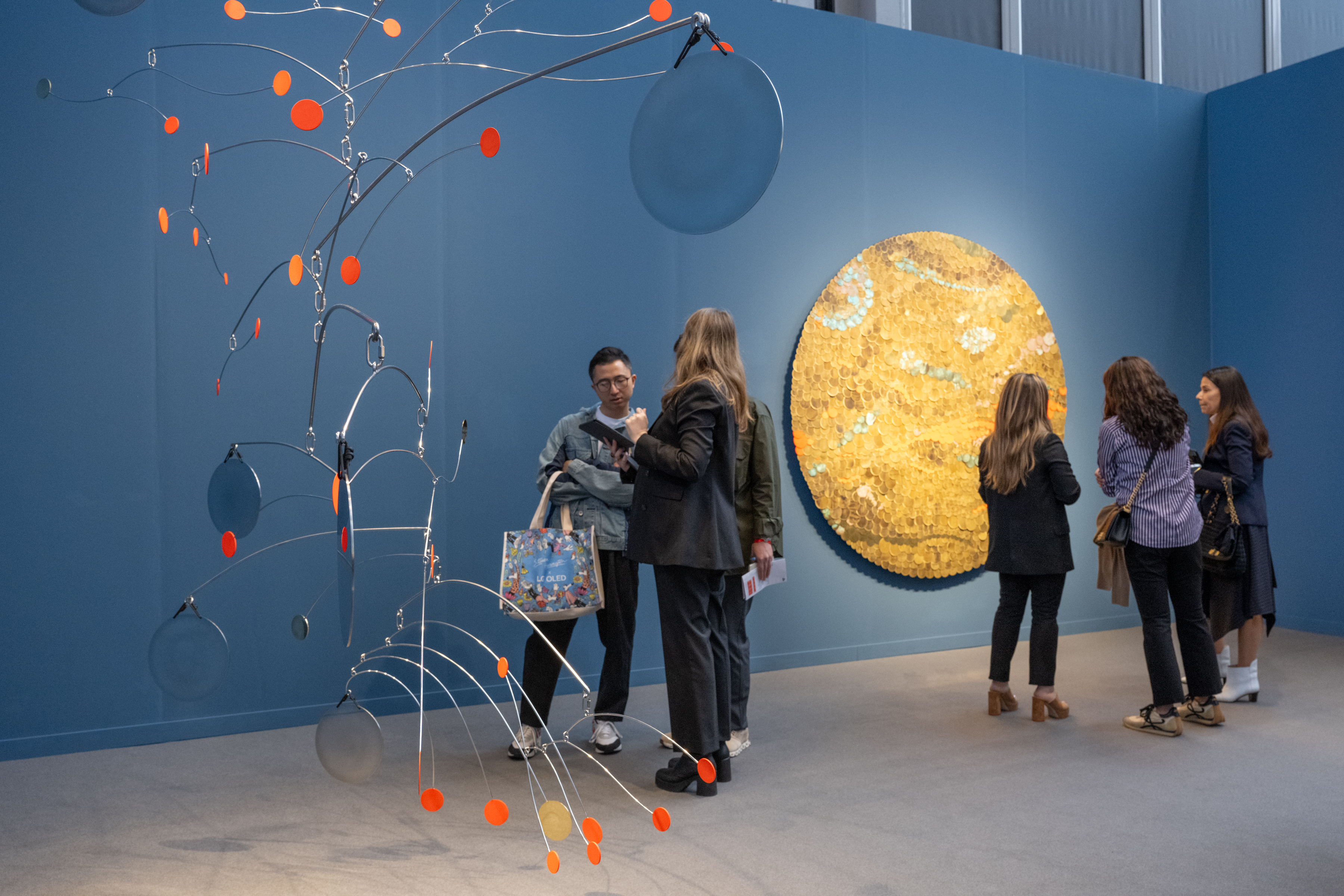
The thirteenth Frieze New York 2025, which took place from May 7th to 11th, once again converted Hudson Yards’ The Shed into a hub of contemporary art, this time hosting a veritable globalization of collectors, curators, and market watchers. The fair was supported by over 65 premier international galleries from more than twenty-five countries. It came against the backdrop of shifting global art sales as well as sustained activity in certain regions. After the recent buyout of the Frieze art fair conglomerate by a new group led by Ari Emanuel, former CEO of Endeavor, for a rumored $200 million, there was a whisper-quiet speculation about the fair’s future alongside The Armory Show and EXPO Chicago. In this transitional climate, Frieze New York 2025 presented an insightful snapshot of the contemporary art world, featuring high-value sales dominated by long-established names and richly praised emerging talent alongside a multifaceted program of immersive and participatory out-of-booth performances.
The Market Pulse Register for Frieze New York 2025: Volumes and Value, Sorrows, and Strategies Append
The overall atmosphere across the stands of Frieze New York 2025 felt to be a blend of measured optimism and palpable excitement.
VIP previews drew in an “upbeat” and “amazingly optimistic” crowd, as dealers described. Frieze’s Director of America, Christine Messineo, noted that “defied expectations” for the New York edition built on the positive energy from Frieze Los Angeles earlier in the year. However, this lively atmosphere was balanced by a market framework described as “cautious” by some advisors. The pace of sales captured this duality. For example, Thaddaeus Ropac remarked that there was a more “considered” approach where collectors were allowed “space to make their decisions,” but other sellers were experiencing “brisk” sales, particularly for blue-chip artists. Hauser & Wirth stated that they moved over 25 works on the opening VIP day alone.
Art advisors Megan Fox Kelly and Gardy St. Fleur further illuminated this selective confidence by stating that collectors evidenced greater thoughtfulness and better attunement to value, which suggests they were interacting with dealers more willing to negotiate. This relates to broader market behavior outlined in the 2024 Art Basel and UBS Art Market Report, which highlighted a softening at the very high end of the market, alongside a noticeable increase in the sales of works priced under $50,000.
This indicates a market that is not necessarily slowing down. Instead, it is becoming more focused and fighting harder for works that are considered scarce or come from distinguished origins. Even while works are being contested fiercely.
Several mega-galleries were reporting significant transactions, which indicates that the dominance of blue-chip art was hardly being contested. A main topic of discussion was Gagosian’s solo presentation of Jeff Koons, which was his first return to the gallery in years. It was reported that the monumental bronze sculpture Hulk (Tubas) (2004-2018) from Koons’s “Hulk Elvis” series initially sold for more than three million dollars on VIP day, with a great deal of interest in the other pieces as well. This sale, along with the so-called “collector frenzy” for the booth, highlighted the way in which high-profile, event-style presentations serve as potent market catalysts, drawing buyers and generating an air of prestige that, for certain pieces, can override broader market caution.
Sales included a Tracey Emin painting for approximately $1.59 million (equivalent to £1.2 million) alongside an Emin bronze selling for £80,000, Etel Adnan for $180,000, and two of Antony Gormley’s sculptures at £325,000 each. This led to White Cube confirming strong standings for the fair.
Most significantly, a painting by Christine Ay Tjoe was secured with an institution for the amount of $280,000. This remarkably illustrates the still-existing function of museums in legitimizing and acquiring contemporary artworks at primary market fairs. On Hauser \& Wirth’s productive opening day, works by Lorna Simpson (Vista, 2025) and Rashid Johnson (Soul Painting “The Jungle,” 2025) were sold for unknown amounts, but their total sales were estimated between $20,000 and $1.2 million.
Furthermore, Pendleton’s Pace Gallery booth, which featured his own works alongside sculptures by Lynda Benglis, was curated by the artist himself and showed brisk sales as well. All six of Pendleton’s paintings were sold to different buyers for $165,000 to $425,000 each. Several sculptures by Benglis also sold for $275,000 to $300,000 each. David Zwirner offered new paintings by Sherrie Levine from her “After Piet Mondrian Inverted” series for $150,000 to $200,000 each. Sales reported by Thaddaeus Ropac included Georg Baselitz’s Motto: sexuelle Niete sagt Heidegger sagt Celan (2023) for €1 million and Liza Lou’s Zeugma (2024) for $225,000. Karma Gallery’s success at the fair included the sale of works by Gertrude Abercrombie, ‘Owl for Emil’ (1958), and Richard Mayhew’s ‘Mountain Mindscape’ (1969) for $350,000 together.
Mendes Wood DM sold Suga Kishio’s eight-sculpture installation, Sliced Stones (2018), to an American institution for somewhere between $200,000 and $300,000. In parallel, Goodman Gallery sold a Carrie Mae Weems piece to a European institution for $100,000. Further international sales include Park Seo-Bo’s painting sold for $250,000-$300,000 at Kukje Gallery, Lee ShinJa sold for $200,000, and a Pacita Abad textile sold for $150,000 at Tina Kim Gallery. Perrotin notably sold out its entire booth of Claire Tabouret’s paintings on VIP Day, each priced between $65,000 and $200,000.
The active upper-end institutional purchases serve as a stabilizing force. Buying a work from a contemporary artist not only cements their market value but also affirms their cultural significance, which is particularly important to collectors and analysts. This is further complicated by the Frieze acquisition made by Ari Emanuel’s new company just before the fair.
Though the immediate effects may not have been evident, it does suggest more than overt belief in the profitability of leading art fair brands during market transitions. Significant investments, especially from entertainment figures, indicate trust in their cultural capital. It indicates understanding that these fairs transcend commerce. They serve as cultural milestones and critical networking intersections.
“Exploring the Aisles of Frieze New York 2025: Artistry and Outstanding Dialogues”Frieze New York 2025 showcased a noteworthy volume of productive artistry, where galleries put together cohesive and frequently bold displays. In addition to the headline sales at the fair, a considerable amount of artistic merit was on display. Particularly, the mega-galleries turned out highly impactful presentations, and Gagosian was no exception, with an immersive environment featuring three monumental sculptures from the “Hulk Elvis” series. Two of these, Hulk (Tubas) and Hulk (Organ), not only functioned as towering interactive sculptures but also boasted muscular bronze exteriors and showcased Koons’s sustained interplay with consumerism and celebrity through art.
Hauser & Wirth’s booth showcased the strength of their roster with significant works of primary contemporary figures such as Simpson, Johnson, and Sherald, who each center their practice on identity, history, and culture. At Pace Gallery, the dialogue offered by Adam Pendleton’s curated booth was particularly compelling with his own “Black Dada” and new “Movement” paintings that engage with language, abstraction, and political discourse alongside newer bronze sculptures by Lynda Benglis, an artist noted for her radical designer’s approach to materials and form. This coupling illustrated concepts of focus concerning gesture, materiality, and the movement of captured energetic stasis. David Zwirner dedicated his booth to Sherrie Levine, which enabled a deepened consideration of her latest works on appropriation, including the ‘After Piet Mondrian Inverted’ pieces. Works referencing Francis Picabia and Alfred Stieglitz were equally part of the sharply Paisan-devised statement on authorship and originality in art history staged by the artist. With White Cube, alongside Tracey Emin and Georg Baselitz, the represented also included Ay Tjoe, broadening the roster from a European one to an international one.
As in previous editions, the more established galleries opted for compelling solo or closely themed presentations, a strategy that enables a more focused, immersive, and almost museum-like experience.
James Cohan Gallery hosted the artwork of Tuan Andrew Nguyen, who formed his sculptures from unexploded ordnances (UXOs) harvested in the Quảng Trị region of Vietnam, which suffered profound and relentless bombing during the Vietnam War. Healing, some transformed by violence into war, Gr Sieghart to Ukrainian woman W21 A11 Gr Sieghart Endow, these objects reminiscent of his kindred who so often offered and curated the cadence of the Reagan years’ tune to the former mobile of Alexander Calder, evolve into symbols of resilience, healing loss, deeply commenting on material transformation and memory.
At Tanya Bonakdar Gallery, Sarah’s intricate II Time is Slowed by the Earth (2025) was placed side by side with her other masterpieces. Known for her everyday objects and collaged imagery construction, her remorseless thoughts, modern examination of timeng of cycles, image in a flow, and measure of stories of life. Perrotin’s sold-out solo show of Claire Tabouret’s introspective portraits examined “the nuances of human relationships,” portraying psychological insight through her characteristically bold and captivating brushwork. In Casey Kaplan’s gallery, a striking solo booth of glass and stainless steel sculptures by Hannah Levy, who often subverts everyday objects, turning them into oddly sensual, somewhat sinister forms steeped in Art Nouveau and modernist design, described as “animalistic” and “seductive.”
Thematic, generational dialogues and interrelations of different ages and times also enriched the fair.
Karma’s booth, for instance, showcased innovative practitioners like Alan Saret, Jeremy Frey, Maja Ruznic, and Thaddeus Mosley, whose diverse artistic practices and material concerns interacted dynamically. This approach to curation fosters a more connected view of art and cultural history, revealing more layers of relevance, relationships and intersections. In the same vein, Gabriel Orozco’s painting Halo at kurimanzutto, featuring an imagined meeting between Da Vinci’s Vitruvian Man and the Aztec goddess Coatlicue, framed a counterclockwise North American and Mesoamerican philosophical spin to Western discourse. Such presentations reveal shifting curatorial priorities towards exhibiting works as systems rather than silos and rethinking the provided context for complex narratives within received art history, encouraging collectors to think of building collections that are richly layered and historically foundational.
Also important was innovation with materials. From Beyond Nguyen’s UXOs turned into art to Levy’s metals and glass polished pieces, Victoria Miro showcased a moving portrait of John Cheim by Alice Neel, which dated back to 1979 and exemplified her enduring legacy as a “painter of people.” Nara Roesler revealed Marcelo Silveira’s surreal sculpture made of Cajacatinga wood and leather, Dupla XI, which redefined the boundaries of art. At the Tina Kim Gallery, vibrant “trapunto” paintings by the late Pacita Abad were displayed, including Bacongo I (Acrylic Study), which featured her pioneering textile-based works drawing from diverse cultures.
Through their chosen materials and unique processes, these artists emphasized the innovation of modern sculpture and painting.
Frieze New York 2025 Focus Section: The Future Unveiled, Emerging Trends

At Frieze New York 2025, the focus section was again a key area of innovation and discovery with solo presentations by twelve galleries aged twelve years and younger. Curator Lumi Tan returned for her second consecutive year overseeing the section, which continues to be praised for its growing internationalism and the more rigorous concepts driving the presentations. Focus featured artists who ‘complicate neatly packaged narratives around the individual and society,’ exploring the ‘extractive commercial and military industries, the feminist repositioning of story-telling traditions, and new imaginaries resulting from the translation of digital engagements into physical encounters.’
Focused younger galleries are subsidized by Frieze and Stone Island sponsorship, allowing these emerging presenters to implement their bold creative visions.
Within Focus, a number of exhibitions stood out.
Gordon Robichaux (NY) provides a thoughtful and thorough examination of the late artist and curator Jenni Crain’s work, who passed away at the age of 30 from Covid-19 complications. The booth both memorialized and introduced her to the public, shedding light on Crain’s wide-ranging contributions to the New York art world. London’s Public Gallery showcased Danielle Brathwaite-Shirley’s interactive animated video pieces that sound and animate Black trans experiences using a gaming aesthetic. From Singapore, Yeo Workshop exhibited Citra Sasmita’s installation of ancient textiles alongside intricately beaded cowhide paintings. Her reinterpretation of traditional Indonesian Kamasan painting and epic stories is often through the lens of womanhood and empowerment.

G Gallery, located in Seoul, featured an experiential installation titled “The Bewitched Surfers and the Holy Barnacles” by Ahyoon Song. The work consists of immersive projections and cardboard structures that examine the illusions and realities fabricated by the internet, selling at a price of $22,000 to $30,000. The Focus Stand Prize in 2025 was given to Mitre Galeria from Brazil for their solo booth exhibiting Luana Vitra, whose works were described as “dense with soot, iron, and symbolic grit” and gave a forceful conceptual and material thrust to the fair. A particularly powerful addition was from Voloshyn Gallery, which is based in both Kyiv and Miami. This marked the first time a Ukrainian gallery took part in Frieze New York 2025, where they showcased a solo exhibition for Nikita Kadan, “Kyiv Siren.” The exhibition included charcoal drawings and installations that evoked ancient warfare, merging contemporary conflict with timeless allegory. The works were offered between $16,000 and $50,000.
Also debuting in the Focus section were Champ Lacombe (Biarritz), King’s Leap (New York), and Management (New York). Central Galeria (São Paulo), Company Gallery (New York), and Madragoa (Lisbon) returned to the fair, the last of which presented Rodrigo Hernández’s Aesop’s Fables bat oil paintings.
The global roster, along with the concerns articulated in Focus—conflict, identity, the digital realm, and environmental concerns—made it a fascinating synthesis of international worries and the varying artistry they provoke. It was not only about presenting “new” art but rather “new” art that resonated with the present moment.
The Focus section of the fair actively spotted emerging artistic trends. For example, fiber and textile art, as noted by The Art Newspaper, was particularly abundant. Apart from Citra Sasmita in Focus, this was clear with Paulino’s compelling Mangrove series at Mendes Wood DM that incorporates colonial history and resistance through fabric, embroidery, and labeling. Also, the previously mentioned Pacita Abad at Tina Kim Gallery and the stunning works by Korean artisans Jian Yoo, Ok Kim, and Subin Seol that were exhibited by THE WHOO, a luxury beauty brand. These articulations showcase how contemporary art is starting to adopt fiber arts more. Contemporary discourse appreciates the materials used in fiber art for their historical importance and the ability to tell a multi-layered, complex narrative.
Another theme, particularly within the Focus section, was art that deals with digital realities and identities. These, along with the pieces by Danielle Brathwaite-Shirley and Yehwan Song that grappled with the intricacies of existence within the digital realm, from identity construction to online frauds, Shwan Shen. This line of thought intersects with broader artistic inquiries like Pierre Huyghe’s recently displayed AI works at Marian Goodman Gallery.
In addition, the re-examination and reinterpretation of historical narratives, colonial legacies, and personal or communal trauma is a powerful current across the fair. Tuan Andrew Nguyen, Nikita Kadan, Citra Sasmita, Rosana Paulino, and Danielle Brathwaite-Shirley are exhibiting these oftentimes painful renditions, showcasing their ability to transform them into deeply powerful contemporary statements. This demonstrates art’s potential for resistance, reclamation, and healing. Incorporating ‘young artists’ or “underappreciated” ones, as exemplified by the posthumous Crain presentation, expands the Focus section’s disregard of where the market and institutions frame value definition. This shift from chronologically based defining value contributes to broadening how emerging consciousness” is prioritized over linear historicism.
Beyond the Booths: Performances, Collaborations, and Frieze New York 2025’s Citywide Resonance
Extending beyond traditional gallery booths, Frieze New York 2025 expanded into citywide immersive performances and collaborations that interwove The Shed with the rest of the city. Christine Messineo’s coverage captures the essence of these live elements as purposefully “disrupting expectations and unfolding in real time,” which allows fairgoers to navigate the event with a whimsical, liberating lens.
Performative highlights center on Pilvi Takala’s The Pin, co-commissioned by Frieze and High Line Art and curated by Taylor Zakarin.
A widely recognized contemporary artist, Marianna Takala has captured much attention through her unique approaches to social interactions. During “Frieze,” Takala goes beyond the frame of standard practice public interaction by inclusion and exclusion through “unanticipated encounters.” Only with High Line Art did Asad Raza showcase Immortal Coil, a meditation project involving a plant walk as well as nurturing seedlings through grow lights, art, music, and horticulture in collaboration with the High Line’s horticulturist. Carlos Reyes added a durational sound artwork that shifted the ambient atmosphere of The Shed, applying spatial soundscape cues to trigger a timed soundscape that activated the often-overlooked liminal spaces of the fair venue. These performances served as an active experience to counterbalance the object-centered, transaction-focused approach of the gallery booth.
Additionally, the fair underlined its social responsibility and cultural responsibility by highlighting key collaborations. The Artist Plate Project returned in support of the Coalition for the Homeless in an exemplary fashion. The project, featuring 50 unique limited-edition plates created by an astounding roster of artists such as Takashi Murakami, Alexander Calder, Amy Sherald, Lawrence Weiner, Jean-Michel Basquiat, Jasper Johns, and Faith Ringgold, surpassed all expectations, yielding over $500,000.
This initiative merges philanthropy and art in a single framework, permitting collectors to acquire pieces by famous artists at lower price levels while also enabling them to support a significant social cause, thus improving Frieze’s бkгад and public image. Another interesting collaboration was with THE WHOO. THE WHOO is a luxury Korean beauty brand, and this was their U.S. launch by showcasing a curated exhibition of contemporary South Korean female artists Jian Yoo, Ok Kim, and Subin Seol. These contemporary masters are transforming traditional Korean methodologies of ceramics, ott-chil lacquer, and mother-of-pearl into modern works. Further, The New School moved forward Vera List Center for Art and Politics presented its Incomplete Listing of NYC Libraries, Reading Rooms, and Archives, which is a nonprofit initiative that is documenting and showcasing the libraries and spaces that one can access freely in the city, focusing on the city’s social and intellectual dimensions alongside community readings. Moreover, the fair was equipped with an academic as well as a community sub-savior.
Frieze Week expanded the broader context within which the fair operated.
New York City emerged as a definitive hub of the art world with a TEFAF New York, NADA New York, Independent, 1-54 Contemporary African Art Fair, Spring/Break Art Show, Future Fair, The Other Art Fair, Focus Art Fair, and satellite fairs are all happening concurrently with gallery openings and special events. This citywide artistic frenzy was complemented by a remarkable lineup of landmark museum exhibitions. Other important exhibitions were Rashid Johnson’s retrospective at Guggenheim, Amy Sherald and Christine Sun Kim at the Whitney Museum of American Art, Hilma af Klint and Rosa Barba at the Museum of Modern Art, Sandra Poulson at MoMA PS1, Torkwase Dyson’s project with the Public Art Fund, Sonia Gomes at the Storm King Art Center, “The Harlem Renaissance and Transatlantic Modernism” at The Met, and “Hiroshige’s 100 Famous Views of Edo (feat. Takashi Murakami)” at the Brooklyn Museum. This rich tapestry showcases the impact of Frieze New York as a key anchor of a bigger metropolitan art ecosystem, not just as a stand-alone occasion. The synergy that this concentration of attention generates for the city benefits all participants, including a critical mass of international sponsors, curators, and art lovers.
Frieze New York 2025—An Indicator of a Changing Market
Frieze New York 2025 has closed as a multifaceted event, masterfully managing a time of palpable market recalibration. It offered a compelling blend of rigorous commerce for well-established artistic empires and a Checkmark eager if more selective appetite for new, emerging voices and practices. The fair claimed an impressive 25,000 attendees over its five-day stretch, underscoring the enduring appeal of the physical art fair even during this increasingly digital era. The remarkable figures, especially sales at the upper end of the market, signaled optimism and resilience against some prevailing economic concerns.
The fair reaffirmed the enduring strength of certain artistic currents, narrative-based work, materially rich innovative practice (often in sculptural or textile forms), and art engaged with present-day socio-political digital realities. Focus, under Lumi Tan’s astute curation, remained an essential engine of discovery, amplifying the global reach and thematic urgency of a new generation of artists and galleries.
The incorporation of performance art and impactful charity partnerships like the Artist Plate Project successfully refined the fair’s character and, as Christine Messineo states, positioned it as an event “responsive to the moment.”
Frieze New York 2025 was an important indicator of where the market currently stands. It showed that while some collecting habits may be tempered with caution, the appetite for exceptional works by blue-chip artists is still fervent, and the excitement for genuine discovery remains undampened. The fair further cemented its position as one of the leading international venues, which not only hosts but also shapes contemporary art dialogues and market trends. Quietly, yet significantly, the mark of new ownership led by Ari Emanuel was felt. What happens as a result of this acquisition will likely be one of the most watched stories to unfold in the coming months and years, possibly marking a new phase for Frieze and its pivotal place in the shifting global art world. For now, the 2025 edition showed that even within uncertainty, the ability of art to bring people together, fascinate, and command great investment remains rock solid.


Leave a Reply