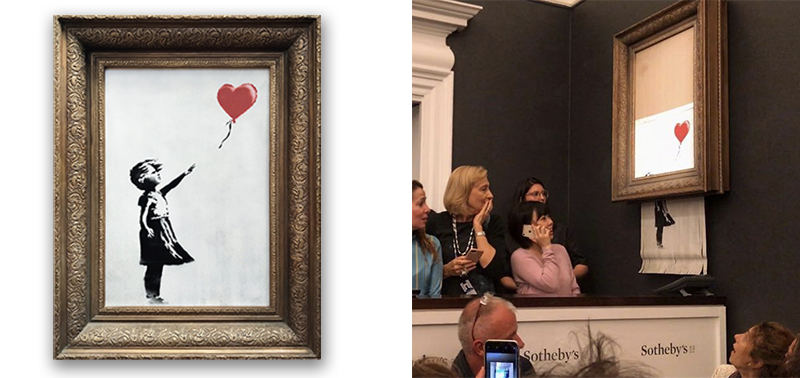
On a crisp October evening in London, the air outside Sotheby’s auction house was filled with a palpable sense of anticipation. The iconic building, a beacon of prestige in the art world, was illuminated against the twilight sky, drawing in an elite crowd of collectors, critics, and connoisseurs. Inside, the atmosphere was electric. People mingled, their hushed conversations and the clinking of champagne glasses creating a symphony of excitement. Tonight, they had gathered for a singular purpose: to witness the sale of Banksy’s “Girl with Balloon,” a piece that had not only captured the public’s imagination but had also sparked deep philosophical debates about the essence of art.
As the auction began, the room fell into a hushed silence, every eye fixed on the auctioneer who stood at the podium. He was a tall, distinguished man, whose commanding presence and practiced ease spoke of years of experience in the high-stakes world of art auctions. With a dramatic flourish, he unveiled the “Girl with Balloon,” and the room buzzed with anticipation. The image, a simple yet poignant portrayal of a young girl reaching out towards a red, heart-shaped balloon, had become one of Banksy’s most beloved works.
The bidding started at a high price, and as the auctioneer called out the escalating amounts, paddles shot up around the room with feverish intensity. The air was thick with competition and desire. Each bid seemed to outdo the last, as determined collectors fought to claim a piece of Banksy’s elusive genius. The price climbed rapidly, the numbers reaching dizzying heights, until finally, with a resounding crack of the gavel, the auctioneer declared the winning bid: £1.04 million. The room erupted into applause, the successful bidder beaming with pride and excitement.
But then, something extraordinary happened. As the applause began to die down, a soft beep emanated from the frame of the “Girl with Balloon.” The crowd watched in stunned silence as the artwork began to move. Slowly, almost deliberately, the canvas slid downward, passing through a hidden shredder concealed within the bottom of the frame. The once pristine image was transformed into a cascade of dangling strips, the red balloon still eerily intact at the top. Gasps of disbelief and shock echoed through the room. Collectors, critics, and onlookers were frozen in a moment of collective astonishment.
Banksy, the enigmatic and anarchistic street artist, had pulled off one of the most audacious stunts in art history. He had turned the auction itself into a live performance, a daring commentary on the commercialization of art and a rebellion against its commodification. His cunning plan, years in the making, had been executed flawlessly. As the final shred fell, revealing the now-tattered image, a sense of awe rippled through the room. The once-complete artwork was now a poignant and powerful statement, a testament to Banksy’s unyielding critique of the art market.
Minutes later, Banksy himself confirmed the stunt with a video on Instagram, showing how he had installed the shredder in the frame years earlier, in case the piece was ever put up for auction. The video quickly went viral, adding to the mystique and legend of the artist. His message was clear and resonant: art should be an act of rebellion, a challenge to the status quo, not merely a product to be bought and sold.
Alex Branczik, Sotheby’s Senior Director and Head of Contemporary Art in Europe, tried to maintain his composure as he faced a barrage of questions from the press. “It’s a brilliant Banksy moment,” he said, struggling to contain his own amazement. “The first time in auction history that a work of art automatically shredded itself after coming under the hammer.” The staff and attendees, still reeling from the spectacle, couldn’t help but marvel at the audacity and genius of Banksy’s act.
The anonymous buyer, who had just spent over a million pounds on the piece, faced a difficult choice. In a remarkable twist, they decided to go through with the purchase, embracing the shredded artwork, now rebranded as “Love is in the Bin.” The value of the piece skyrocketed. It was no longer just a piece of art; it was a piece of art history, a symbol of Banksy’s critique of the art market, and a testament to his unpredictable genius.
Debates raged in the aftermath. Was the shredded piece now more valuable because of the spectacle? Did the act of destruction add a new layer of meaning to the artwork? Could the destruction itself be considered part of the creative process? These questions only deepened the intrigue surrounding Banksy’s work and his statement on the nature of art and value.
As the days passed, the “Girl with Balloon” incident at Sotheby’s became a defining moment in modern art history. It was a reminder of the power of art to surprise, challenge, and provoke thought. Banksy had once again left his indelible mark on the world, proving that true art transcends the frame it inhabits. The story of that night became a legend, a tale retold in art circles and beyond, cementing Banksy’s place as one of the most provocative and influential artists of his time.
The shredded “Girl with Balloon” was not just an artwork; it was a symbol, a statement, and a moment in time that captured the essence of Banksy’s rebellious spirit and his relentless pursuit of challenging the boundaries of art. As the art world continued to grapple with the implications of Banksy’s audacious act, one thing was certain: the “Girl with Balloon” incident had forever changed the landscape of contemporary art, leaving an indelible mark on the hearts and minds of those who witnessed it.





Leave a Reply