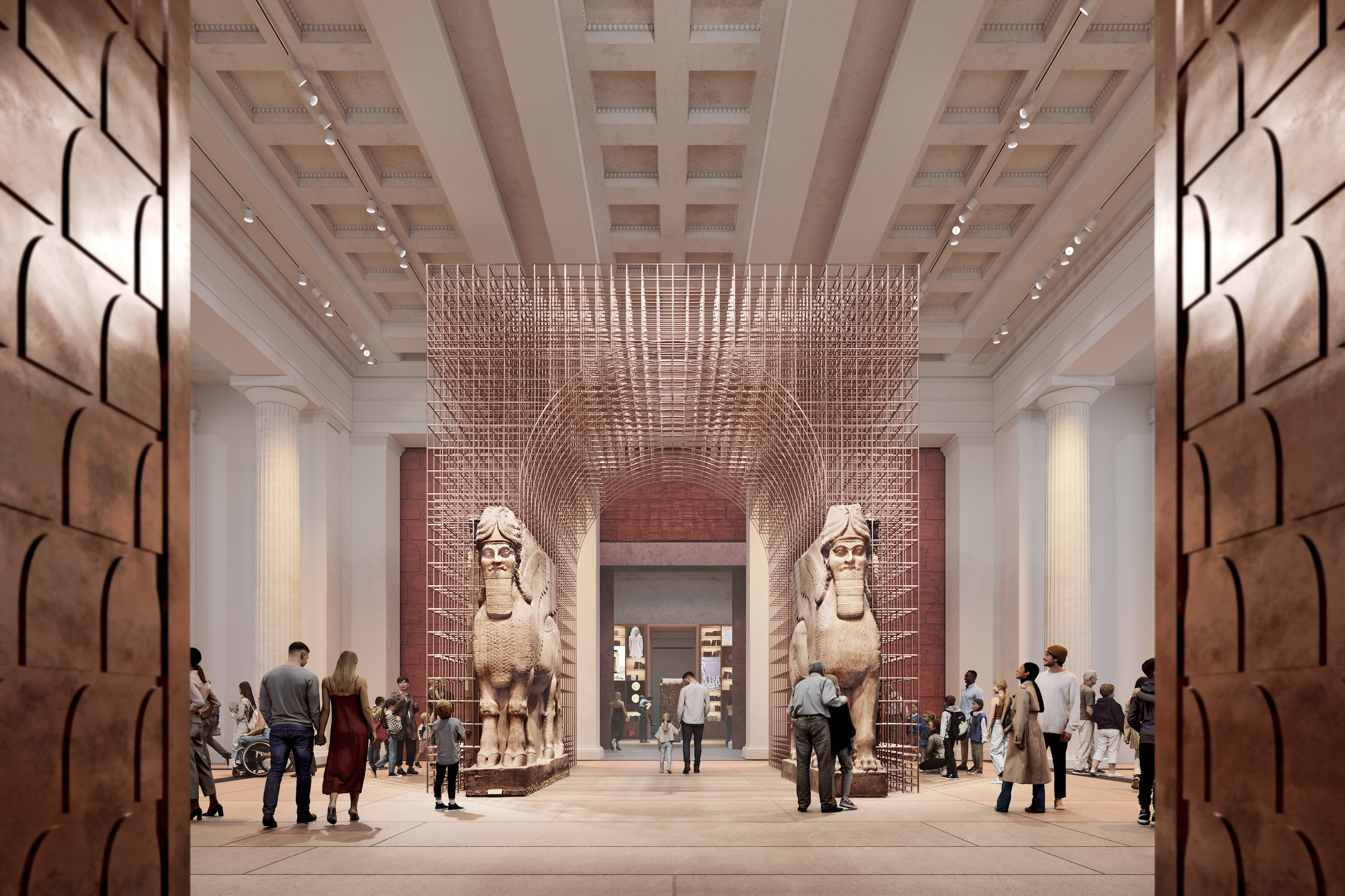
In northern London’s Bloomsbury region lies one of the top-tier art and history museums in the world, the British Museum. This iconic institution, which is the pride of the Kingdom, receives millions of tourists every year and has artifacts more than 8 million in number, including the Rosetta Stone, Parthenon Marbles, and ancient Mesopotamian treasures. Historically, it has been a center of attraction for a plethora of artists, scholars, and enthusiasts. Institutions, however, need to change and evolve to remain relevant. On February 21, 2025, the museum declared Paris-based Lina Ghotmeh Architecture as the winner of the Western Range galleries renovation design competition. The transformation includes 15,650 square meters of surrounding infrastructure and 7,500 square meters of exhibition area, making it the highest amount of space allocated for a British Museum project. The Ghotmeh renovation is of significant importance in the history of the museum as it innovatively combines modern infrastructure and artistic expansion.
It unveils the intricate story of how the British Museum is dealing with the challenge of protecting the famed history while welcoming a futuristic vision. This paper looks at the renovation project through both the modern architectural artistry enabling the physical change and the artistic ramifications for the unrivaled collections that the museum possesses. It is primarily focused on the changes taking place at the Louvre in Paris while portraying contemporary strategies for modernizing British Museum design and their incorporation into the overarching theme of the article.
A Legacy Under Pressure: The Western Range’s Call for Renewal
The British Museum begins its story in the 1820s. Its beginning is marked with the construction of the neoclassical-sounding quadrangle by Greek Revival Sir Robert Smirke, which took place in the 1820s. Over the period of 200 years, the fabric was reinforced by many of the institution’s necessities, like the King Edward VII building of 1914 and Norman Foster’s glass-roofed Great Court in 2000. Still, the Western Range, which holds some of the most important collections from ancient Egypt, Greece, Rome, and the Middle East, is still not caught up. These galleries have been built since the 1850s, but with time, their supportive infrastructure has faced the brunt of decaying climate control systems, dilapidated space designs, and poor layout accessibility.
The turn of the year 2024 marked a difficult time for the British Museum. In May of that year, the chairman, George Osborne, alongside director Nicholas Cullinan, announced a worldwide competition for architecture, setting out to find a visionary redesign for the critical third portion of the museum bordering its footprint. The Osbornes put forward expectations of a happy collision of modern functionality with maintaining heritage: new systems that are less intrusive, better circulation of visitors, and shout-out exhibitions for the 21st-century audience. For an institution of the British Museum’s magnitude, the issue was simply not a case of changing a structure, but safeguarding its cultural wealth was more important.
The Fight: The World’s Great Architects Compete
More than sixty contenders from different countries participated in the British Museum project competition. This highlights the importance of the project. Five winners were selected by August 2024. They included 6a Architects, David Chipperfield Architects, OMA, Lina Ghotmeh Architecture, and a joint venture of Eric Parry with Jamie Fobert Architects. Each team possessed its own unique blend of architectural styles. contribute a minimalist touch, OMA was much more radical, and Ghotmeh was going to provide a narrative sensitivity. All these differing styles would clash in the architectural world that was about to unfold.
This stage was achieved between September and December of 2024, and it was entirely focused on the product’s concept. In the British Museum’s Round Reading Room, the finalists had a public design workshop phase. Visitors, including Osborne, the chair of the jury, were able to hear and see the designs that were publicly displayed and were judging them. The jury, which comprised RIBA Gold Medal holder Yvonne Farrel and artist Tracey Emin, measured the plans within the strict borders of rationality: sustainability, integration with the Grade I-listed building, and curatorial creativity. The award ceremony took place on February 21, 2025. It is Lina Ghotmeh Architecture that receives the award. The decision was received with fresh applause, showing how original it was.
From her birth country of Lebanon, Ghotmeh had already achieved much as an architect after designing the Estonian National Museum, raising her prestige even more thanks to established actors Rem Koolhaas and Chiperfield. This victory indicates that a softer architectural voice, which combines reverence for history with the boldness of a contemporary approach, is getting preference. Who else but the British Museum would appreciate such boldness?
Lina Ghotmeh’s Vision: Building the Future

Lina Ghotmeh’s innovative design for the British Museum’s Western Range incorporates what she refers to as an ‘archaeological approach’ in thinking that describes peeling away layers of history to uncover endless possibilities. Its essence lies at the epicenter of the space: a re-conceptualized volumetric central place that is radiantly lit and replaces the wing’s former maze of rooms. The core is surrounded by galleries and encapsulates the spirit of discovery while complementing the museum’s aims of celebrating the unearthing of human narratives.
The design is architecturally perceived as a duality. Ghotmeh maintains portions of Smirke’s neoclassical skeleton by restoring cornices and stonework with great craftsmanship while adding modern features like skylights, translucent canopies, and advanced sustainable materials. The striking feature of the design is how light is manipulated: windows are designed to let in natural light without the need for artificial energy while also allowing the dynamic artifacts encased within to be illuminated from every angle. The combination of stone, glass, and low-carbon compost offers a nod to the shaped classical architecture of the British Museum while also representing a shift toward being environmentally conscious.
In the Ghotmeh design, the museum’s underused courtyards are transformed into exhibition spaces, providing additional square footage for the museum’s curatorial work. These new ads display the Elgin Marbles of Ramses II in scenarios that are more interactive than passive. New design concepts, which include unbroken connections between spaces, re-envision the notion of accessibility by removing the obstructions of the old layout’s physical and contextual boundaries. Everything is integrated with sustainability in mind, from passive ventilation and modern insulation to decarbonized American systems, branding the British Museum with goals for climate change efforts.
The Artistic Impact: Recontextualizing a Collection

Artistically speaking, the upgrade of the British Museum is of primary importance. Some of the most famous souvenirs are located in the Western Range, but their display has always been limited by its rigidly presented galleries, such as split showcases. With Ghotmeh’s design, these works of art are freed from their constraints forever, as he provides the curators with amazing instruments to compose stories with the aid of splendid spatial narratives. The central hub, with its soaring scale, could host thematic installations—say, a dialogue between Greek sculpture and Egyptian reliefs—while smaller galleries allow for focused explorations of lesser-known pieces.
Art preservation has always faced issues with lighting and climate control, but that has changed for the better. Adjustable systems and skylights provide the required protection from UV rays and humidity for sensitive objects such as Roman frescoes and Assyrian reliefs. This technical improvement will not only better display the treasures of the British Museum but also increase their impact visually by illuminating details that have been hidden behind years of inadequate display.
Museum curation has taken a step in the digital direction, promising increased interaction through augmented reality or touchscreens. Imagine the Parthenon Marbles’ complicated journey from Athens to London or the ease of the virtual reconstruction of vandalized relics. These prospects for the British Museum will definitely engage a younger audience, allowing it to widen its cultural appeal while maintaining its academic focus.
While this perspective is indeed captivating, it invites a different set of problems. The Elgin Marbles, widely discussed in relation to repatriation issues, will acquire a fresh viewpoint, potentially leading to a change in the interpretive equilibrium. Curators must tread carefully, ensuring that the architectural display enhances rather than overwhelms the historical significance of the artifacts.
The British Museum vs. The Louvre: A Tale of Two Restorations
Examining renovations at the British Museum offers one perspective on the philosophies of cultural restoration in comparison with the Louvre. The Louvre, which used to be a 72,735 sq m palace, has done some contemporary gilding to its interiors ever since commencing construction in the year 2014. Projects like the Islamic Art galleries in 2017 and the Richelieu Wing in 2021 focus mainly on continuity by concealing the museum’s lavish heritage behind modern advancements and techniques.
In contrast, the British Museum prefers to aim for transformation. Ghotmeh’s Western Range scheme alters the spatial order through which architecture dictates movement and vision within a building by forming large, sparse volumes in a relatively small square. While the Louvre refines the palace’s opulence, the British Museum transforms the museum’s neoclassical center. The differences also indicate their curatorial personas: the British Museum, with its signature style of a comprehensive catalog of the history of mankind, and the Louvre, representing the grand collage of art history.
Sustainability emphasizes differing comparisons. The French capital incorporates geothermal heating and solar panels into the building’s historic shell, which contribute to energy-saving solutions through their simplicity and effectiveness. are more sophisticated than other forms of providing energy-saving solutions. Ghotmeh’s “archaeological” sentiment strikes me as more extreme when set alongside other approaches to resource-sensitive architecture.
Ghotmeh and the Louvre add amenities and improve wayfinding, which marks further enhancement to their accessibility. simplifies navigation and enhances the inclusiveness of the museum, which is another example of the integration of accessibility features. All these museums serve a greater need of providing cultural spaces for many people with different needs and expectations.
Looking Ahead
The renovation plan of the British Museum bears some risk. Inserting Ghotmeh’s ideas into a grade-I listed building requires care. compromising Smirke’s architectural integrity of losing Smirke’s mark. The costs are bound to increase, especially during the years of protest against fossil fuels, and they were supported by BP’s pledge of 50 million. These conflicts are met at the Louvre with Total Energies, which demonstrates the problem of cultural funding orientation.
It is also important from an artistic perspective. The Elgin Marbles or any other contested artifacts are under profound scrutiny. Making any representation of them without taking substantial responsibility for innovation introduces another set of boundaries. The British Museum needs to ensure it will not abandon its vision while surviving the antagonism from everyone around the world.
A Decade of Transformation
The range in the west is one of the features that form the British Museum master plan for the year 2023. This scheme has been ongoing for 10 years and includes completing various projects with a total area of 100,834 square meters. Other projects in progress are the new Energy Centre, the Archaeological Research Collection at Thames Valley, and the entrance redesigns by Studio Weave. A comprehensive approach is already evident. The construction consultancy framework guarantees the unification of structural coherence for these works and is valued at 46.1 million, having been prepared in August 2023 for the years 2025–2029.
A Museum Reborn
Dr. Lina Ghotmeh is the designer responsible for the British Museum Western Range remodeling project. It is supposed to be finished in the spring of twenty-six. This renovation is attributed to the bold fusion of structures and sculptures. Dr. Ghotmeh’s logic, which draws from the past and looks to the future, places the museum at the forefront of cultural transformation. With regards to the British Museum, it now has a bolder position compared to the Oberes Belvedere in Vienna or the Louvre Museum, which utilizes a more reserved approach toward its restoration. The British Museum is now ready to take back its position as the world’s gallery of human imagination with every scroll, room, and magnificent space.
FAQ: British Museum Western Range Renovation
Q1: What is the Western Range renovation project?
A: It is an overall redesign of the British Museum’s Western Range, which seeks to replace newly out-of-date infrastructure while maintaining the building’s historic character.
Q2: Who won the design competition?
A: Lina Ghotmeh Architecture, located in Paris, was awarded the prize on February 21, 2025.
Q3: What are the main components of Lina Ghotmeh’s design?
A: The design features a redefined central hub, a neoclassical head, restored skylights, and translucent canopies, as well as neoclassical sustainable strategies and materials.
Q4: How does the project achieve a modern look without sacrificing heritage preservation?
A: The project keeps important historic components such as Smirke’s cornices and stonework but adds modern features to improve visitor circulation, environmental control, and the interactiveness of exhibition spaces.
Q5: What steps are being taken in regard to sustainability?
A: The renovation aims to reduce energy consumption and damage to artifacts by using passive ventilation and modern insulation with low carbon materials and natural light strategies.
Q6: What is the difference between this renovation and the Louvre’s approach?
A: The British Museum project, in contrast to the Louvre’s approach of keeping classic continuity, changes its spatial order to one that is more interactive and transformed with dynamic volumes rather than subdued grandeur.
Q7: What are the boundaries and timelines of the project?
A: The Western Range redesign will be done by the spring of 2026 as part of a decade-long transformation project that spans over 100,000 square meters.
Q8: How will the renovation change the display and preservation of artifacts?
A: Iconic collections like the Rosetta Stone and Parthenon Marbles will be preserved and displayed using enhanced lighting, improved climate control, and flexible interactive spaces.
Q9: What do users stand to gain?
A: Users will experience a museum that is more engaging, accessible, and interactive while logically blending modern technology with historic legacy.
Q10: What challenges does the problem pose?
A: The main challenges are integrating new designs into a Grade I listed building, keeping control over rising expenses, and combining modern usability with cultural heritage.



Leave a Reply