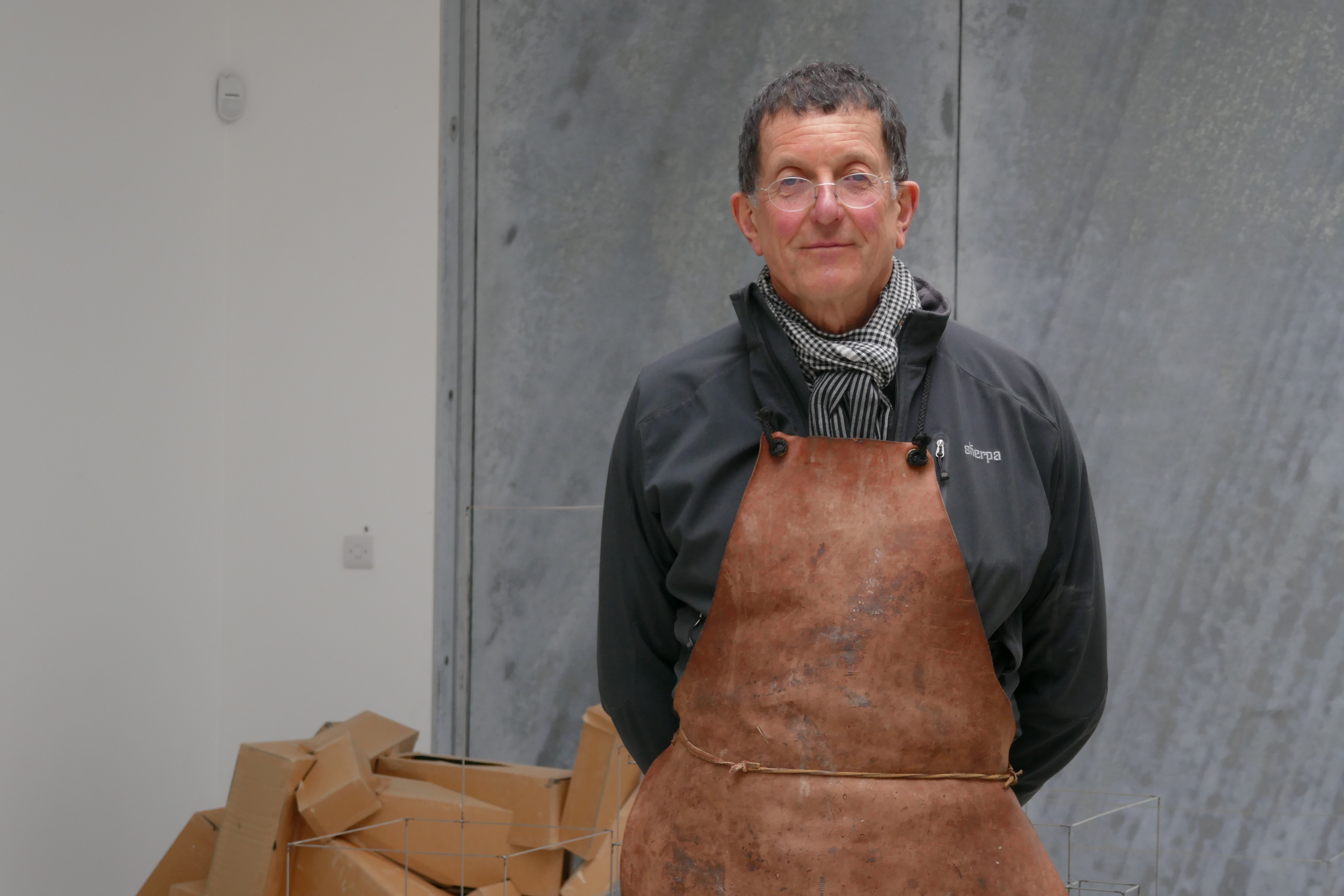
At Galleria Continua, located in Beijing’s 798 Art District, a peculiar contrast greets visitors. It is the third solo showcase by Antony Gormley that is dubbed Body Buildings. This new series will last from November 14, 2024, until April 14, 2025, and it constitutes figurative sculptures and drawings, which are about the coexistence of people with their constructed surroundings. The exposition is framed by a context of the world’s population becoming more urbanized, and Gormley’s pieces act as visuals toward pondering how people, as products of brutalist architecture, engage with and understand their new environments.
In Body Buildings, Gormley’s work gives the viewer concern with ideas of identity, space and continuity, and life or death. The exhibition presents a psychological difficulty: to consider the human being, not just a human figure, but as a territory of remembering, persistence, and doing.
Gormley’s Signature: Exploring the Selves With Spacial Dimensions
Antony Gormley, for a long time, has been known to concentrate upon the placement of the human body, whether it is in the natural world, outer space or the built environment. With classics such as Angel of the North or Another Place, Gormley has shown how he can make sculptural statements that explore the intricacies of humanity, memory and place. His works are sculptures, but they do not merely end there; they create an event where the artwork fuses into the viewer’s being, consciousness and activity in the surrounding space.
Gormley’s work has been widely exhibited throughout the UK and internationally with exhibitions at Musée Rodin, Paris (2023); TAG Art Museum, Qingdao (2023); Lehmbruck Museum, Duisburg (2022); Museum Voorlinden, Wassenaar (2022); National Gallery Singapore, Singapore (2021); Schauwerk Sindelfingen, Germany (2021); Royal Academy of Arts, London (2019); Delos, Greece (2019); Uffizi Gallery, Florence (2019); Philadelphia Museum of Art, USA (2019); Long Museum, Shanghai (2017); National Portrait Gallery, London (2016); Forte di Belvedere, Florence (2015); Zentrum Paul Klee, Bern (2014); Centro Cultural Banco do Brasil, São Paulo, Rio de Janeiro and Brasília (2012); Deichtorhallen, Hamburg (2012); The State Hermitage Museum, St. Petersburg (2011); Kunsthaus Bregenz, Austria (2010); Hayward Gallery, London (2007); Malmö Konsthall, Sweden (1993); and Louisiana Museum of Modern Art, Humlebæk (1989). Permanent public works include the Angel of the North (Gateshead, England), Another Place (Crosby Beach, England), Inside Australia (Lake Ballard, Western Australia), Exposure (Lelystad, the 2/2 Netherlands), Chord (MIT – Massachusetts Institute of Technology, Cambridge, MA, USA) and Alert (Imperial College London, England). Gormley was awarded the Turner Prize in 1994, the South Bank Prize for Visual Art in 1999, the Bernhard Heiliger Award for Sculpture in 2007, the Obayashi Prize in 2012 and the Praemium Imperiale in 2013. In 1997 he was made an Officer of the British Empire (OBE) and was made a knight in the New Year’s Honours list in 2014. He is an Honorary Fellow of the Royal Institute of British Architects, an Honorary Doctor of the University of Cambridge and a Fellow of Trinity and Jesus Colleges, Cambridge. Gormley has been a Royal Academician since 2003.
As in his previous exhibitions Another Singularity 2009 and Host 2016, Gormley once more carries with him materials that reflect architecture and earth. His use of clay and iron in body buildings serves not only to relate to Chinese material and art history but also to give references to basic ideas of creation, construction and security within the context of changing environments.

The Core Work: Resting Place II
At the heart of Body Buildings is the giant work Resting Place II, which covers the exhibition area with 132 large sculptures made of fired clay bricks depicting human bodies. Every sculpture depicts a different physical orientation that resembles or mimics a range of human weakness and strength, from a slight arch to fully spread-out limbs. According to Gormley, in this work of art, which is impressively large, the author has touched on the most interesting aspects of what he calls the “physical pixel,” the brick as a thing base and yet specific to the Chinese architectural structure.
When viewed from various perspectives inside the gallery, these clay forms tend to fuse with and separate from the swarms of humans strolling the surroundings, forming a complex interplay that highlights the fact that the body has both a role: a subject and a medium of the experience. Gormley explains, “Resting Place II evokes the human body’s relationship to the ground, the surface of the earth… inviting empathy with the body as a place of indwelling.”
It is an effect with many faces; it reminds one of the comforting feeling of lying on the sand at ‘the beach’ as well as the physical, emotional and even ‘life itself’ bears the sacrifice made through the ‘journey’ by crossing into ‘the unknown.’ Through haphazardly structured living organs that exhort a typical block or even the apartment complex, Resting Place II becomes a thought about the impermanence of humanity, the fragility of their lives filled with uncertainty.

Sculptural Works in Iron: Circuit, Ally, Short, and Shame acconcompaling Resting
Place II are a number of iron-cast sculptures that depict the various aspects of human connectedness and dissonance. Gormley works with the inverse of approaches in the examination of the relations Samuels and Isaacs focus. In Circuit, Gormley considers the intersections of roads, circuits, plumbing and stocking and the relation of these structures to the people. Circuit, on the other hand, extends these nanotechnologies into hands together with the body and places them at metaphysical junctions of dualism of independence dependence void of machine or social structure and technology.
This is further accentuated by Ally, in which a stack of girls attempts to balance two figures on a flat piece of one and a half inch thick iron plate, defining two-dimensional equilibrium. A sculptural dialogue emerges out of bodies seeking shared weight despite variable pressures. He hopes that this exposition will enable the audience to grasp the gently restrained tensions that bind together such aspects as relativity, altruism and cohesion in urban settings.
Associating with the previous work, Kim and this includes Short and Shame, aim point higher than conventional attitude toward representation of power of body. The latter, on the other hand, offers the body as a’single force field’ where the torso is off the center and about to break. Most of these structures, however, are characterized by arms and are prepackaged with substantial moving parts as well. These include the twisted metal orthotics and the bent leg, which reach for and indicate temporomandibular joint castration.

Antony Gormley: Sculptural Views on the Body, Architecture and Spaces
When it comes to sculpture, Gormley tends to meditate in a distinct manner; being a historian himself, he seeks to contextualize sculptures in the broader spectrum of society and philosophy. In the course of his work, he has developed a specific way to make a particular part of the body function, almost as an instrument. Sculpting to Gormley is a step towards self-awareness and social understanding. His art encourages viewers to consider their own connection to nature and the built environment and the impact these places have on their issues of self-conception and identity.
This idea of “interiorization” and inward looking is especially prominent in Gormley’s work, where he describes how viewers are smart about the interaction and, rather than understanding how to make a form, how forms work. For him, the purpose is not to make deities out of sculptures or charts out of the few of his works. It is to create, as he puts it, “experience models” in which the audience has a function and the role in each of the models, to alter what is happening. According to Gormley, “the space of art is a place of becoming,” where any actions, emotions and answers don’t exist but are anticipated eagerly.
You literally cannot miss this exhibit, Scaffolding Body Structures: Rule III and Buttress, as they already come off as enticing structural bodies with an exhibit about scaffolding and a human body iron structure as well. Now that we have introduced our exhibit, allow me to inform you that these explorations can be found on the upper floors of the Gallery Brisman. Additionally, the artist has nigh lost contact with reality to the extent that he has constructed a much richer architecture that deviates from the ordinary and instead focuses on the metaphor of a series of urban skeletons. With this in mind, they definitely challenge the audience’s perception of the relationship between international development and even our very existence; this assumes that there is a lattice work structure to begin with. This galvanization stands in stark contrast with each other, making it even more motivating and thought-provoking as to why humanity’s ultimate goal in life would be to have an unsoiled connection with the core content of a pure being. If you want to understand this better, I recommend a short video showing how my daughter was entertaining a lot of people on stage. Sci-fi enthusiasts, but not just anyone out there.

The Meditative Drawings: Singularity X, Event VII, and Lux Series
Body Buildings features a collection of more abstract drawings made with media such as inkcap mushroom ink, carbon and casein that deepen the self-therapy of the entire exhibition. These drawings, which are known as Singularity X, Event VII and the Lux series revolve around space, light, darkness and the third space. Using natural inks and pigments, Gormley touches the two ends of the universe—tthe sucking force of the void and the illuminating power of the cosmos—as well as expanding the theme of the exhibition, which is focused upon man’s outer and inner worlds.
The series titled Lux in this regard has images of light penetrating dark spaces, which are interpreted as opening “apertures” and “windows” of metaphorical significance. These are also in addition to images of alleged ‘darkness,’ a fundamental absence, or even the absence of absence that produces confounding intersections of shadows and identity.
Galleria Continua: A Cross-Disciplinary Artistic Performative Engagement
Founded in 1990 in San Gimignano, Italy, GALLERIA CONTINUA has expanded its locations to Beijing, Les Moulins, Havana, São Paulo, Rome, Paris and Dubai. GALLERIA CONTINUA represents a desire for continuity between times and a desire to write a current history. Thanks to its investment in forgotten and unconventional sites, the gallery has always chosen atypical locations, developing a strong identity and an original positioning in over thirty years of activity. In 2004, Galleria Continua has been one of the first foreign art galleries to reach China, opening the second gallery space in Beijing’s 798 Art District. Since then, Galleria Continua has endorsed an important role of cultural mediator on that side of the world, offering Chinese art-lovers a chance to enjoy exhibitions created specifically for this space by internationally acclaimed artists.
Antony Gormley Vision’s of Body Buildings
Antony Gormley’s exhibition titled Body Buildings is far more than creating sculptures; it is an engagement with humanity’s architecture, inquiring in and out the barriers and boundaries that people occupy. Making a broad use of different material chunks such as iron and clay, Gormley seems to bridge the gap between the ancient and the contemporary, individual and collective, by appealing to the viewers to think through the walls of the houses they inhabit and their roles in a huge, intricately interrelated, evolving cosmos. ‘In Body Buildings’ Gormley and Galleria Continua have also provided an opportunity for those exposed to these artworks to think deeply on how they impact the modern man. Through monumental, site-specific works, as it is architectural and artistic designs, Antony Gormley advocates the examination of the ever-changing nature of urbanization and the unrelenting quest for stability and sense our kind is compelled to pursue as in where we are the more developed the environment is.
Galleria Continua / Beijing
798 Art Dst. 2 Jiuxianqiao Rd. Chaoyang Dst,
Beijing
+86 1059789505 | beijing@galleriacontinua.cn
https://www.galleriacontinua.com
From Tuesday to Sunday:
11 AM – 6 PM

Leave a Reply