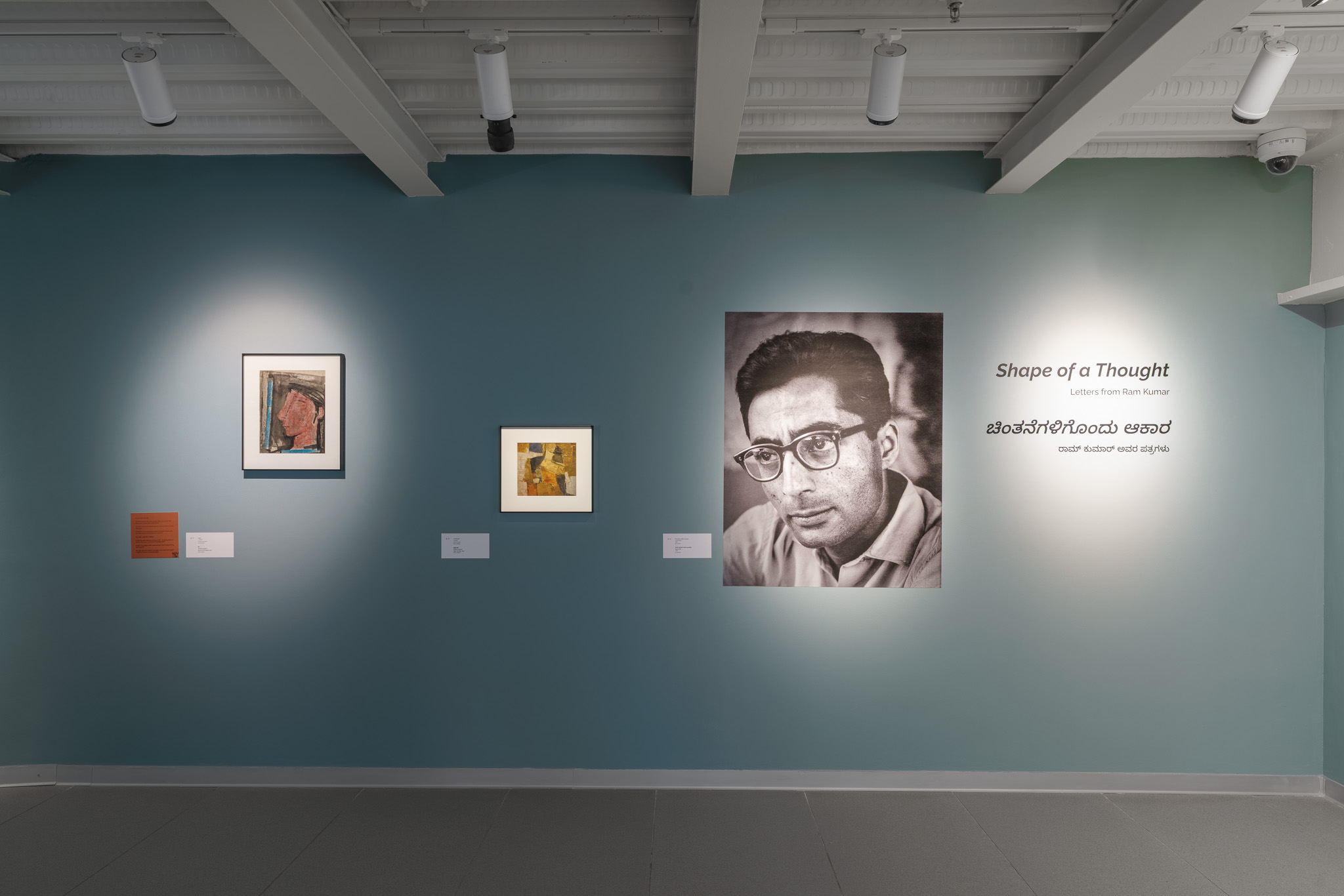
A silent conversation takes place in the quiet, thoughtful galleries of the Museum of Art & Photography (MAP) in Bengaluru. It is a conversation that has been going on for decades, connecting the written word and the painted canvas, as well as private thoughts and public legacies. Shape of a Thought: Letters from Ram Kumar is a unique look at the mind of one of India’s most important modern masters on the occasion of his 100th birthday. The show doesn’t just show off the enormous abstract landscapes that Ram Kumar (1924–2018) is known for; it also shows them with his words, which he wrote in a series of very personal letters to a friend. This brilliant curatorial move by Arnika Ahldag and Priya Chauhan changes how we think about a famously quiet artist, turning seeing into listening. For the scholar, the collector, and the expert, the exhibition isn’t just another look back. It is like a pilgrimage into the very structure of a legendary artist’s solitude, with the Letters from Ram Kumar as our main guide.
For Ram Kumar, the path to abstraction was anything but straight. It was a long, winding path that started with a pen instead of a brush. He was born in Simla, a peaceful hill station in the Himalayas, in 1924. His first language was literary. He was already a successful Hindi fiction writer when he was studying for his master’s degree in economics at St. Stephen’s College in New Delhi. His stories were full of the lost, introspective souls who lived in the rapidly urbanizing landscape of a newly independent India. His early success as a writer was important, and it peaked with the prestigious Premchand Puraskar in 1972. This dual identity is not just a footnote in his artistic biography; it is the very foundation of his creative mind. The deep sense of being alone, the existential angst, and the quiet despair that run through his short stories would later be seen in the dark, figurative paintings of the 1950s.

His formal entry into art was almost accidental; a poster for an exhibition in 1945 sparked his interest. This led to night classes and, eventually, a big break from a stable job in banking. However, it was in Paris that he truly learned how to be an artist. He moved to the art capital after the war in 1949 and studied under the Cubist master Fernand Léger and the important theorist André Lhote. He got deeply involved in the ideas and art movements of European Modernism. His path was not the journey of a follower trying to copy someone else but of a synthesizer looking for a new way to put things together. He learned the structural power of color from Léger and the logic of composition from Lhote. But maybe what affected him the most were his interactions with the social realism of artists like Kathe Kollwitz, which confirmed his interest in the human condition.

When Kumar got back to India, he found a natural home in the Progressive Artists’ Group (PAG), even though it was different from his own. F.N. Souza, S.H. Raza, and M.F. Husain were all part of this loose group of firebrands who wanted to break the rules of the Bengal School and create a new, international language for Indian art. Kumar wanted the same things they did, but he wasn’t as brave. Kumar’s rebellion was quieter and more introspective than the others in the group, who wore their modernist rebellion on their sleeves. His paintings from this time, like the important The Vagabond (1956), are strong visual records of this way of thinking. They are full of thin, hollow-eyed people whose bodies are twisted in silent pain, set against dark, empty cityscapes. These aren’t just pictures of poor people; they’re pictures of a mental state, a visual representation of the existential loneliness he had first written about in his fiction. The city isn’t just a background; it’s a character that shows how trapped someone feels on the inside.
The Revelation and the Varanasi Epiphany in the Letters from Ram Kumar.
Ram Kumar’s artistic life underwent a profound transformation in the winter of 1960. It was the moment that set him on the path from the figure to the formless. Going to the old, holy city of Varanasi with M.F. Husain turned out to be more of a mental break than a trip. Kumar reached an artistic and emotional dead end when he saw the raw, overwhelming sight of life and death coexisting on the ghats. The amount of pain he witnessed was “too overwhelming” for a human body to contain. The face, the body, and the person—the very things he had been working on until then—suddenly seemed too specific and almost sinful.
This crisis was the source of his abstraction. It wasn’t a stylistic choice; it was a philosophical need. He left the figure not because he was intellectually curious, but because he felt it was the right thing to do. He started to write about the city itself: its broken-down, maze-like buildings, its crumbling riverfront facades, and its crowded, dark lanes. These abstracted architectural shapes, painted in a range of muddy, sad greys and browns, stood for a universal human condition, the never-ending cycle of decay and survival. The letters from Ram Kumar serve as a written record of this big change and were a significant part of the MAP exhibition. We can see the artist’s struggle to put into words an experience that didn’t fit with the usual ways of doing things in these works. He talks about wanting a “confrontation with myself without any distraction,” which shows how he has moved away from the specific stories of figuration and toward a more basic, internal language. The Varanasi paintings are the first strong examples of this new language, which connects the world we see with the world we feel.The Inner Landscapes: How Ram Kumar’s Letters Help Us Understand His Abstracts
After the Varanasi epiphany, Kumar’s abstraction grew. The haunted cityscapes slowly gave way to what can only be called “landscapes of the mind.” His paintings became places for deep, meditative inquiry, drawing on the memories of his childhood in the Himalayas and the stark, elemental beauty of his later trips to places like Ladakh. These mature works, which would define the rest of his seven-decade career, make him a pioneer of Indian abstraction.

Ram Kumar
1976
Oil on canvas
They are known for their outstanding skill with color, texture, and shape. Brushstrokes that sweep and change create thick layers of impasto, and blocks of color—bright blues, earthy ochres, and deep greens—are arranged in compositions that are well-balanced and harmonious. He broke down the visible world into lines and planes, not to study it, but to connect to its emotional and spiritual core. The artist himself said that these paintings are “pure, simple, plain, painted color propositions that come from one’s past experiences.” They are not pictures of a place; they are a place themselves, a place to think.
The MAP exhibition’s curatorial strategy truly shines in this context. People unfamiliar with abstract art, especially the subtle and contemplative type, may find it difficult to understand. Kumar made the matter worse by often not giving his works titles. The artist intentionally included this feature to remove the viewer from the artist’s personal narrative. The curators give people a key way to gain entry to the gallery by putting the Letters from Ram Kumar in it. The letters serve an educational purpose, but they do not “explain” the paintings. Instead, they make the viewer aware of the emotional frequency that the paintings work on. They show how deeply the artist was interested in being alone, how he thought about memory and existence, and how he was always looking inside himself. When we read about his desire to see things from a “deeper perspective,” the abstract colors in a painting like Untitled (Landscape) stop being just formal arrangements and become fields of feeling that are full of the thoughts and feelings that the artist had when he made them.

Ram Kumar
c. 1960
Mixed media on paper
Thus, the show “Shape of a Thought” serves as a powerful critique of an individual’s life. To really feel Kumar’s art, as he wanted, it helps to know the man, the article says. The interactive parts of the show, like the screening of Naveed Mulki’s film “The Spaces in Between,” which looks at the letters exchanged, and the simple but deep invitation for visitors to write their letters, are not just extras. They are important teaching tools. They gently lead the audience away from the scary question “What does it mean?” and toward the more personal, and ultimately more rewarding, question “How does it make me feel?”
The Collector’s View: The Market Legacy and the Lasting Value of Ram Kumar’s Letters
There is no doubt that Ram Kumar left behind a strong legacy as a “pioneering visual metaphorist.” He was one of the first Indian artists to fully embrace the abstract style. He created a unique space that set him apart from other members of the Progressive Artists’ Group and had a profound impact on future generations. Early critics like Richard Bartholomew recognized Kumar’s genius, stating that he was “unmatched” and had “no imitators.” His work shows how unique and honest his vision was.
His reputation in the global art market is just as strong as all the praise he’s gotten. His works sell for a lot of money at auction, and this trend was cemented when “The Vagabond,” his 1956 figurative masterpiece, sold for $1.1 million at Christie’s. Recent market research suggests that this is not a historical peak but rather a robust and stable market. In the first ten months of 2024, his works brought in more than $5.2 million in sales, with a remarkable 100% sell-through rate across 70 lots. This feat is a clear sign of collectors’ continued trust in him.
For the discerning collector, this information presents a significant narrative. Works from the 1950s and 1960s are the most valuable on the market. This trend is not a coincidence. This recognition emphasizes the value of these two decades: the period when he created his most intense and powerful figurative work, followed by the years in which he changed his style and moved away from figurative art. Collectors aren’t just getting a signature; they’re getting a piece of art history. They are putting money into the very times of artistic struggle and success that made his career what it was. The letters from Ram Kumar will definitely add another layer of provenance and desirability to these works because they present such a vivid and personal account of this time. They highlight the “enduring appeal and rarity” of the canvases that show his most important artistic journey.
The Museum of Art & Photography (MAP), which is hosting this important exhibition, is a wonderful place to visit on its own. This cutting-edge institution opened in February 2023 and has quickly become an important new center for South Asian art. The elegant seven-story building on Kasturba Road in the heart of Bengaluru is more than just a museum; it is a full cultural center with galleries, an auditorium, a research library, and a conservation facility. It has over 100,000 items from the 10th century to now, showing how hard it works to make art accessible and fascinating.
The show at MAP is a rare and valuable chance. It lets us into the quiet, private world of a master and lets us see how his hand and heart talk to each other. It makes us remember that every wide-open space, every plane of color, was once a thought, a feeling, or a memory. The exhibition doesn’t just show us Ram Kumar’s art; it also teaches us how to look at it by letting us read his letters. It invites you to stay, think, and realize that the deepest journeys are often the ones you take inside yourself. Anyone who cares about the future of modern Indian art should make this pilgrimage.
Shape of a Thought: Letters from Ram Kumar
DATE: July 26 – October 26, 2025
22, Kasturba Rd, Shanthala Nagar,
Bengaluru, Karnataka 560001



Leave a Reply