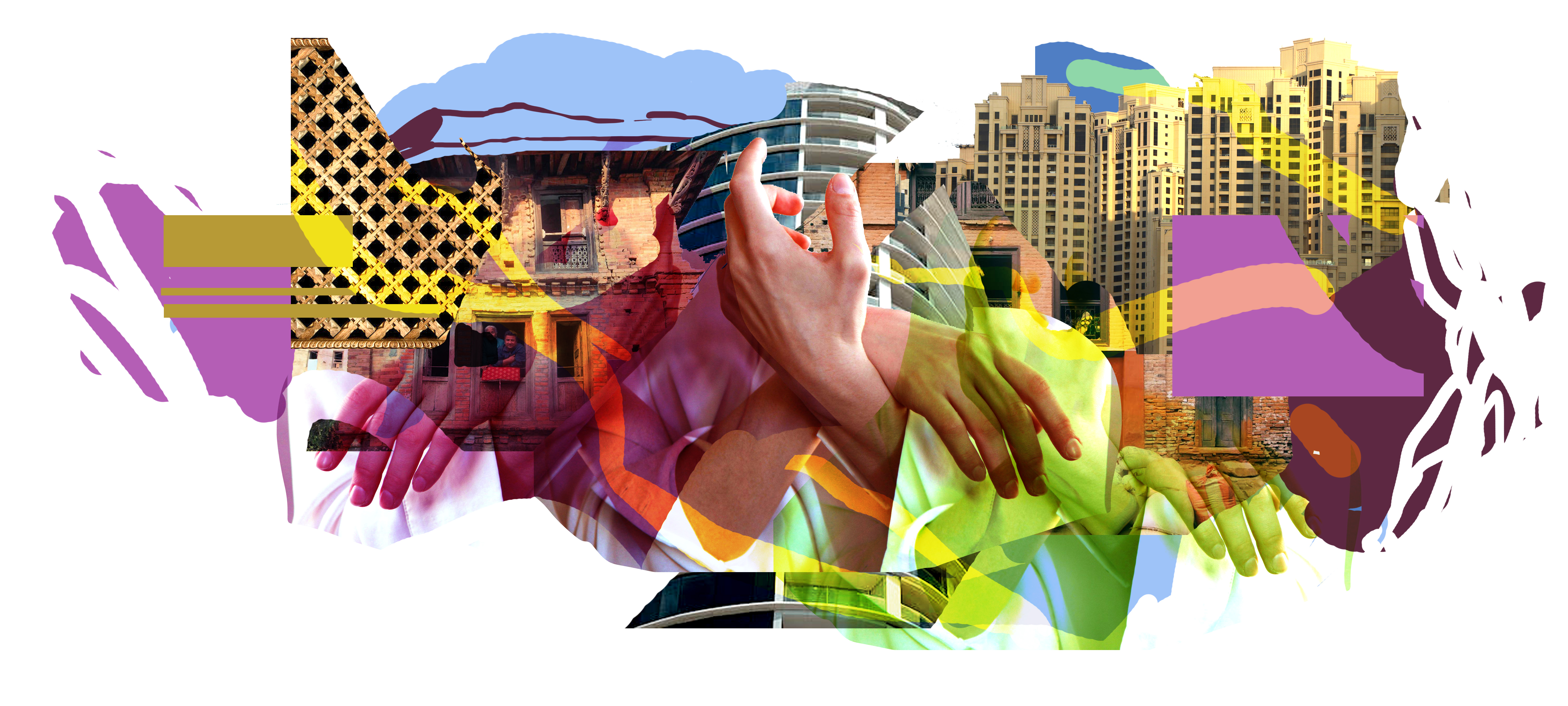
For the upcoming summer show, “No Trespassing,” the Ishara Art Foundation gets ready to question the perfect rules of the gallery space. Priyanka Mehra‘s major exhibition, running from 4 July to 30 August 2025, promises a deep and immersive exploration of the street, transposing its raw, dynamic, and often contentious aesthetics into the institutional environment of the white cube. Comprising the unique methods of six well-known UAE-based South Asian artists, the exhibition explores the complex relationship between the artist and the street and interacts with it not only as a subject of study but also as a vital and visceral medium. Poised as a historic event, “No Trespassing” is a potent conversation challenging the very limits of space, art, and ownership.
The title of the exhibition, “No Trespassing,” is itself a deft investigation and ironic stroke. Instead of acting as a barrier, it invites us to violate, to see past appearances, and to reevaluate the invisible powers sculpting our cities. The show essentially opposes any effort at a single definition of the street. Rather, it honors its natural conflicts and its rejection of being precisely classified. The street is shown as a complex tapestry of personal and group experiences, a place that swings sharply between anarchy and order, the gritty and the sublime, and the uninhibited and the carefully chosen. From the artists’ perspective, the ordinary elements of the urban scene—signposts, abandoned building materials, pavements, lights, street art, and the neglected scrapheaps—are turned into potent marks of a city’s soul and evidence of its continuous motion. This exhibition looks at the streets as a main site of deconstruction and continuous reinventions, a place that is relentlessly shaped by people who pass through it even as it shapes them in return.
The “No Trespassing” Philosophical Core
Fundamentally, “No Trespassing” is a thorough meditation on what it means to create, experience, and document art in, on, and from the street. The show transcends conventional portrayal to reflect the very urban environment’s processes. Using a form of mark-making that directly reflects the ongoing, layered, and sometimes anonymous interactions between a city and its residents, the six participating artists have produced their works through a sequence of on-site interventions. The argument of the exhibition revolves around this methodological approach. By “tagging” the immaculate walls and flooring of a formal exhibition space, the artists are presenting work and making a strong assertion over the institution itself.
This act of appropriation is a deliberate and strong challenge to the long-held belief that institutionalized forms of artistic expression intrinsically have more cultural value than the transient, usually unapproved art of the streets. The title “No Trespassing” starts to directly comment on this dynamic. The street is a territory systemically controlled, watched over, and progressively commodified, an area full of both explicit and implicit rules of behavior. We are told all the time to “follow the signs,” to keep inside the lines, and to eat and move in predictable patterns. The artists in this show challenge this paradigm. Declaring their presence and writing fresh stories onto the walls of the gallery and the objects of the street, they scavenge, carve, layer, and overwork.
Viewers will be prompted to rethink how we move through, see, and finally leave our marks on the places we live daily by the conversation between the anarchic energy of the street and the ordered environment of the institution. It explores the very concept of value and ownership. Who is entitled to leave his mark? Whose stories vanish and whose are kept? “No Trespassing” questions the invisible walls separating “high art” from the creative pulse of daily life by bringing the language of the street—its materials, gestures, and spirit of resistance—into the gallery, implying that the most profound cultural statements are often found in the most unexpected places.
Artist Interventions in “No Trespassing”: White Cube Deconstruction
The strong and unique interventions of “No Trespassing’s six featured artists help vividly capture its conceptual framework. Every artist questions the audience’s conception of space and material, so transforming the gallery into an active, changing scene.
The visitor will first be faced with a sizable mixed-media piece by H11235 (Kiran Maharjan) upon arriving at the exhibition. The writing of this work offers a wonderful investigation of presence and absence. It investigates the very possibilities of mark-making from a distance, as the artist was unable to be physically present to create the work on-site. This geographical distance is a central motif rather than a restriction. The work deliberately moves from Maharjan’s signature photorealistic and finely detailed style, a move that powerfully marks the void left by his physical absence. Presenting the opposite of a digital rendering, the physical piece is an abstraction of the entangled architectural and bodily components of the original idea. Most importantly, it uses locally produced building materials like MDF and corrugated metal, so grounding the remote digital concept in the actual physical space of the exhibition. The work deftly questions the binary between people and the built environment, exploring the deep and sometimes subconscious influence of our material surroundings on our psyche.
Rami Farook makes one of the boldest interventions in the show right at the far end of the gallery. He has literally cut out a four-square-meter section of the gallery wall, surgically exposing the hidden infrastructure—the studs, wire, and raw materials—that underlies the immaculate white surface. This act exposes the constructed character of the white cube and questions its authority as a neutral container for art, making a great statement about its vulnerability. The act forces one to consider the very ownership of art and space critically. Still, the act is not one of pure critique or attack. Unbelievably, the removed wall pieces are presented as a gift to the founders and staff of the Ishara Art Foundation. Honoring the legacy of the foundation, the presentation transforms the deconstructive act into a symbol of trust, openness, and connection, so inviting a shared custodianship and collective care for its future.
Fatspatrol (Fathima Mohiuddin) will present “The World Out There” in the second gallery. Her work consists in gathering what she describes as “scavenged” items: old posters, worn-out wood scraps, and abandoned street signs. She takes on the flâneur, the lone wanderer who studies and muses over the metropolitan scene in all its intricacy. She uses these discovered objects as canvases to reinterpret their stories with her own unique gestural language, intervening in their path toward oblivion. These marks blur the distinction between the art object and its surroundings by extending beyond their frames and onto the adjacent gallery wall. For Fatspatrol, this process is a powerful act of reclaiming the street—a space that is so often over-regulated and commercialized. Though she shows how fresh, personal, and resilient stories are always being etched onto its surfaces, signs control our movements in this world.
Nestled into an alcove, the observer will find Sara Alahbabi’s installation “For a Better Modern Something,” which investigates Abu Dhabi’s fast-changing urban fabric. Alahbabi’s artistic approach, which stresses the act of walking, directly produced the work. Experiencing the streets as a pedestrian is a transforming act in a city where driving rules most of the time. Her foot-based explorations expose fresh, sometimes disregarded facets of Abu Dhabi’s character and highlight the subtle links among its many neighborhoods. This experience is turned into a scaffolding-like construction made of cement blocks printed with maps, finely joined against the wall and floor by LED tube lights. The work reveals that only when one is ready to violate the city’s recommended modes of movement is there the possibility for mutual understanding across cultural and financial borders.
The installation “Heritage Legacy Authentic” by Khaled Esguerra sharply criticizes the continuous, sometimes sanitized renovation of old areas. Responding to urban renewal initiatives often driven under the promise of preserving legacy, Esguerra’s work questions the authenticity of such assertions. Shown in the third gallery, the work consists of floor tiles made of regular copier paper—a medium sometimes used for unofficial street advertising. Words and phrases straight from the promotional messaging of redevelopment projects are printed on these sheets, then deliberately covered with blank carbon paper. Explicitly interactive, the work asks viewers to stomp on, kick, tear, and skid across its surface. This involvement is crucial since, throughout the exhibition, the physical abrasion progressively exposes the hidden marketing language, enabling the audience to participate in the act of truth-telling.
The walls surrounding Esguerra serve as Salma Dib’s canvas, adorned with layers of traces, lettering, fragments, and textured elements. This immersive work is greatly inspired by the walls of Palestine, Jordan, and Syria—surfaces loaded with history and public venues for expression. Dib turns the gallery into a living palimpsest, a surface covered in the ideas and ideas left over by several writers across time. Her work masterfully captures the central idea of “No Trespassing,” showing how public places become archives of collective memory and continuous, always written and rewritten public dialogue.
The institution and the curatorial vision
Priyanka Mehra, the exhibitions manager and programs curator at the Ishara Art Foundation, provides an insightful curatorial vision that directs the ambitious scope of “No Trespassing.” Mehra offers a unique and very informed viewpoint from her broad background in design, public art commissions in the UAE, urban regeneration programs in India, and work on major urban art events like St+art Delhi. Her background as a project director for internationally well-known, site-specific artists enhances her approach to changing the gallery environment. This show is evidence of her will to encourage critical thinking and challenge institutional limits.
The show also reflects the main objective of the Ishara Art Foundation. Established in 2019 by art patron, collector, and entrepreneur Smita Prabhakar, Ishara is a non-profit committed to exhibiting South Asian modern art in Dubai. Aiming to forward critical dialogues and investigate the many worldwide connections influencing the region, the Foundation supports both established and emerging artistic practices. Under a research-led direction, Ishara understands its goal by means of a dynamic program of exhibitions, educational activities, and partnerships both in the UAE and abroad. Common in many languages, the very name “Ishara” denotes a gesture, a signal, or a hint—a word that captures the foundation’s aim of enabling interaction and understanding between South Asian and international artistic networks.
The Foundation is ideally situated to present a show as creative as “No Trespassing” in the energetic cultural area of Alserkal Avenue, a center for modern art galleries and creative communities. Reframe generously supports the exhibition; it will also be accompanied by a suite of physical and virtual tours as well as comprehensive public events meant to increase audience involvement.
“No Trespassing” asks viewers to enter a rich and provocative conversation between the wild vitality of the street and the regimented surroundings of the institution. This timely and strong exhibition challenges us to rethink how we negotiate, see, and leave our mark on the multifarious environments we all live in. Anyone interested in the direction of urbanism, public art, or the always widening definition of modern practice must have this fundamental experience.


Leave a Reply