Location :
Art Heritage
205, Tansen Marg, Triveni Kala Sangam,
New Delhi 110001, India
September 11 – October 20, 2023
Gallery Hours / M – Sat (11 am – 7 pm)
Artists :
Aban Raza   Arpana Caur   Devraj Dakoji   Gulammohammed Sheikh   Jagadeesh Tammineni

Jai Zharotia   Kanchan Chander   Kavita Jaiswal   Kavita Nayar   P D Dhumal   Rajesh Deb   Rini Dhumal

Seema Kohli   Tarun Sharma


One caption of a print shows the medium’s immensity. Since prints may be generated using numerous procedures, the terminology might be confusing because the same technique is sometimes explained differently and in a foreign language. Editioning, print and paper size annotation, confuses the explanation. Given these complexity levels, seeing 20 captions with their corresponding artworks in one show might be overwhelming!
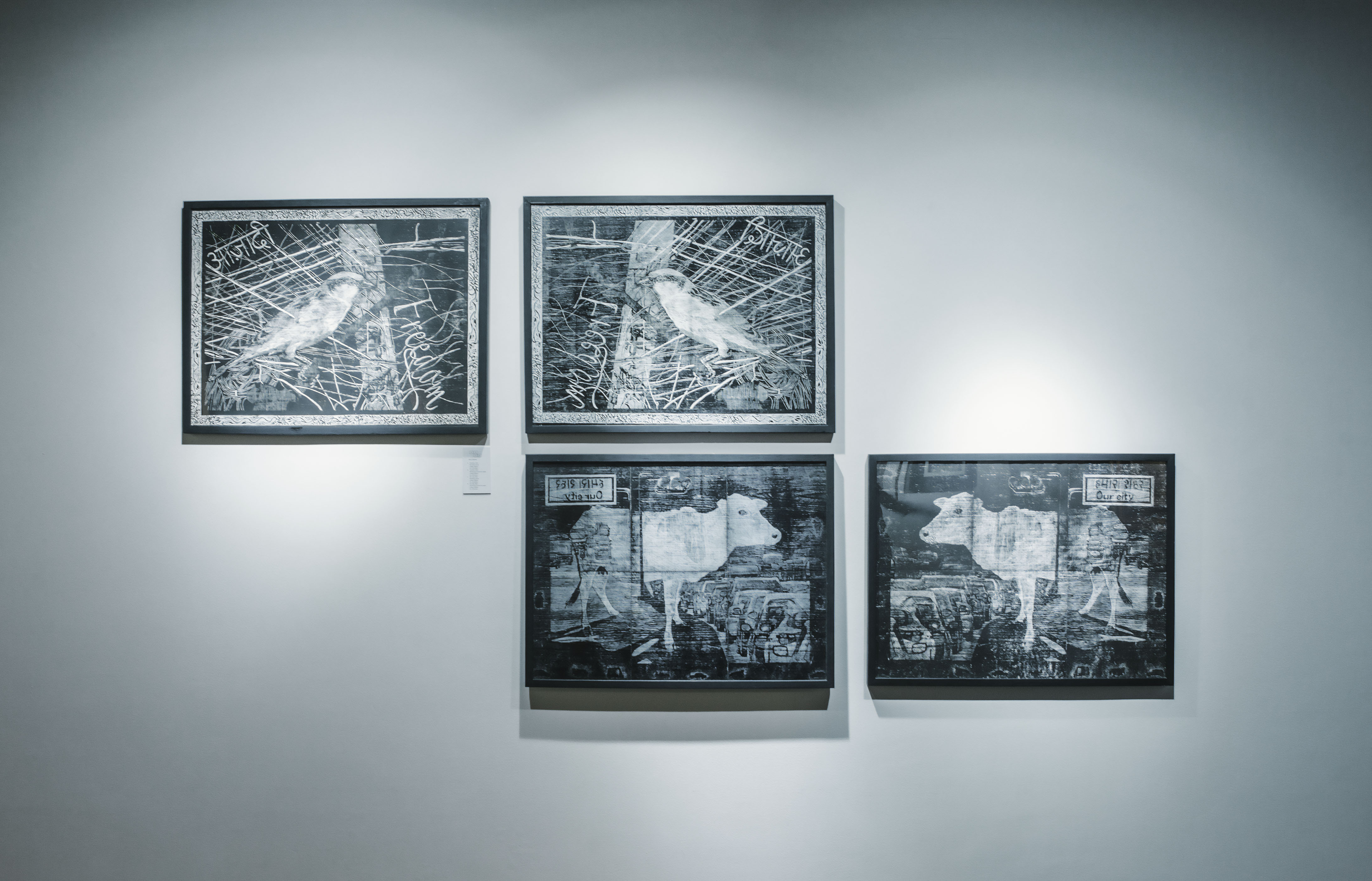
Where to start with a medium that is loved by a legion of ardent followers yet underappreciated for its intrinsic qualities? Our show, ‘Untouched, Backwards and Under Pressure’, focuses on how printmakers create “original multiples” rather than printing processes or editions. The matrix, test prints, and artist proofs are meticulously prepared. Artist proofs enable editioned works. The printmaker should strike the matrix and take a cancellation print after finishing editions.
The matrix—a reverse representation of the print—is considered an artwork by many. Here, artists manifest their creativity. To polish the image, the matrix might be worked on numerous times. After the artist approves the matrix picture, acids, inks, and pressure are tested. Test printing may change the matrix or colour palette. Many printmakers wait with bated breath to see how a print will turn out since the moment of production is hidden. Finally, numbered editions are made from artist proofs. Each test print, artist proof, and numbered edition is an original because a matrix presses against a surface (paper, canvas) to create a unique imprint.
Printmaking combines creative imagination, scientific approach, technology, and manual mechanical application. Printmaking is beautiful because ‘it is a way of increasing possibilities of creative expression’ (A Continuing Multiplication, Waswo X. Waswo, 2011, Artetc Volume 3, No.12).
Prints are typically considered ‘duplicates on paper’ and ignored. Prints are not copies like photocopies or digital photos. The ‘duplicate’ label implies rarity, although mass-produced open-edition prints are widely accessible. But limited edition prints are manufactured in tiny batches of 5 or 10. Prints, like first edition books, are uncommon but not ‘one-of-a-kind’ like paintings. Instead of starting the dialogue regarding prints as fine art and their role in the art world, editions typically terminate it.
Additionally, paper is less durable than canvas. The fibrous paper absorbs more moisture and acidity, which reacts with iron particles and ink chemicals, causing degradation and ‘foxing’ (rust stains). These impacts can be more prominent in India, where the climate is severe, and central air conditioning is rare. Artists and collectors must maintain paper creations. Artists must choose acid-free, high-quality paper to print on, while collectors can prolong the lifespan of paper works by framing them in acid-free mounts and using Coroplast, an archival board, to prevent moisture from seeping in. Douglass Howell’s final chapter of Fritz Eichenberg’s printing bible, The Art of the Print, is dedicated to the ‘care and preservation of art on paper’.
‘Untouched, Backwards and Under Pressure’ explores the printing process and the artworks that result. This show features experienced printmakers and newbies fascinated by the medium. The exhibition focuses on artist proofs, special edition prints, and matrices to attract viewers and collectors and encourage them to set aside prior preconceptions and get a new perspective on printmaking.
Images by Proteek Mandal


Leave a Reply