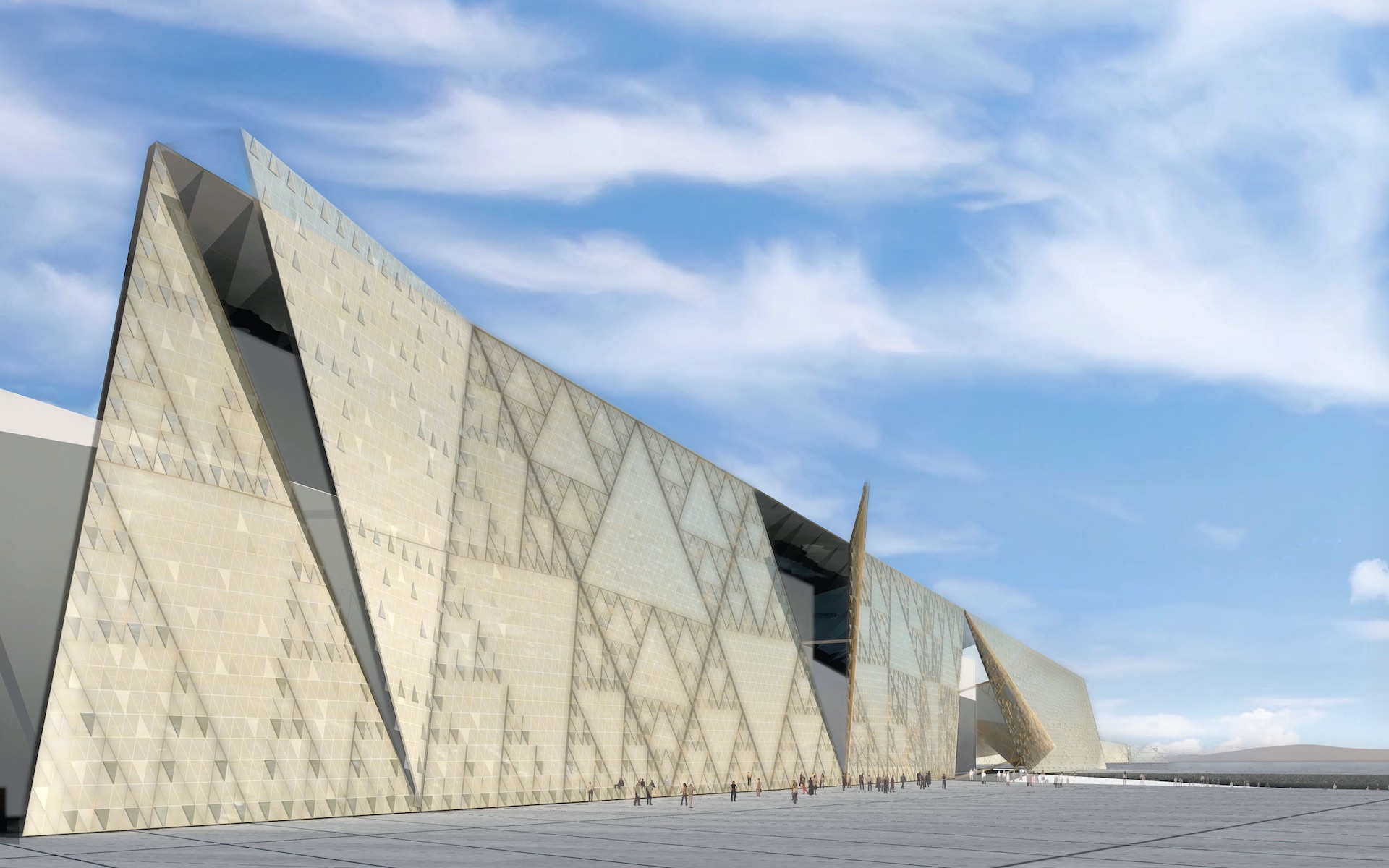
Still a monument in waiting is the massive Grand Egyptian Museum (GEM), a project more than thirty years in development. It’s official: the grand inauguration—a much-awaited event most recently scheduled for July 3rd—has once more been canceled. Citing the start of highlighting the complex and sometimes precarious geopolitics of the Middle East. Announced by Prime Minister Mostafa Madbouly, this latest delay marks yet another chapter in the museum’s protracted journey, a story entwined with political unrest, financial crises, and the ongoing specter of regional instability.
The delay represents a further pause in the long-awaited unveiling of a museum poised to revolutionize the presentation of ancient Egyptian civilization for archaeologists, art connoisseurs, and eager visitors. Although much of the museum has been open to the public in a phased “soft opening,” including its magnificent grand staircase and several expansive galleries, the crown jewel—the whole, never-before-seen collection of Tutankhamun’s riches—remains under wraps, waiting for a celebratory inauguration fit for the current regional environment.
Emphasizing a commitment to organizing an event “that reflects Egypt’s prominent cultural and tourism status on the international stage” and guarantees “broad international participation aligned with the significance of the occasion,” the Ministry of Tourism and Antiquities said in a statement the rationale behind the postponement. The ministry explained the decision “stems from Egypt’s national responsibility and its commitment to presenting a truly exceptional global event in an atmosphere worthy of the grandeur of Egyptian civilization and its unique heritage.” Egypt is not directly involved in the Israel-Iran conflict, but the official justification emphasizes a sensitivity to the regional landscape, a knowledge that a lavish celebration would be discordant with the somber reality developing over its borders.
Protracted Gestation the Grand Egyptian Museum
The is one of ambitious vision and relentless difficulty. Originally announced in 1992, the project was designed as a modern repository for Egypt’s unmatched archaeological riches, a fitting successor to the cherished but packed Egyptian Museum at Tahrir Square. Situated on the Giza Plateau under the shadow of the pyramids, the design of Irish architectural firm Heneghan Peng is itself a wonder of modern architecture, a large, translucent construction meant to provide panoramic views of the ancient marvels it accentuates.
But the road from conception to almost completion has not been easy. The first years saw the slow grind of fundraising and planning. The 2011 revolution and later political unrest caused more delays; then, economic problems hampered building. More recently, the COVID-19 epidemic pushed back expected opening dates, so throwing still another twist in the works.
This latest postponement is not the first time regional politics has loomed large over the great opening of the museum. A scheduled autumn opening for last year was quietly postponed because of the growing conflict in nearby Gaza and Sudan’s continuous civil war. Egypt has suffered directly and practically from these conflicts. Government estimates suggest that the Sudanese Civil War has caused 1.2 million refugees to flee into Egypt, seriously taxing public services. Thousands of Palestinians have also sought safety in Egypt via the Rafah crossing, a politically and humanitarianly complex scenario related to the war in Gaza.
Strong economic headwinds exacerbate these geopolitical stresses. Egypt struggled with a severe currency crisis between 2022 and 2024, whereby the value of the Egyptian pound dropped almost 75%. Although the economy has shown indications of stabilization thanks in part to foreign support, the effects of this crisis are still felt in all spheres, including the financing of major national projects like the GEM and the cost of living.
A Geopolitical Calculus: The Value of a Distant Conflict
For an international audience, the particular reference to the Israel-Iran conflict as the cause of the most recent delay may first seem confusing. Not a belligerent in this conflict, Egypt is a major regional power broker with diplomatic ties to Israel. Still, the choice shows a convoluted geopolitical calculus. Not only a cultural event, a grand opening of the Grand Egyptian Museum is a major act of cultural diplomacy for Egypt to present a picture of stability, cultural leadership, and world openness. Such an event would inevitably include the attendance of high-level international dignitaries, and the security concerns of organizing such a conference amid increasing regional tensions are rather significant.
Besides, Egypt suffers real security and financial consequences from the conflict. results of the regional unrest, the Houthi attacks in the Red Sea have already affected Suez Canal income, a major source of foreign exchange. The more general instability threatens tourism, a pillar of Egypt’s GEM is meant to greatly increase. The choice to delay can thus be considered a pragmatic one, a realization that the “atmosphere” is just not fit for the triumphant narrative a grand opening is meant to transmit. It is a tacit recognition that a conflict, even one level removed, can have a significant knock-on effect in a linked Middle East.
More than just a museum: the Grand Egyptian Museum as a national symbol
Apart from the immediate political and financial issues, the frequent delays reflect the enormous symbolic weight given to the Grand Egyptian Museum. The GEM is more than just a museum for the Egyptian government; it’s a potent emblem of national pride, evidence of the ongoing grandeur of its ancient past, and a projection of a modern, capable country. The GEM should be a worldwide symbol, a cultural monument attracting millions of tourists and supporting a rebuilt travel industry for many years to come.
Clearly among the most important collections in the world is that of the museum. It is expected to hold more than 100,000 objects covering all of ancient Egyptian history. The Tutankhamun galleries, the focal point, will show the whole treasure collection—more than 5,000 objects taken from the boy king’s tomb in 1922—for the first time. This all-encompassing show promises a hitherto unheard-of, closely detailed view of a pharaoh’s life and death.
From a museological standpoint, the GEM marks a dramatic change in Egypt’s presentation of its legacy. Incorporating modern exhibition design, interactive displays, and a closer attention to the visitor experience, the museum has been built to transcend the object-oriented approach of the past. Operating since 2010, its conservation facilities—which highlight a dedication to the scientific preservation of its invaluable collection—are among the most advanced in the world.
Although it irritates those who want to visit the museum in its entirety, the repeated postponements can also be seen as a reflection of this high-stakes ambition. Clearly, the Egyptian authorities are resolved that the ribbon will be cut in a setting that fairly represents the scope and importance of the project when it comes time. This is a statement declaring the Grand Egyptian Museum to be opened with a roar that will be heard all around rather than in whispers. The world has to wait for now; this great monument to civilization bides its time, a silent tribute to the ongoing force of history and the turbulent present.


Leave a Reply